Regular bread bakers
If you regularly slice homemade loaves, look for a blade suitable for bread, the slice thickness you want and a carriage guide that suits your needs.


When choosing a slicer for homemade bread, consider the serrated blade, adjustable thickness range and carriage guide together; wattage alone won’t tell you how well it slices. In a shared kitchen, a food holder and switch-on protection also matter, as do easy-to-reach areas for cleaning and the space available for use and storage. The features that matter most depend on whether your priority is bread, safe shared use, cleaning or saving space.
If you regularly slice homemade loaves, look for a blade suitable for bread, the slice thickness you want and a carriage guide that suits your needs.
If several people use or have access to the appliance, clear controls, a food holder and a safe place to store it are important. If children can access it, a model-specific switch-on safety feature may also be worth considering.
If you need to clear the worktop after use, consider how easy the slicer is to clean and how much space it needs for use and storage. Easy-to-reach areas or a foldable design may be useful.
Choose a slicer to suit your main priority: slicing bread, shared use, cleaning afterwards or freeing up worktop space. Depending on the model, manufacturers such as ritterwerk, Graef, Bomann and Severin list different blades and thickness ranges.
| Buying consideration | What to look for | Who it matters most to |
|---|---|---|
| Bread crust and slice thickness | Check for a serrated blade and adjustable thickness range; the carriage guide needs to suit your loaf. | If I want to slice crusty bread to my preferred thickness, I look at the blade and guide. Around 29% of consumers prioritise bread and slice thickness. |
| Shared use | Check for a food holder and finger guard, and, where applicable, documented switch-on protection. | If several people use the appliance, I want clear controls and suitable safety features for everyone who is expected to use it. Around 29% of consumers prioritise safe shared use. |
| Cleaning after use | Look for easy-to-reach surfaces and model-specific guidance on removing parts; always follow the relevant instructions before cleaning. | If the appliance needs to be clean and the kitchen clear after different people have used it, I want to know how easily I can reach the relevant areas. Around 24% of consumers prioritise cleaning after shared use. |
| Worktop and storage space | Compare the dimensions with the space available; for foldable models, check their actual folded storage dimensions too. | If I need to use the worktop again after slicing, convenient storage matters to me. Around 18% of consumers focus primarily on worktop and storage space. |
Manufacturers list different motor outputs, blades and thickness ranges. Wattage alone is not a comparative test of slicing performance.
Compare the serrated blade, your preferred slice thickness and the carriage guide. Independent slicing tests can offer an additional point of reference.
Switch-on protection is an extra feature specific to the model and does not replace a food holder or safe operation. The Severin AS 3915 instructions require the carriage and food holder to be used in their operating positions, provided the size and shape of the food being sliced allow it.
Check the safety features of the specific model and agree who will clean and safely store the appliance after use.
The Unold Curve’s foldable design makes it easier to store, but the blade and surfaces that come into contact with food still need to be cleaned.
Compare storage dimensions and cleaning instructions separately before choosing a design.
The E-16 range is designed for bread and other slicing tasks. Details for the standard E 16 do not automatically apply to the E 16 Duo Plus variant.
The Classic C20 and SKS500 differ in design and features, so don’t assume that features of one model apply to the other.
The AS 3915 is an electric food slicer with metal components, a carriage, finger guard and food holder.
The MA 451 CB may be worth considering if a universal serrated blade and a tilting support table are among your selection criteria.
The Curve has a foldable design, while the larger Metall Plus is a cantilever-style alternative.
The Joybuy products below are electric food slicers for bread with adjustable slice thickness; some models also feature a foldable design.
 No image available
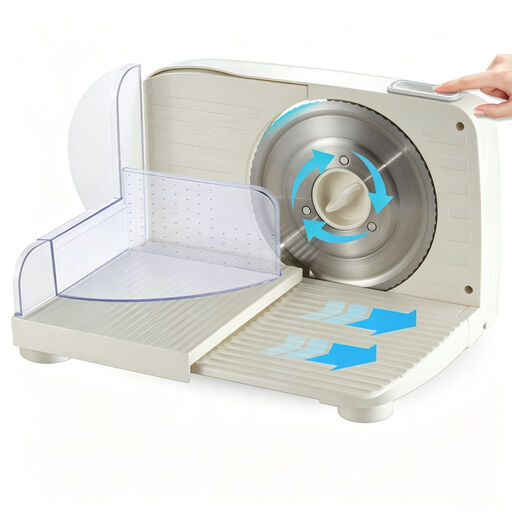
Could be worth considering if you want to store your bread slicer away after use.
The title specifies an adjustment of 0–15 mm, a stainless steel blade and a foldable design.
 No image available
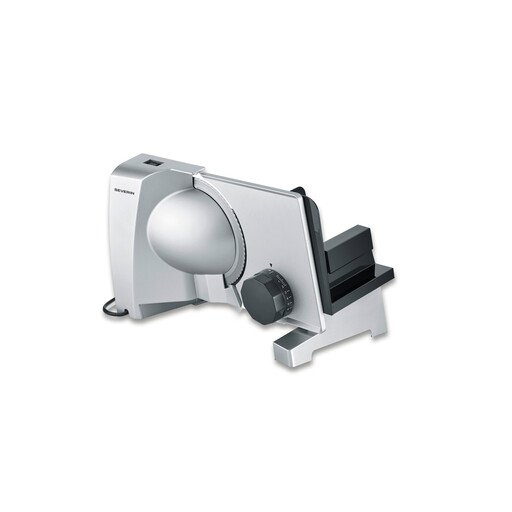
Could suit you if you’re looking for a bread slicer with adjustable slice thickness and a foldable design.
The product title specifies 250 W, two blades and an adjustment range of 0–15 mm.
 No image available
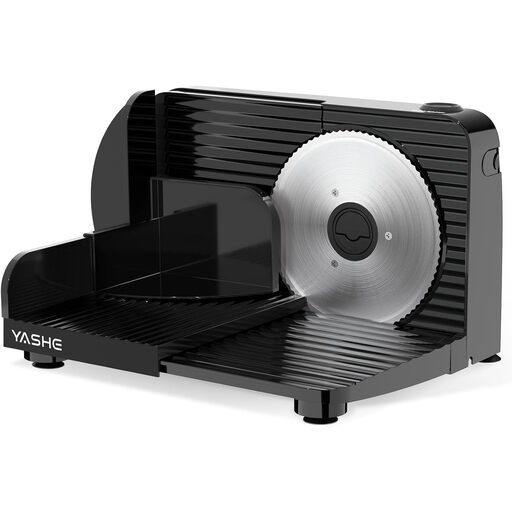
Could be of interest if you’re looking for a wide adjustment range, as stated in the product title, for slicing homemade bread.
The title specifies continuously adjustable cutting thickness of 0–23 mm and 130 W.
 No image available
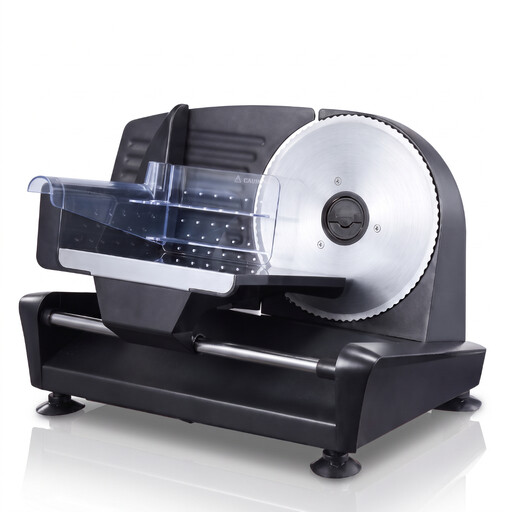
Could be worth considering if you’re looking for a foldable model for bread with adjustable slice thickness.
The product title specifies 180 W, an adjustment of 0–15 mm and a 17 cm stainless steel blade.
 No image available
Could suit you if you want to slice other foods mentioned in the product title as well as bread, and are considering a model with two blades.
The title specifies 200 W, two 19 cm blades, a safety guard and an adjustment of 0–15 mm.
Make the instructions for the specific appliance available to everyone who is expected to use it. The Severin AS 3915 instructions require users to be familiar with the safety guidance; unplug the appliance before every clean and never immerse it in water. For other models, follow their respective instructions.
No. If a product is faulty, your statutory consumer rights are against the retailer; a guarantee is an additional, voluntary promise and is subject to its own terms. If needed, also check what spare parts and servicing are available for the specific model.
Electrical equipment within the scope of the EU Low Voltage Directive, including equipment rated at 50 to 1,000 V AC, must meet requirements for conformity assessment and CE marking. Check the marking and documentation for the specific appliance; the CE mark alone does not prove any particular slicing performance. The requirements are set out in the EU Low Voltage Directive.
No. Waste electrical equipment must be taken to an authorised collection point, such as a local council recycling centre. Retailers with a take-back obligation must accept items without a new purchase only if each item measures no more than 25 cm on its outer dimensions; the applicable take-back conditions determine what is accepted. Germany’s Federal Ministry for the Environment explains these requirements for disposing of waste electrical equipment.
Not necessarily. ritterwerk specifically states that the E 16 is for household use and excludes commercial use. If the kitchen is operated commercially, check the suitability and terms of use for the specific model; simply sharing a kitchen privately does not make it a commercial operation.