Which type of baked goods suits you?

Freshness-focused breakfast shoppers

You want to buy bread rolls as close to breakfast as possible and eat them straight away. REWE, Lidl and ALDI Nord say their in-store bakeries bake several times a day. The varieties available on a particular morning depend on the store.

Breakfast shoppers who can plan oven time

You buy rolls in advance and finish baking them in time for breakfast. Make time for the oven and follow the instructions on the pack. EDEKA gives a baking time of 8–10 minutes for its GUT&GÜNSTIG breakfast rolls.

Households looking for slices or a stock-up option

You want bread that’s quick to top, lets you take out individual slices, or makes it easy to compare ingredients before buying. The type of bread matters when you’re planning ahead: the Verbraucherzentrale gives wheat bread a shorter shelf life than some other types of bread, assuming it’s stored properly.

What to consider when buying

First decide whether you need individual bread rolls, rolls to finish baking at home, or sliced bread. Then compare when you’ll shop, how much preparation is needed and the information given for the specific product.

Fresh bread rolls

A good choice if: You want to buy them shortly before breakfast and eat them without waiting for the oven.

The trade-off: The variety and availability depend on the store and time of day.

Bake-at-home rolls

A good choice if: You want to shop before the weekend and choose when to finish baking the rolls.

The trade-off: You’ll need an oven and must allow time for the baking instructions on the pack.

Sliced bread

A good choice if: You want to top slices without any preparation or take out portions for other meals.

The trade-off: How long it stays fresh depends on the type of bread and how it’s stored.

What matters to you What to check when buying Who it matters to
Freshness at breakfast Your preferred variety and what the store has available on the morning you shop. I want to pick up bread rolls just before eating rather than use the oven in the morning; around 37% of consumers put this immediate freshness first.
Preparation you can plan The baking time, temperature and number of rolls stated on the specific pack. If I shop in advance, I want to finish baking the rolls just in time for breakfast. Around 27% of consumers prioritise being able to choose when they’re ready.
Slices and stocking up The product format, type of bread and a quantity you can use in time or freeze in portions. For several breakfasts, I want to take out slices without having to buy bread rolls each time; around 18% of consumers say this is their main priority.
Ingredients and allergens For packaged products, check the ingredients list and allergen labelling; for loose products, check the allergen information available. If I need to avoid certain ingredients, the recipe for each individual product determines what I choose. Around 18% of consumers put this check first.

Common shopping mistakes

  • Taking “medium sliced” to mean something without checking the product format

    The wording doesn’t make it clear whether it means sliced bread or bread rolls that have been cut open. Whole rolls, bake-at-home rolls and sliced bread each serve a different purpose.

    Check the actual product format and how it’s cut before you buy. Only then compare the number of pieces or the weight, and any preparation instructions.

  • Buying more wheat bread than you’ll use soon

    The Verbraucherzentrale says wheat bread can stay fresh for up to two days when stored properly. This is a general guide, not a guarantee for every pack.

    Buy the amount you need and freeze any bread you won’t eat soon in individual portions.

    If you buy too much, it could go stale or spoil before you’ve had a chance to use it.

  • Guessing the allergens from the variety name

    The name of a type of bread or bread roll is no substitute for checking the recipe of the specific product. EDEKA lists wheat and gluten-containing cereals in its GUT&GÜNSTIG breakfast rolls.

    For packaged products, read the ingredients and allergen information. For loose products, ask for the information for that specific item.

  • Assuming an online range is available in store

    A variety shown online may not be available in every store on the morning you plan to shop. EDEKA specifically notes that its bake-at-home product may vary between stores.

    If you need a particular variety, check its availability at your local store or be prepared to choose another type of baked goods.

Brands and retailers to consider

REWE

An in-store bakery and range of bread rolls and sliced bread, for shoppers considering both options.

  • REWE says its in-store bakeries bake every day and are replenished several times a day.
  • The specific selection in store may differ from the range shown.

EDEKA

An example of a retailer offering packaged rolls to finish baking at home, with product-specific information.

  • For its GUT&GÜNSTIG breakfast rolls, EDEKA lists the number of rolls, ingredients, allergens and baking instructions.
  • According to EDEKA, the product may not be available in every store. Always follow the information on the specific pack.

Lidl

An in-store bakery range for buying bread and bread rolls locally.

  • Lidl says its “Unser Brot” range includes baked goods made several times a day and a variety of breads.
  • General information about the range doesn’t confirm the ingredients or availability of a particular type of bread roll.

ALDI Nord

A range of baked goods including bread and different types of bread rolls.

  • ALDI Nord lists wheat, multigrain and wholemeal rolls among its range and says it bakes several times a day.
  • The products on offer may vary by region and time.

ALDI SÜD

A range of fresh and packaged rolls, including varieties to finish baking at home.

  • The range shown includes Kaiser rolls, wheat rolls, multigrain rolls and bake-at-home rolls.
  • Check the product information and labelling for the specific item and store.

Der Meisterbäcker

A regional artisan bakery for households who want to choose bread and bread rolls from a specialist shop.

  • Der Meisterbäcker describes its bread and bread-roll specialities as being made with natural sourdough using a long fermentation process; this is information provided by the retailer.
  • Its network of regional specialist shops doesn’t offer a nationwide shopping option.

Bake-at-home rolls at Joybuy

If you’re looking for rolls to finish baking at home for weekend breakfast, the following Kaiser roll product may suit you. If you specifically need sliced bread or bread rolls that are already cut open, check the product format before you buy.
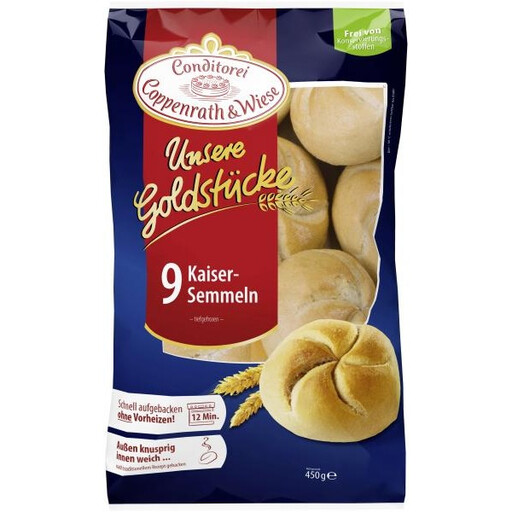
Coppenrath & Wiese Our Gold Pieces Kaiser Rolls, 9 rolls, 450 g

Coppenrath & Wiese Our Gold Pieces Kaiser Rolls, 9 rolls, 450 g

For a breakfast of Kaiser rolls that you want to finish baking at home.

Allow for an oven and 12–15 minutes of preparation time. If you need rolls that are already cut open, check how they’re cut before buying.

View at Joybuy

Frequently asked questions

Bread rolls or sliced bread: which is better for weekend breakfast?

Bread rolls are a good choice if you can buy them shortly before breakfast and eat them straight away. Sliced bread is handy if you want to top slices or take out portions without any preparation. If you’re stocking up, take the type of bread into account: according to the Verbraucherzentrale, wheat bread stays fresh for up to two days when stored properly, while wheat-and-rye bread lasts around two to four days.

How long do bake-at-home rolls need in the oven?

Baking times depend on the product. EDEKA recommends 8–10 minutes for its GUT&GÜNSTIG breakfast rolls at 180–200 °C fan or 200–220 °C conventional heat. For other rolls, follow the instructions on their own pack.

Where can I check the allergens in bread rolls?

For packaged rolls, check the ingredients and allergen information on the specific pack. For loose rolls from a bakery or in-store bakery, ask for the allergen information for that particular variety rather than trying to work out the recipe from its name or appearance.

What should I do with leftover bread and bread rolls?

Store bread and rolls at room temperature in a dry, dark place, and freeze any portions you won’t need soon. The Verbraucherzentrale advises against regularly storing bread in the fridge, as it goes stale faster there. If you can see mould on bread, throw the whole loaf away.