
Lieferung heute & morgen

Qualitätsgarantie

Willkommens-Angebote freischalten: KOSTENLOSE Lieferung | Bis zu 80 % RABATT | Kostenlose 30-Tage-JoyPlus-Testphase
App herunterladen
By Joybuy Product Recommendation Officer, July 28, 2026
A baby carrier promises freedom: your hands are free for daily tasks while your child is safe and secure. But the search for the right model can quickly become overwhelming. Especially as temperatures rise, a breathable baby carrier becomes a necessity. Many parents invest in a product only to find out after a short time that it's uncomfortable, causes heat buildup, or leads to back pain. This guide will help you identify the crucial features and avoid common purchasing traps.
Before we dive into the important features, let's look at two common marketing promises that often lead to unsatisfactory purchases:
To make an informed decision, focus on three objective criteria. These are key to determining the safety, comfort, and durability of your baby carrier.
An ergonomic baby carrier isn't a marketing buzzword; it's a necessity for the healthy development of your child's hips and spine. The defining feature is its support for the spread-squat position, also known as the M-position. In this position, the baby's knees are slightly higher than their bottom, and their back is gently rounded.
Pay attention to the following points:
The material is crucial, especially in summer or for active parents. A lightweight baby carrier made from the right fabric prevents excessive sweating for both you and your child.
The child's weight can quickly become a strain on the parent's back and shoulders. A well-designed carrying system distributes the weight evenly.
Based on the criteria above, we present a product that puts these requirements into practice.
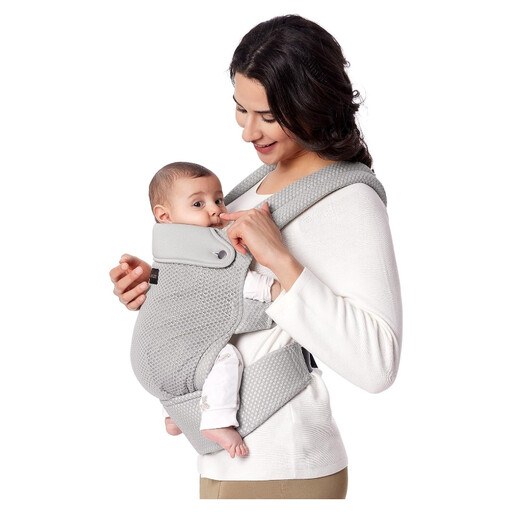
Why it's a great fit: Ideal for parents seeking a flexible and comfortable solution for daily use, whether for shopping, walks, or travel. The combination of low weight and breathable material makes it particularly suitable for warmer months or active families.
The model uses genuine Air-Mesh fabric for proven air circulation, thus avoiding the heat-trap effect. Instead of a "one-size" solution, it offers three adjustable size positions to ensure a correct ergonomic fit for babies from approx. 3.2 kg to 20 kg.
The X-shaped back design and integrated EVA lumbar support effectively distribute weight to relieve back strain. Additionally, the carrier is machine-washable, simplifying daily care.
We have compiled a list of products that meet strict selection criteria for ergonomics, material, and safety.
1. When can I start using an ergonomic baby carrier? Most ergonomic carriers are designed for babies starting from a weight of approx. 3.2 kg to 3.5 kg. However, the crucial factor is whether the child can already hold their head up independently or if the carrier provides adequate, stable neck support. Always follow the manufacturer's specific weight and age recommendations.
2. How do I know if my baby is positioned correctly in the carrier? Check three simple points: The baby's knees should be higher than their bottom (M-position), their back should be slightly rounded, and their face should be visible at all times and not covered by fabric. A good rule of thumb is the "kissable height": you should be able to kiss your baby's head easily without bending forward significantly.
3. How do I clean a baby carrier correctly? Most modern baby carriers are machine-washable. Fasten all buckles before washing and use a gentle cycle with a mild detergent. It is recommended to air-dry the carrier instead of putting it in the dryer to preserve the materials and shape. Always check the manufacturer's care label.