When watching short films in a bright living room, what matters is how the specific model handles reflections and whether dark scenes remain visible in ambient light – the panel type alone won’t tell you that. If there’s lots of daylight, LCD TVs with local dimming are worth considering. If you also care about dark scenes in the evening, you could compare an OLED model with a stated anti-reflection treatment. Also check the playback method, screen size and energy label for the exact variant.
Who should consider this type of TV
Film fans watching in daylight
If you watch short films with the curtains open, check reflections and how clearly dark scenes appear on the specific model. The consumer advice centre recommends considering your viewing distance and where you’ll place the TV before making your choice.
Watching by day and in the evening
If you use the same TV during the day and for film nights, you’ll want to consider both visibility in ambient light and how dark scenes look. OLED and local-dimming LCD models are both worth comparing; it comes down to the features of each variant.
Budget-conscious short-film viewers
If you watch films via an existing app, a file or an external source, you don’t have to choose based on panel type alone. Check that the specific TV has the connections or apps you need, the right screen size and an energy label that suits you.
What to look for when buying
LCD with local dimming
A good fit if: windows or lamps face the screen during the day and you want to compare models specifically for how they handle reflections and look in ambient light.
The trade-off: Local dimming alone doesn’t tell you how well a particular TV handles reflections or displays dark film scenes.
OLED with anti-reflection treatment
A good fit if: you care about dark film scenes and film nights as well as watching TV during the day, and the specific model is listed as having anti-reflection treatment.
The trade-off: Visibility depends on the ambient light and the model. You should also consider the OLED-specific risk of burn-in if static elements are displayed for long periods.
| Buying priority |
What to look for |
Who it matters most to |
| Reflections and daylight |
Consider light sources where you plan to put the TV, and check how the specific model handles reflections and looks in ambient light. |
If I watch during the day with the curtains open, I don’t want reflections to obscure dark scenes. For around 29% of consumers, visibility in daylight is the top priority. |
| Film contrast |
Compare dark film scenes in ambient light; don’t judge OLED and local-dimming LCD models by their technology labels alone. |
If I also watch short films with dark scenes in the evening, how they’re displayed matters to me as well as daytime visibility. For around 23% of consumers, film contrast comes first. |
| Playback method |
Check the apps, file formats or connections you need for the exact model variant; streaming requires an internet connection. |
If I watch short films from a particular app or file, or via a connected player, that playback method needs to work with the TV. For around 18% of consumers, compatibility is the main priority. |
| Total cost |
Compare the energy label and product fiche for the exact variant, as well as any service options on offer. |
If I need to keep an eye on both the purchase price and running costs, I also want to factor in electricity consumption and any additional services. For around 18% of consumers, total cost comes first. |
| Size and placement |
Consider viewing distance, available space, the stand or wall mounting, and the direction of incoming light in advance. |
If the TV needs to fit in a particular spot, screen size and mounting are crucial for me. For around 12% of consumers, finding the right fit for their space is the top priority. |
Avoiding buying pitfalls
-
Assuming the panel type tells you how well reflections are handled
“Mini-LED” or “OLED” alone doesn’t tell you how visible a window will be on screen or how dark film scenes will look in your room.
Check the specific model in ambient light, taking the position of windows and lamps into account.
-
Confusing peak HDR brightness with sustained brightness
A peak HDR brightness figure doesn’t automatically tell you how bright the screen will remain during everyday film viewing. TCL describes the figure for the 65Q7D Pro as peak HDR brightness.
Use it as a manufacturer’s specification, not as the only indication of how the picture will look in your living room.
-
Looking only at the price of the TV
Power consumption and any delivery or installation services on offer may also affect your buying decision.
Compare the EU energy label for the exact variant and check which services are available before placing your order.
-
Confusing a voluntary warranty with your statutory rights
The consumer advice centre distinguishes between your statutory rights against the seller and a voluntary warranty with its own terms and conditions.
Read the terms and exclusions before taking out an additional package. A voluntary warranty package may cost extra; its cover and cost depend on the offer.
Relevant brands at a glance
Sony
The German-market BRAVIA 9 II K-65XR95M2 is worth considering when comparing TVs for bright rooms.
- Sony lists RGB-LED, local dimming and anti-reflection screen technology for this model.
- RTINGS.com highlights the BRAVIA 9 II in its own review for bright rooms. This doesn’t establish the same performance for every size or variant sold in Germany.
LG
The German-market OLED model OLED55G69LS combines OLED with an anti-reflection treatment specified by the manufacturer.
- LG also lists Filmmaker Ambient Mode for this variant.
- Manufacturer specifications aren’t an independent comparison with LCD TVs. The OLED-specific risk of burn-in from static image elements is still a factor to consider when using the TV.
TCL
According to TCL, the German-market 65Q7D Pro features SQD Mini-LED with local dimming.
- TCL lists 646 dimming zones and peak HDR brightness of up to 2.000 Nits for this model.
- These are manufacturer or laboratory figures, not independent measurements of everyday brightness or a guarantee of anti-reflection performance.
Samsung
Samsung’s Neo QLED range includes other Mini-LED models worth comparing.
- Samsung classifies Neo QLED as Mini-LED technology.
- Check the reflection handling and picture performance of each model; the range name doesn’t indicate a consistent anti-reflection treatment.
Philips
The 65PUS9000/12 TV listed in Germany includes Ambilight as an additional feature.
- Ambilight sets this model apart in terms of its features.
- The manufacturer’s information doesn’t show that it offers any advantage for reflections on the screen in a bright room.
Joybuy TVs for bright rooms
This Joybuy selection includes TCL Q7D Pro TVs with SQD Mini-LED and local dimming, in several screen sizes, including one model bundled with a soundbar.
 No image available
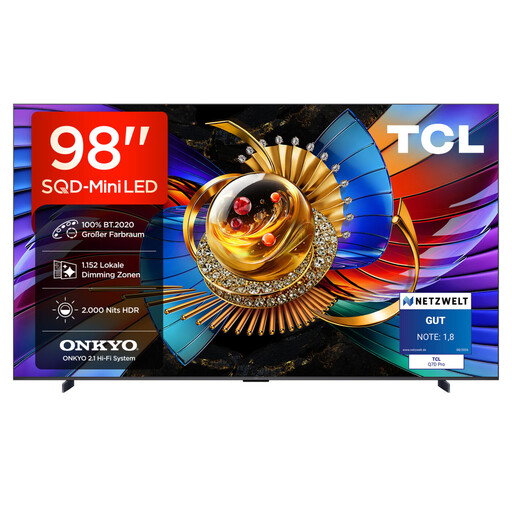
TCL 98Q7D PRO, 98 inches
An option if you want to compare an SQD Mini-LED TV with local dimming and anti-reflection technology; the 98-inch screen needs plenty of space and a suitable viewing distance.
Listed in the product title: 4K, 1.152 local dimming zones, 2.000 Nits peak HDR brightness, 144 Hz, Dolby Vision IQ, Dolby Atmos and Google TV.
Also listed: 100 % BT.2020. Before choosing, check that the screen size and placement will work in your room.
View at Joybuy
 No image available
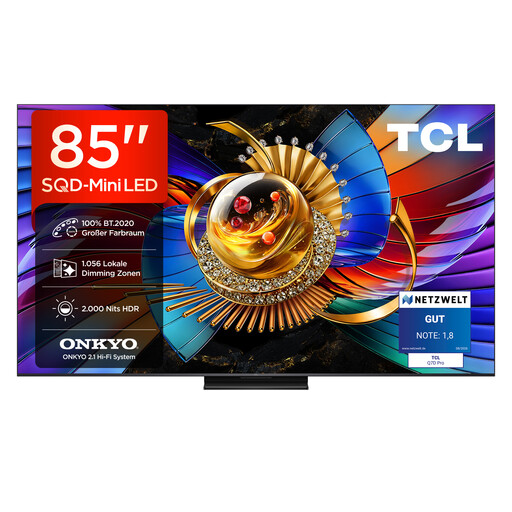
TCL 85Q7D PRO, 85 inches
An option if you want to compare SQD Mini-LED, local dimming and anti-reflection technology in an 85-inch variant. The consumer advice centre recommends measuring your viewing distance before choosing a size.
Listed in the product title: 4K, 1.056 local dimming zones, 2.000 Nits peak HDR brightness, 144 Hz, Dolby Vision IQ, Dolby Atmos and Google TV.
Also listed: 100 % BT.2020. The peak brightness figure alone doesn’t tell you how the picture will look in your room.
View at Joybuy
 No image available
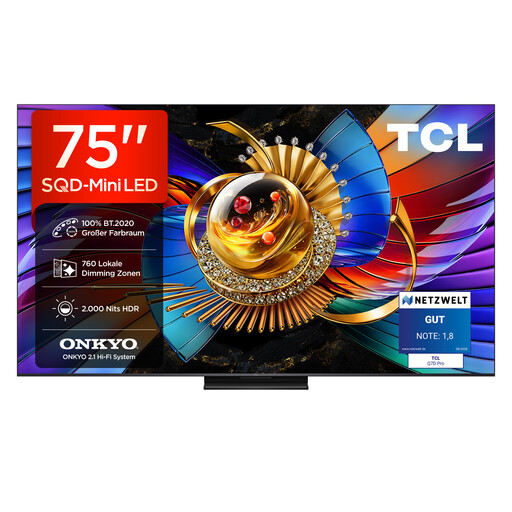
TCL 75Q7D PRO, 75 inches
An option if you want to compare the Q7D Pro features in a 75-inch screen size. Check that the screen will suit your viewing distance, available space and light levels.
Listed in the product title: 4K, SQD Mini-LED, 760 local dimming zones, 2.000 Nits peak HDR brightness, anti-reflection technology, 144 Hz, Dolby Vision IQ, Dolby Atmos and Google TV.
Also listed: 100 % BT.2020. Peak HDR brightness shouldn’t be confused with sustained picture brightness.
View at Joybuy
 No image available
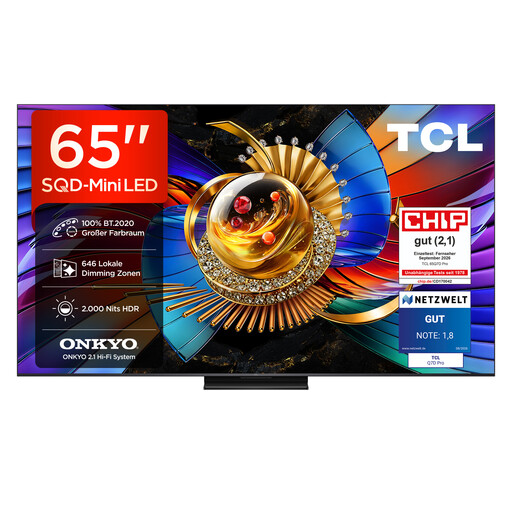
TCL 65Q7D PRO, 65 inches
An option if you want to compare SQD Mini-LED with local dimming in a 65-inch screen size. TCL also lists local dimming for this model; check how the specific TV handles reflections and looks in ambient light.
Listed in the product title: 4K, 646 local dimming zones, 2.000 Nits peak HDR brightness, anti-reflection technology, 144 Hz, Dolby Vision IQ, Dolby Atmos and Google TV.
Also listed: 100 % BT.2020. The peak brightness figure alone doesn’t prove how bright the screen will be in everyday use.
View at Joybuy
 No image available
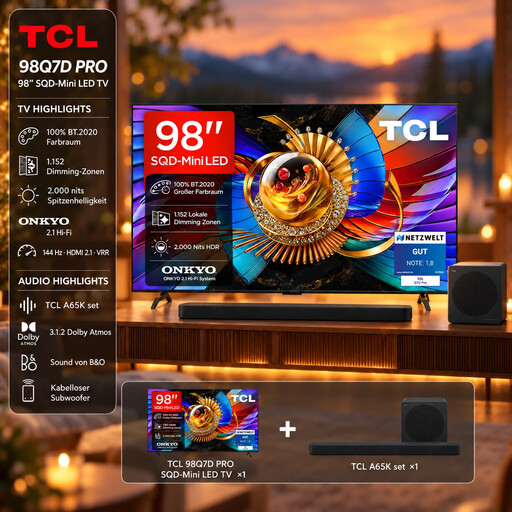
TCL 98Q7D PRO, 98 inches, with A65K soundbar bundle
An option if you’re looking for the 98-inch variant together with the A65K soundbar bundle mentioned in the product title. Make sure you have enough space for the TV and a suitable viewing distance.
Listed in the product title: 4K, SQD Mini-LED, 1.152 local dimming zones, 2.000 Nits peak HDR brightness, anti-reflection technology, 144 Hz, Dolby Vision IQ, Dolby Atmos and Google TV.
Also listed: 100 % BT.2020. Check the exact bundle contents and make sure the screen size is right for your room.
View at Joybuy
Frequently asked questions
Is high peak HDR brightness enough for a bright living room?
No, high peak HDR brightness alone doesn’t answer that question. Also check for direct reflections and how clearly dark scenes appear in ambient light; TCL describes the figure for the 65Q7D Pro as peak HDR brightness.
What should I check for streaming or my own short-film files?
First decide whether you’ll use an app, a file or an external player. Then check app support, file formats and connections for the exact TV variant; streaming requires an internet connection.
How should I position and clean a TV with an anti-reflection screen?
When positioning the TV, consider the direction of windows and lamps, and follow the cleaning instructions for the specific model. Sony warns against spraying liquids directly onto the BRAVIA 9 II and provides specific care instructions for its screen surface.
How can I compare power consumption and service options?
Compare the EU energy label for the model variant actually on offer. The consumer advice centre distinguishes between your statutory rights against the seller and a voluntary warranty; additional service packages don’t replace your statutory rights.
Do I need a particular TV tuner to watch short films?
You don’t generally need a particular tuner to watch short films from apps or files. If you also want to watch live TV, the consumer advice centre says the tuner you need depends on your chosen reception method.


