For the occasional small batch of broccoli, your existing freezer compartment should be enough if there’s room alongside your other frozen food. According to the Verbraucherzentrale, an oversized extra chest freezer can use more electricity than necessary. If you regularly freeze larger batches, compare the largest amount you plan to freeze in one day with the model’s freezing capacity in kg/24 h, and your total stock with its usable capacity – these are different figures. Also check annual energy consumption, dimensions and installation requirements. According to the Federal Centre for Nutrition, labelling portions with their contents, quantity and date makes it easier to keep track of everything.
Who should consider this decision?
Batch-freezing cooks
If you blanch several portions on a regular cooking day, compare the largest amount you plan to freeze in one day with the specific model’s freezing capacity. The Verbraucherzentrale recommends choosing a freezer based on your actual needs.
Households planning ahead
If you store broccoli and other food in portions, labelling packs with their contents, quantity and date can help. The Federal Centre for Nutrition recommends including this information to keep your supplies organised and make them easier to use later.
Households short on space
If you’re considering extra freezer space, check the usable capacity you need alongside the space available. The Verbraucherzentrale points out that a freezer that’s too large for your needs can use more electricity than necessary.
What should you look for when buying?
| Buying priority |
What to check |
Who is it most relevant to? |
| New batch to freeze |
Compare the largest planned quantity in kg with the model’s freezing capacity in kg/24 h; a quick-freeze function is no substitute for this check. |
If you plan to freeze a larger quantity all at once on a batch-preparation day, the capacity for that specific batch matters. Around 33% of consumers prioritise batch capacity. |
| Space for all your supplies |
Add up the food you’ll store at the same time and check the required usable capacity in litres; also consider the external dimensions. |
If you store broccoli alongside other supplies, you’ll need enough room without choosing an unnecessarily large chest freezer. Around 27% of consumers prioritise having the right amount of storage space. |
| Ongoing electricity use |
Compare the specific model’s annual energy consumption in kWh and its efficiency class; the EU label uses classes A to G. |
If an extra appliance will be running all the time, its annual energy use is an important factor in your choice. Around 20% of consumers prioritise running costs. |
| Finding portions again |
Check whether the baskets and interior layout suit your packs; label each portion with its contents, quantity and date. |
If you prepare several portions to use at different times, you’ll want to identify them easily and take them out as planned. Around 13% of consumers prioritise keeping portions organised. |
| Where to put it |
Measure the available floor space and room to open the lid; if the freezer will be kept somewhere cold, check that the specific model is approved for those conditions. |
If space is limited or you plan to keep the chest freezer in a cold room, its dimensions and permitted ambient temperature must suit the location. Around 7% of consumers prioritise where the freezer will be installed. |
Avoiding common buying mistakes
-
Confusing capacity in litres with freezing capacity
Usable capacity tells you how much storage space there is; freezing capacity tells you how much food an appliance can freeze from fresh within 24 hours. A chest freezer may offer enough room without necessarily being suitable for a particular daily batch.
Write down the largest amount you plan to freeze in one day and compare it with the specific model’s freezing capacity. Check how much storage space you need separately.
-
Buying a large chest freezer too soon for a few portions of broccoli
According to the Verbraucherzentrale, an appliance that’s significantly bigger than you need can use more electricity than necessary and take up extra space.
First check whether there’s room in your existing freezer compartment. If you do need an extra chest freezer, plan its size around all the supplies you’ll be storing at the same time.
-
Storing small portions without labels
If several people take food out at different times, it can be harder to identify unlabelled packs and tell how old they are.
Divide the quantity into the portions you plan to use and label each one with its contents, quantity and date. A freezer basket can keep small packs within easy reach, as long as it fits the model.
-
Assuming cold-location specifications apply to other chest freezers
Approval for low ambient temperatures applies only to the specific model it refers to. Liebherr states that the CFe 1870 Pure FrostProtect can operate at temperatures down to −15 °C; this specification does not apply to other chest freezers.
If you plan to keep the chest freezer in a cold room, compare the expected ambient temperature with the installation instructions for that specific model.
Notable brands and models
Severin
The GT 8849 is an example of a 200-l chest freezer for storing food in portions.
- Severin lists a freezing capacity of 9 kg in 24 hours, a freezer basket and annual energy consumption of 128 kWh for this model.
- Whether its freezing capacity is enough for a batch prepared in one day depends on the actual quantity.
Haier
The HCE200C, with a capacity of 196 l, and the HCE420D, with 418 l, show two different storage sizes.
- Haier lists an efficiency class of C, Fast Freeze and external dimensions of 915 × 555 × 845 mm for the HCE200C.
- A quick-freeze function is no substitute for comparing the batch size with the specific model’s freezing capacity.
Liebherr
The CFe 1870 Pure is an example of a model with a total volume of 281 l for larger stocks of food.
- Liebherr lists a footprint of 104 × 71 cm and FrostProtect for ambient temperatures down to −15 °C for this model.
- The cold-location specification applies to this model only; a frost-reducing function doesn’t mean that defrosting is never needed.
Beko
The HSA24540N is an option with 230 l of usable capacity.
- Beko lists an efficiency class of E, a static cooling system and a footprint of 110,5 × 67,5 cm for the HSA24540N.
- If you plan to freeze larger batches regularly, check the specific model’s freezing capacity separately.
Chest freezers at Joybuy
This Joybuy selection includes chest freezers for regular batch freezing, as well as a larger model for bigger stocks of food. Compare batch capacity, usable capacity and floor space for each specific appliance.
 No image available
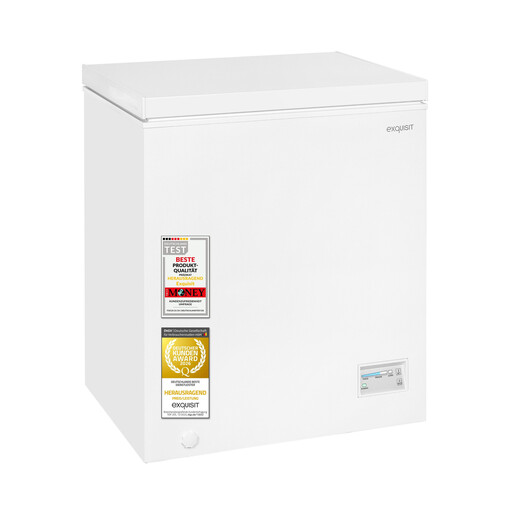
Exquisit chest freezer, 142 l, 4-star freezer
For regular batch freezing, provided the freezing capacity suits the amount you plan to freeze in one day.
142 l usable capacity; freezing capacity of up to 7 kg in 24 hours; electronic temperature control with LED display; quick-freeze function; removable basket.
Joybuy
 No image available
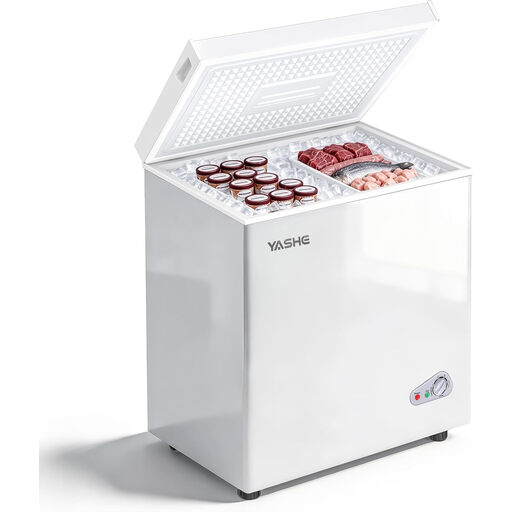
YASHE BC-150Q-EU chest freezer, 150 l
For portioned supplies, if two separate baskets suit the way you plan to organise the interior.
150 l usable capacity; two removable baskets; six temperature settings; quick-freeze function.
Joybuy
 No image available
AUCMA chest freezer, 291 l, convertible
For larger stocks of food, if the greater usable capacity and floor space suit your household.
291 l usable capacity; switches between fridge and freezer functions; efficiency class E; five temperature settings; removable basket; interior light and defrost drain.
Joybuy
 No image available
TCL CF182EWE0 chest freezer, 140 l, energy class E
For extra freezer space, if the usable capacity and floor space suit the supplies you have planned.
140 l usable capacity; one storage basket; counterbalanced lid; adjustable feet.
Joybuy
 No image available
TCL CF126EWE0 chest freezer
For smaller batches to freeze in one day, if the stated freezing capacity suits the amount you plan to freeze.
Freezing capacity of up to 4,5 kg in 24 hours; wire basket; quick-freeze function.
Joybuy
Frequently asked questions
How should I plan blanching for a shared freezing and cooking schedule?
Wash and cut the vegetables, blanch them briefly in boiling water, then cool them in iced water. Divide the quantity into portions for future meals and label freezer-safe packs with their contents, quantity and date. When adding fresh food, take care not to let food that’s already frozen thaw.
What temperature should a chest freezer be set to?
The Verbraucherzentrale recommends −18 °C as the ideal temperature for freezers. Dated portions make it easier to plan meals together; the Verbraucherzentrale says frozen vegetables can go straight into a pan or microwave to cook.
What should I check before installation and when defrosting?
Check the external dimensions, the space needed to open the lid and the installation instructions for the specific model. The German Environment Agency recommends keeping freezers away from heat sources and out of direct sunlight. A manufacturer’s frost-reducing function doesn’t mean that defrosting is never needed.
Which energy label applies to chest freezers in Germany?
Household freezers use the EU energy label, with efficiency classes from A to G. It includes information such as annual energy consumption in kWh. Compare the figures for the specific model and don’t use the former A+++ rating as its current class.


