
Lieferung heute & morgen

Qualitätsgarantie

Willkommens-Angebote freischalten: KOSTENLOSE Lieferung | Bis zu 80 % RABATT | Kostenlose 30-Tage-JoyPlus-Testphase
App herunterladen
The selection of brush pen sets can be overwhelming. Whether for calligraphy, illustration, or bullet journaling, the market offers countless options. But not every set delivers on its promise. Many creatives invest in pens that become unusable after a short time or produce disappointing results. As your Joybuy Product Recommendation Officer, I'll help you identify the typical pitfalls and make an informed decision.
The most common problems aren't always apparent at first glance. They often hide behind attractive packaging and long feature lists. Let's focus on the three most critical points that frequently lead to a bad buy:
A good brush pen set is distinguished by durable materials and a thoughtfully curated collection. Before we look at specific recommendations, we should understand the technical features that truly matter.
To separate the wheat from the chaff, you need to evaluate the core components of a pen. The following three aspects are decisive for the performance and longevity of your future drawing pen set.
Many sets advertise themselves as dual-tip pens, suggesting a high degree of versatility. However, the quality of the tips is more important than their mere existence.
The type of ink determines the application, blending properties, and compatibility with different types of paper.
A set with 120 pens is not necessarily better than one with 40. The curation is what counts. A good set of colouring pens for adults offers a balanced palette with many shades within a colour family, skin tones, and various shades of grey. Accessories like a sturdy carrying case, a DIY colour chart (swatch card), and replacement tips significantly increase the overall value.
Based on the criteria above, we have identified a few products that represent a well-considered solution for specific user profiles.
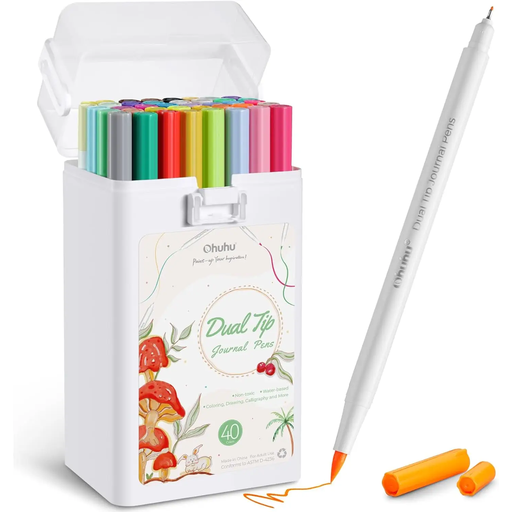
Why This Fits Their Persona: With 40 colours, this set offers a manageable yet versatile palette to get started. The combination of a fineliner and a brush tip is ideal for bullet journals, where both writing and illustrating are common. The attractive price point makes it a sensible initial investment.
The quick-drying, water-based ink minimises smudging and bleeding on suitable notebook paper. The tips are robust enough to withstand the somewhat uneven pressure applied by beginners.
Excellent value for money; dual-tip design (0.4 mm fineliner & 1-5 mm brush) for maximum flexibility in a compact set.
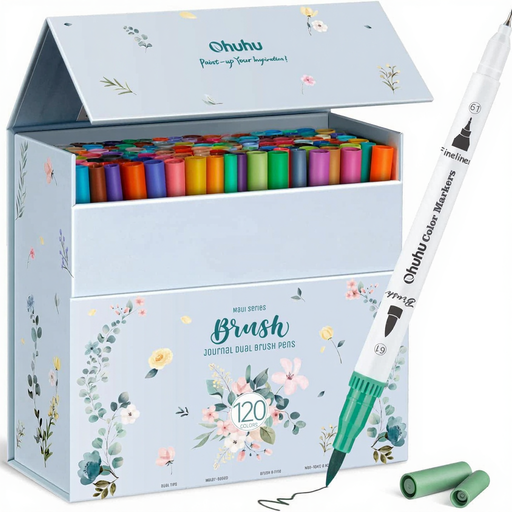
Why This Fits Their Persona: Anyone looking to create illustrations and complex colour gradients needs a wide selection. This 120-colour set offers an enormous range for shading and detail. The water-based ink allows for watercolour techniques on suitable paper.
The set includes 8 replacement tips (5 brush, 3 fineliner), which directly counteracts the problem of fraying and extends the set's lifespan. The numbered pens and DIY swatch card prevent confusion with the large colour selection.
Comprehensive colour palette with 120 shades; includes replacement tips and a practical storage case.
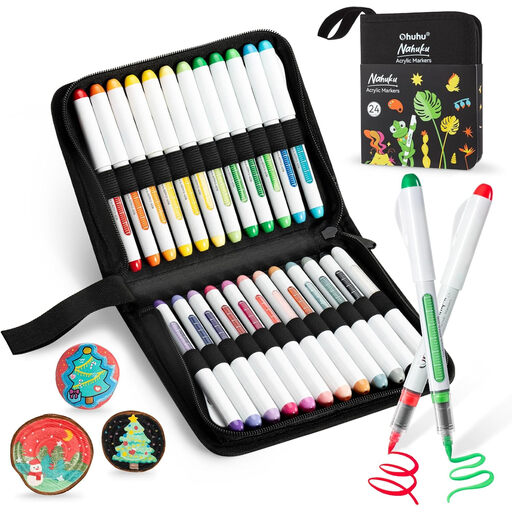
Why This Fits Their Persona: Those who want to paint on various surfaces like stones, wood, glass, or fabric need special pens. This set with acrylic ink is designed precisely for that. The flexible brush tip allows for both fine details and broad coverage.
Unlike water- or alcohol-based pens that would bead up on non-porous surfaces, the high-opacity acrylic ink provides excellent adhesion. The ink is waterproof and lightfast after drying, which makes the artwork durable.
Works on a variety of surfaces; high-opacity, waterproof ink; flexible 1-5 mm brush tip for versatile application.
We have compiled a complete, up-to-date list of products that fully meet these strict selection criteria and rigorous safety standards.
The right technique and materials are crucial. Use the smoothest paper possible (e.g., marker paper or Bristol board), as rough surfaces mechanically wear down the fibres. Also, avoid applying too much pressure and use the side of the brush tip for broad strokes rather than just the very tip.
For alcohol-based pens, special marker paper with a coated backing is ideal. For water-based pens, thicker mixed-media paper or smooth cardstock with a weight of at least 180 g/m? is suitable. If you want to achieve watercolour effects, watercolour paper (from 250 g/m?) is the right choice, as it can absorb moisture without significant buckling.
Not necessarily. For modern calligraphy, which thrives on the variation between thick and thin lines, you need a very flexible and responsive brush tip. Some dual-tip pens have a rather firm brush tip that is better suited for colouring in areas. Look for terms like "flexible brush tip" or explicit suitability for "calligraphy" in the product description.