People who train and check pack sizes
You’re looking for a bar to eat on the go or after exercise, and want to compare single bars and multipacks based on the portions they actually contain.


When shopping for budget protein bars, compare the amount of protein in each bar you’ll actually eat, rather than relying on a percentage displayed on the front of the pack. Portion size, sugar and polyols also matter, as do the ingredients and allergen information for the specific variety. A bar can be a handy option when you’re out and about, but it isn’t essential for getting enough protein, as Germany’s consumer advice centre explains.
You’re looking for a bar to eat on the go or after exercise, and want to compare single bars and multipacks based on the portions they actually contain.
You want to know how many grams of protein are in the bar you’re eating. The bar’s weight and the nutrition information per portion are more useful than a standalone percentage.
You avoid certain ingredients or need to steer clear of allergens. In that case, the information for the specific variety is what matters. Details of polyols and serving advice may also help you choose.
Start by comparing portions on the same basis. Then check the nutrition information and ingredients for the variety you’re actually planning to buy.
| Criteria | What to check | Who it matters most to |
|---|---|---|
| Pack and portion | Compare the number and weight of the bars, as well as the protein per bar. | If you’re choosing between a single bar and a multipack in the budget range, you’ll want to know how many portions are in the pack. For about 36% of consumers, comparing portions comes first. |
| Protein per bar | Check the amount per portion, or convert the figure per 100 g to match the bar’s weight. | After a workout, you want a bar to provide a clear amount of protein, not just an eye-catching percentage. Around 29% of consumers put this first. |
| Sugar and sweeteners | Check the sugar and polyols per portion, as well as the serving advice. | If you’re keeping an eye on sweeteners or polyols, check the other information on the pack as well as the sugar content. This is a priority for around 21% of consumers. |
| Ingredients and allergens | Read the ingredients list, highlighted allergens and ‘may contain’ information for the specific variety. | If you need to avoid certain ingredients, your choice of flavour could make all the difference. For around 14% of consumers, checking this comes first. |
A bar containing 20% protein doesn’t automatically provide 20 g of protein. In a 50 g bar, that would work out at 10 g. The North Rhine-Westphalia Consumer Advice Centre warns that it’s easy to confuse grams and percentages on protein bars.
Check the figure per portion. If the pack only gives a value per 100 g, multiply it by the bar’s weight and divide the result by 100.
A bar can be a convenient snack, but it isn’t essential for getting enough protein. Germany’s consumer advice centre points out that even people who are physically active can get protein from everyday foods.
Decide whether you’re mainly looking for a convenient snack to take with you, and consider the bar as part of your overall diet.
A low sugar content doesn’t tell you everything you need to know about a product’s ingredients. For example, according to REWE, its REWE PWR Brownie bar contains 1,4 g of sugar and 11,7 g of polyols per 45-g bar.
Compare both figures per portion and check the serving advice on the pack.
At EDEKA, product information online may differ from the packaging in store, and some varieties aren’t available at every store. ALDI Nord also warns that limited-availability products may sell out.
Before making your choice, check the specific variety, bar weight, ingredients and allergen information on the pack.
ALDI Nord and ALDI SÜD offer different protein bars and pack formats under the ALDI SPORTS name.
MAX BALANCE is an EDEKA range of protein bars available in several varieties.
REWE PWR includes protein-focused snacks. One specific bar used for comparison is the 45-g Brownie variety.
This Joybuy selection includes bars and a protein bite in a range of portion and pack sizes. To choose the right option for you, compare the nutrition information for the specific variety and pay particular attention to ingredients, allergens and serving advice.
 No image available
A single bar for a snack on the go, weighing 40 g.
If you have a milk or soya allergy, check the ingredients and ‘may contain’ information. Make sure you compare sugar on the same basis as the figures on the pack.
 No image available
A multipack for taking individual bars with you, containing twelve 50 g bars.
If you have a peanut, milk or soya allergy, check the information on the specific pack.
 No image available
A single 50-g snack bar. If you’re comparing nutrition, use the figures per bar.
For this variety, check the information about polyols and the allergen labelling. The product name alone doesn’t tell you everything you need to know about its nutrition.
 No image available
A compact protein bite for when you’re out and about, with a stated weight of 35 g.
When comparing it with larger bars, look at the protein per bite. If you’re checking ingredients, read the information about milk, soya and egg on the pack.
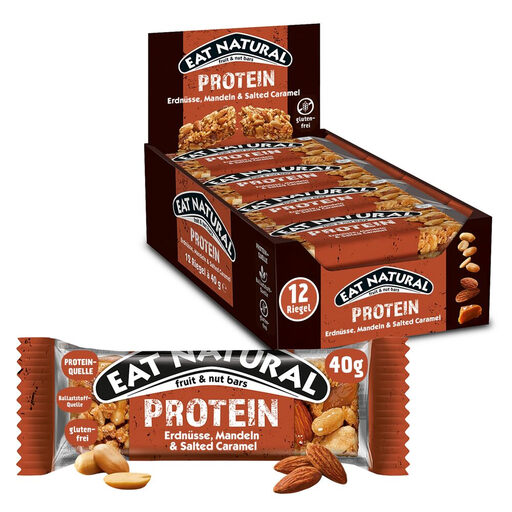 No image available
A multipack for snacks on the go, containing twelve 40 g bars.
If you have a peanut, almond, milk or soya allergy, check the ingredients and ‘may contain’ information on the pack.
No. A protein bar isn’t essential for getting enough protein. Germany’s consumer advice centre explains that even people who are physically active can get protein from everyday foods; a bar is simply a convenient snack option when you’re out and about.
No, the percentage refers to the weight of the product. EDEKA lists 50 g of protein per 100 g for its 45-g MAX BALANCE peanut bar, which works out at 22,5 g of protein per bar.
The ingredients list and allergen information on the specific pack are what matter. The MAX BALANCE and REWE PWR varieties described contain milk and soya; the MAX BALANCE peanut bar also contains peanuts. Don’t assume a product is suitable for vegans based only on the brand name or product category.
No, this advice applies to a specific product. ALDI SÜD gives it for the High Protein Nougat variety described and warns that excessive consumption may have a laxative effect. Always follow the serving advice on the pack.