
Lieferung heute & morgen

Qualitätsgarantie

Willkommens-Angebote freischalten: KOSTENLOSE Lieferung | Bis zu 80 % RABATT | Kostenlose 30-Tage-JoyPlus-Testphase
App herunterladen
Building toys for children should suit their age, the space you have available, and how they actually play. In practice, purchases often go wrong not because of a lack of features, but because of unclear information: a set may look extensive in pictures but contain lots of small pieces. Large building blocks need more storage space than expected, while compact sets can quickly limit older children’s creativity.
A high piece count can look appealing. What really matters, however, is whether the pieces match the child’s developmental stage and can be combined in meaningful ways. For toddlers from 1 year old, large, easy-to-grip elements are usually more practical than fiddly construction sets. For children aged 3 and up, smaller building blocks, stacking systems and creative blocks can offer extra design possibilities.
Wooden blocks should be free from sharp edges and splinters. For plastic and foam products, material details, fastenings and warning labels are important. An age recommendation is not a general quality seal, but a guide to the intended use. If a product contains small parts, it must be kept out of reach of younger children.
Large foam blocks are great for climbing, crawling and building indoors, but they need permanent floor space. For sets with fabric covers, check whether the cover is removable and washable. For wooden or plastic parts, compact storage is helpful, especially in children’s bedrooms, nurseries and childcare settings.
For children from 1 year old, large shapes and simple stacking or slotting functions make sense. The Hauck Sort N Build and the HABA Basic Building Block Starter Kit are listed as suitable from 12 months. Both still include warnings about possible small parts or the need for supervision.
From 3 years old, sets with more complex shapes, cubes or lots of individual pieces become suitable. This applies, for example, to the Fidl Bitz Bag of Bitz with around 320 foam cubes or the 51-piece wooden stacking game. Even for this age group, direct supervision remains sensible if small parts are included.
Look for specific details rather than general marketing claims:
For a stacking game on the table, compact wooden sets are sufficient. For active play in the living room or group spaces, large foam elements are more suitable. Before buying, check the footprint, weight, storage requirements and, for vacuum-packed products, the stated time needed for full expansion.
Building toys without batteries are especially easy to fit into daily routines: they don’t need a power supply, create no charging times, and can be used flexibly in the bedroom, on trips or in group settings.
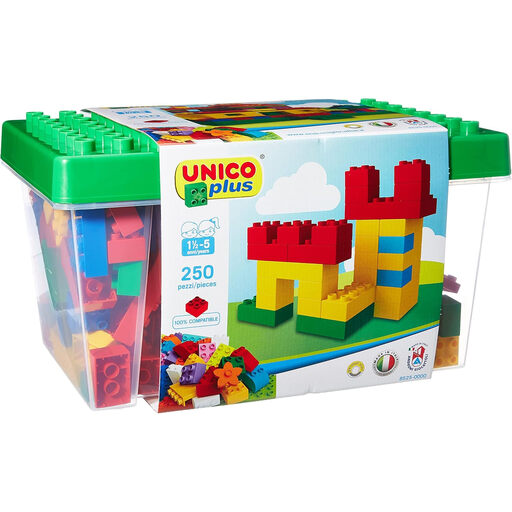
Why this product fits the profile: The box contains 250 plastic pieces according to the product details and is intended for children from 18 months to 5 years. This makes it suitable for families looking for a versatile basic set.
The age range and piece count are clearly stated. Before use, you should still check whether the pieces are suitable for your child.
250 pieces, storage box and no batteries required; reportedly compatible with common building block brands.
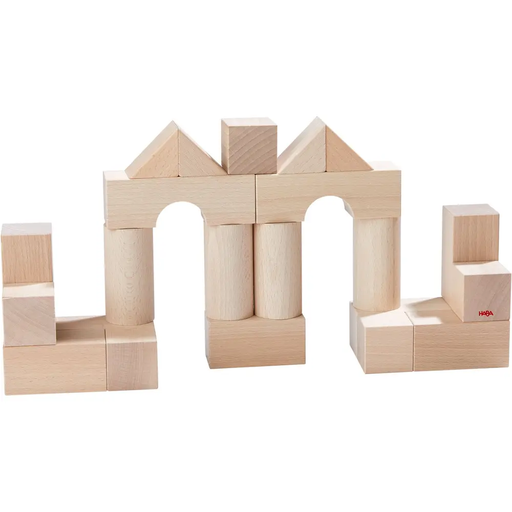
Why this product fits the profile: The set is made from beech wood according to the product details and includes various shapes such as cubes, cuboids, triangles, arches and columns. It is aimed at children from 12 months.
The selection of shapes is clearly described. Small parts and the warning label should be considered when choosing for younger children.
Beech wood, 26 building pieces and a storage box; reportedly no batteries needed and compatible with other HABA sets.
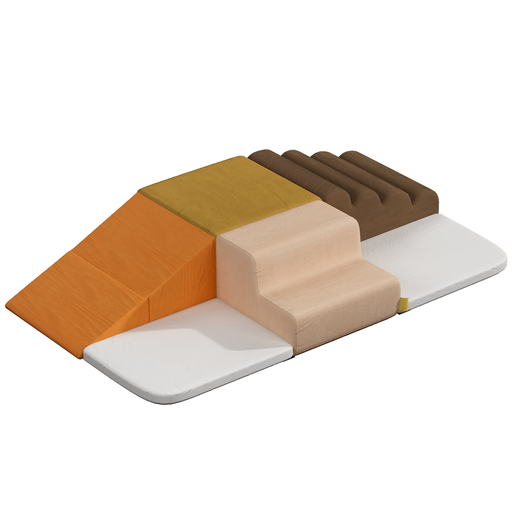
Why this product fits the profile: The six large foam blocks are designed for climbing, crawling, sliding and building indoors, according to the product description. This suits families, nurseries and childcare settings with enough space for movement.
The space needed is obvious from the XXL design. The covers are removable and reportedly machine-washable; after unpacking, an expansion time of 24 to 48 hours is required.
High-density foam, non-slip base, Velcro connections and washable covers according to the product details.
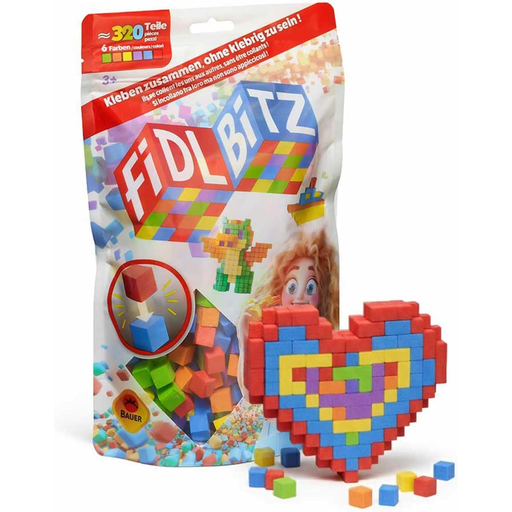
Why this product fits the profile: The set is intended for children from 3 years old according to the product details and contains around 320 coloured cubes that can be connected and separated by pressing them together.
The connection works without glue and without batteries. Because of the small parts, the age recommendation and supervision are especially important.
Around 320 pieces, 2D and 3D constructions, and manual use without batteries according to the product description.
We’ve put together a full, regularly updated list of products that fully meet these strict selection criteria and the safety regulations in force in the EU.
For children from 1 year old, large, easy-to-grip building blocks and simple sorting or stacking tasks are suitable. Wooden blocks and shape-sorting games can be a good option. Always check the manufacturer’s information, small parts and the condition of the toy.
The lifespan depends on the material, workmanship, the child’s interest and how expandable the set is. Simple wooden blocks often remain interesting across several developmental stages because they can first be stacked and later used for more complex structures. For foam sets, the care of the covers and regular checks for tears or damaged connections also play a role.
Battery-free building toys incur no electricity or battery costs during use. However, you should factor in storage, cleaning and, for foam products, enough space. So the total cost includes not just the purchase price, but also the material, care effort and any possible expansions.