
Lieferung heute & morgen

Qualitätsgarantie

Willkommens-Angebote freischalten: KOSTENLOSE Lieferung | Bis zu 80 % RABATT | Kostenlose 30-Tage-JoyPlus-Testphase
App herunterladen
Building toys for children can combine free-form creativity, collaborative play, and an understanding of shapes and structures. At the same time, magnetic tiles, classic LEGO sets, construction toys and detailed model kits differ significantly in age recommendation, piece size and play complexity.
To ensure a set doesn’t end up unused after a short time, it’s worth looking at the actual product data rather than just the packaging images and marketing claims.
A high piece count can look appealing, but it says little about whether the set is suitable for a particular child. A set with 800 pieces may be too challenging for younger children, while a smaller 3D construction kit with a few specialised parts follows a clear building concept. What really matters are age rating, instructions, variety of pieces and difficulty level.
Magnetic tiles contain small, strong magnets. Even if these are supposedly securely sealed inside the pieces according to product information, parents should regularly check the elements for cracks, loose parts or visible magnets. If magnets are swallowed, there is a serious health risk. Therefore: never use magnetic toys for children below the stated age limit, and always supervise their use.
Labels like STEM toys or creative learning toys are no guarantee of a specific learning outcome. What’s practically relevant is what the set actually allows: free building, following instructions, rebuilding, role play or decorative display. A suitable building toy should match the child’s developmental stage and interests.
For a building set for ages 3 and up, the warnings about small parts and magnets must be read particularly carefully. The age indication is not just marketing information; it takes into account, among other things, the size of the pieces and the required handling of the set. For children under three, sets with small parts are fundamentally unsuitable.
Even with sets for ages 4, 6 or 7, individual skill levels should be considered. A child who enjoys building from instructions may manage well with a more complex LEGO set. For children who prefer free construction, large sorting boxes or open-ended brick sets are often more practical.
ABS plastic is commonly used in plastic sets. According to the manufacturers’ product information, several of the products listed here have rounded or smooth edges. This doesn’t replace checking before play: damaged pieces should be discarded.
Also look out for:
With magnetic systems, the stated size is important. A set with 2.5 cm magnetic tiles is not automatically compatible with a system for 5.5 or 7.5 cm. “Compatible” should explicitly refer to dimensions and connection points.
The piece count should always be considered alongside the storage solution. A box or bag makes sorting easier and reduces lost pieces. Before buying, it’s also a good idea to check the dimensions of the finished model and the packaging. This is especially relevant for a DIY miniature house or a decorative 3D construction kit.
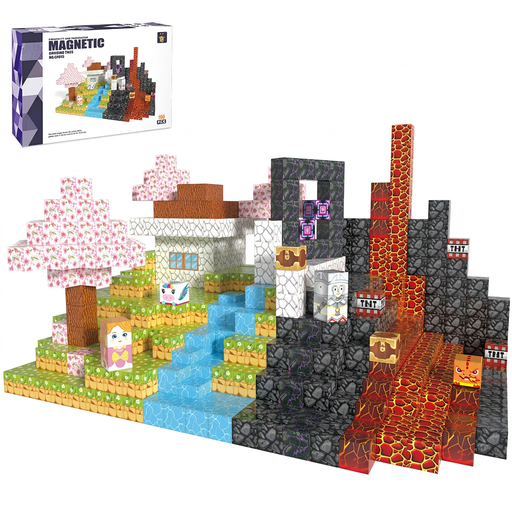
Why this product fits the profile: The set contains 100 geometric magnetic tiles, a storage bag and is stated as suitable for children aged 3 and over. It’s ideal for first 2D patterns and simple 3D constructions.
The piece count is complemented by a specific tile size of 2.5 cm, a bag and a stated age limit. The magnet warning should still be observed.
100 pieces, no batteries required and, according to product information, compatibility with other 2.5 cm magnetic tiles.
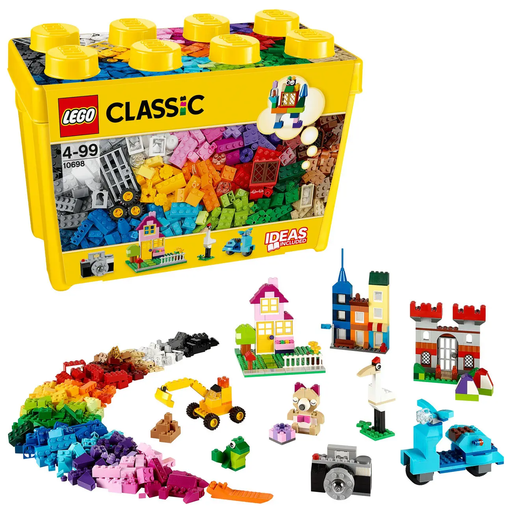
Why this product fits the profile: According to product information, the box is aimed at children aged 4 and over and contains 790 pieces in 33 colours, plus windows, doors, wheels and base plates for free building.
The open-ended selection of pieces avoids being tied to just one model. The plastic box helps with sorting after play.
790 pieces, two green base plates and idea instructions; suitable as an expandable foundation for building bricks for children aged 4 and over.

Why this product fits the profile: The set combines transparent magnetic tiles with a marble run and a light function. According to product information, 126 pieces are included; three AA batteries are required for the lighting.
The specific play purpose is clearly stated: constructions, marble runs and lights. This makes it easier to decide before buying whether batteries and extra supervision are acceptable.
126 pieces, transparent building elements and a combined marble run function; batteries are not included.
We’ve put together a complete, regularly updated list of products that fully meet these strict selection criteria and the safety regulations in force in the EU.
For children aged 6 and over, themed models like the LEGO Disney Classic 43271 Lucky & Penny 101 Dalmatians Puppies can be appealing. According to product information, the set contains 268 pieces and movable figures. From age 7, the LEGO Creator 31376 Cute Hamster with a Flower offers three alternative animal models from 166 bricks.
Older children and teenagers interested in technology or vehicles will find the CAYI F4U-4 CORSAIR PLANE Building Set, a model with 318 pieces. For teenagers and adults, the Robotime Rolife Baking Kitchen DIY Dollhouse Kit is intended. It contains 62 laser-cut wooden pieces and is recommended for ages 14 and over according to product information. Due to small and delicate parts, it is not an accessible toy for younger children.
For adult fans, the LEGO Disney Pixar 43279 WALL-E and EVE with 811 pieces and an age recommendation of 18+ is a good example. With sets like these, focused building and decorative display take priority over spontaneous play.
Only products that are explicitly approved for ages 3 and over are suitable. Magnetic tiles and other sets with small parts must be used under direct supervision. Check before each play session whether any pieces are damaged or magnets are exposed.
The lifespan depends on the material, connection method, storage and handling. Dry storage, organised sorting and regular checks can extend the practical use time. Heavily worn or damaged pieces should not be used further.
Classic bricks and magnetic tiles usually don’t require batteries. Sets with light or electronic functions may require batteries. Check whether these are included and whether battery changes should only be carried out by adults.