
Lieferung heute & morgen

Qualitätsgarantie

Willkommens-Angebote freischalten: KOSTENLOSE Lieferung | Bis zu 80 % RABATT | Kostenlose 30-Tage-JoyPlus-Testphase
App herunterladen
Finding a new bookshelf seems simple at first glance. But the selection is vast, and not every model that looks good online proves its worth in daily use. Unstable construction, impractical shelf dimensions, or poor-quality finishes often lead to disappointment. This guide will help you identify the crucial features and choose a shelf that is both functional and durable.
Before you make a decision, you should familiarise yourself with three common problems that often only become apparent after the purchase.
To avoid the problems mentioned above, focus on three technical aspects. These form the basis for an informed purchasing decision.
The material is a key determinant of your shelf's stability and longevity.
Always check the maximum load capacity per shelf. This value indicates how much weight a single shelf can safely support and is crucial if you plan to store heavy books or binders.
A safe shelf stands firm and does not tip over. Two features are essential for this:
Measure not only the available space but also think about what you will store.
Here are some recommendations tailored to specific user profiles that meet the quality criteria mentioned.
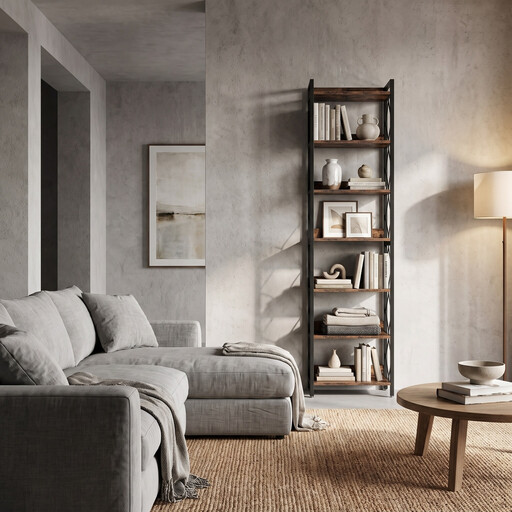
Why it's a great fit: Ideal for small apartments or unused corners. This tall and narrow corner shelf transforms hard-to-use areas into valuable vertical storage without looking bulky.
The construction of a metal frame and particleboard ensures stability. An included anti-tip kit directly addresses the safety risk of unstable shelves. The dimensions are specifically designed for corners, solving the problem of unused space.
Maximum space utilisation with a height of 200 cm on a minimal footprint. Adjustable foot pads ensure stable footing even on uneven floors.
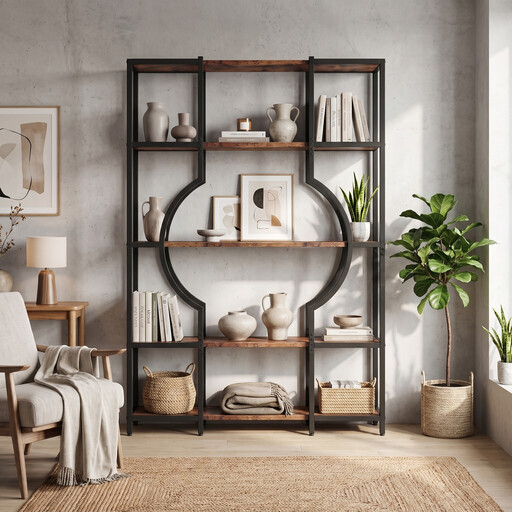
Why it's a great fit: For anyone looking for a piece of furniture that is more than just storage. The curved silhouette and the combination of a brown wood tone and black metal frame make this shelf a statement piece in an industrial-vintage style.
The sturdy metal frame provides the necessary stability. The 12 differently sized open compartments are intentionally designed for displaying decor, plants, and books, thus avoiding the dilemma of impractical standard dimensions.
A unique design with high decorative impact. The high total load capacity of 113 kg and the optional wall mounting ensure safe use.
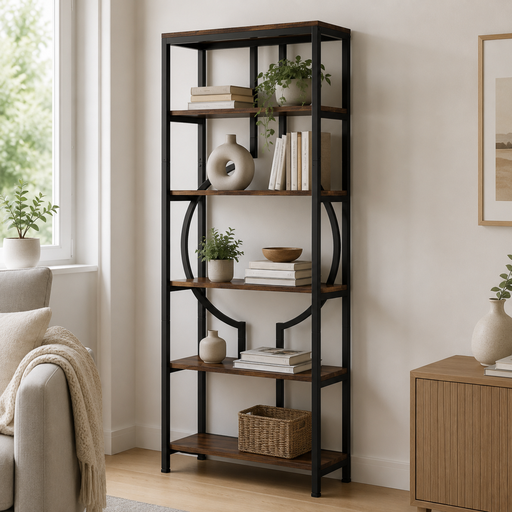
Why it's a great fit: Anyone needing to store heavy binders, professional literature, and office supplies in their home office needs one thing above all: a durable and spacious freestanding shelf. This model offers both in an attractive industrial look.
With a total load capacity of 100 kg, supported by a robust iron frame, the stability trap is consistently avoided. The scratch and stain-resistant surface of the shelves is designed for intensive daily use, counteracting the problem of delicate finishes.
Very high load capacity and durable materials. The six spacious shelves with a depth of 30 cm offer ample space for standard office binders.
We have compiled a complete, up-to-date list of products that fully meet these strict selection criteria and UK safety regulations.
1. How do I securely attach a bookshelf to the wall? Most tall shelves come with an anti-tip kit. This usually consists of a bracket or a strap that is screwed to the shelf and the wall. For wall mounting, use wall plugs and screws that are appropriate for your wall type (e.g., concrete, drywall). Position the fastener in the upper third of the shelf to maximise leverage and effectively prevent tipping.
2. What is the difference between MDF and solid wood in shelves?Solid wood, as the name suggests, is made from solid, natural wood. It is very stable, durable, and has a unique grain, but it is also heavier and more expensive. MDF (Medium-Density Fibreboard) is made from finely shredded wood fibres that are pressed into a panel with adhesive. MDF boards are very dimensionally stable, have a smooth surface that is easy to paint or coat, and are a cost-effective alternative. Their stability depends heavily on the density and thickness of the board.
3. How much weight can an average shelf hold? The load capacity varies greatly depending on the material, thickness, and span of the shelf. A simple 16 mm particleboard shelf with a width of 80 cm often only supports 10-15 kg. A shelf made of thicker material or with a supporting metal frame can hold 20 kg, 30 kg, or more. The maximum load capacity per shelf is an important manufacturer specification that you should check before buying, especially if you plan to store heavy items like books.