
Lieferung heute & morgen

Qualitätsgarantie

Willkommens-Angebote freischalten: KOSTENLOSE Lieferung | Bis zu 80 % RABATT | Kostenlose 30-Tage-JoyPlus-Testphase
App herunterladen
A built-in ceramic hob can add functionality to an existing kitchen or replace an older hob. Before buying, however, looks and price should not be the only considerations. The most important factors are the correct cut-out dimensions, the electrical connection and how the cooking zones will actually be used.
Many unsuitable purchases result from three typical pitfalls:
Before ordering, measure the worktop from underneath or refer to the existing installation documentation. Pay attention to:
A compact built-in electric hob with two zones is often suitable for small kitchens, single-person households or narrow worktops. Typical dimensions in this category are around 29 × 52 cm, while larger four-zone models are often approximately 59 × 52 cm. The existing cut-out must nevertheless always match the manufacturer’s specifications.
A 3000 W ceramic hob distributes its power across two cooking zones. This is sufficient for simple meals and limited simultaneous cooking. A 6600 W ceramic hob with four zones offers more power reserves, but also places greater demands on the electrical connection.
Maximum power should not be confused with actual consumption. For a rough estimate:
Power in kilowatts × operating time in hours = energy consumption in kilowatt-hours.
A hob rated at 3000 W uses 3 kWh when operated at full power for one hour. In practice, different power settings are generally used. For installation, the voltage, frequency and fuse rating are relevant. The models featured are designed for 220–240 V; depending on the appliance, either 16 A or 32 A is specified. The connection should be checked by a qualified electrician in accordance with the instructions and local requirements.
A 2-zone ceramic hob saves space and may be sufficient for smaller households. A 4-zone ceramic hob is a sensible choice if several pots and pans are regularly used at the same time. A flexible hob with a dual cooking zone is particularly practical, as the heated area can be adapted to different pan sizes.
Also look out for:
Glass ceramic becomes hot during use and remains hot afterwards. The residual heat indicator therefore does not replace the need for caution. If the glass surface develops a crack, disconnect the appliance from the mains immediately and do not use it again.
The following models cover different installation situations and cooking habits. Technical specifications are based on the product data provided.
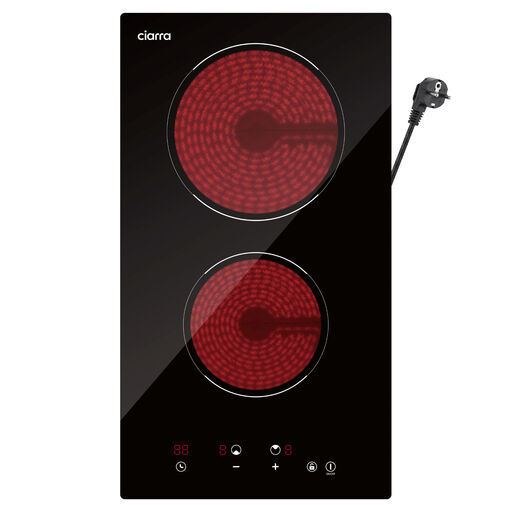
Why this product suits the profile: Two cooking zones, compact dimensions of 290 × 520 × 50 mm and a specified cut-out of 260 × 490 mm make this model suitable for small kitchens and modest cooking requirements.
The cut-out, total power and 16 A fuse rating are clearly specified, making it easier to check suitability before installation. The timer runs for up to 99 minutes.
2 cooking zones, 9 power levels, touch control, child lock and residual heat indicator.
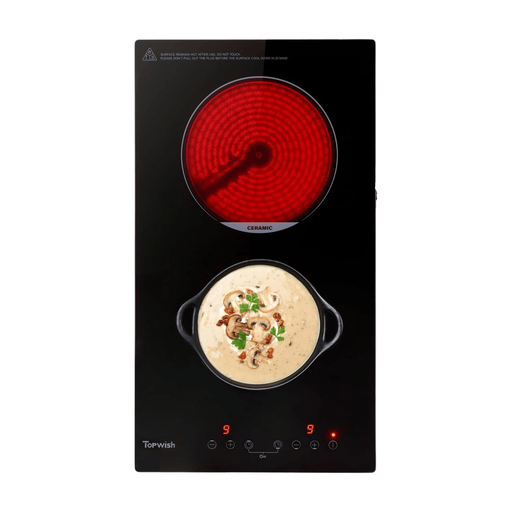
Why this product suits the profile: Buyers who value clearly specified operating and safety features get a compact solution with touch control and 9 power levels.
The product data specifies the 260 × 490 mm cut-out, zone outputs of 1200 and 1800 W, as well as automatic switch-off.
Timer of up to 90 minutes, child lock, overheating protection and “H” residual heat indicator.
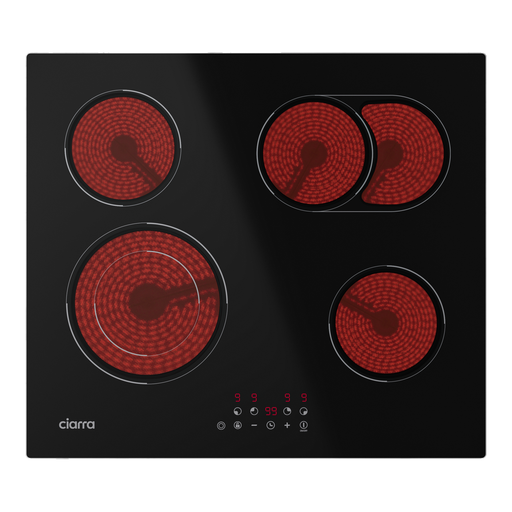
Why this product suits the profile: Four cooking zones and two expandable areas are suitable for households that regularly prepare several dishes at once or use cookware in different shapes simultaneously.
The zone dimensions are clearly specified: oval 230 mm with 1100/2200 W and round 165–270 mm with 1100/2000 W. The cut-out measures 560 × 490 mm.
4 zones, 9 power levels, timer of up to 99 minutes, child lock and automatic safety shut-off.
We have put together a complete, regularly updated list of products that fully meet these strict selection criteria and the safety regulations applicable in the EU.
A built-in ceramic hob requires a level, heat-resistant worktop and sufficient ventilation beneath the appliance. Before buying, also check whether the existing connection is suitable for the specified fuse rating. The inclusion of a plug does not automatically mean that every installation situation is suitable without further checks.
For everyday care, a soft, slightly damp cloth is usually all that is needed. Do not use abrasive sponges, and do not place heavy objects on the glass surface. Pots and pans should have a smooth base and be suitable for the respective cooking zone. Oversized cookware can affect heat distribution and operation.
The manufacturer’s specified cut-out dimensions are the key factor, not just the visible width of the appliance. Existing cut-outs should be checked to the nearest millimetre. You should also take ventilation, worktop thickness and clearances from other appliances into account.
The cost depends on the power rating, usage time and electricity tariff. A 3000 W model can theoretically use 3 kWh per hour at full power, while a 6600 W model uses 6.6 kWh. As cooking zones are not usually operated continuously at the highest setting, actual consumption is often lower. For a more accurate estimate, you can calculate the power used and daily operating time based on your tariff.
It is not possible to give a reliable fixed service life for every appliance. Among other things, it depends on how intensively the hob is used, how it is cleaned, whether it is installed correctly and the condition of the glass surface. Regular checks, suitable cookware and switching the appliance off immediately if cracks appear all help to minimise operating risks.