What to look for when buying
For a family gathering, choose an appliance that suits the number of trays you plan to use, the space available in your kitchen and the way you want to prepare the apples.
| Priority |
What to check before buying |
Who it matters most to |
| Tray area and number of batches |
Check the internal and tray dimensions, along with an explicit manufacturer’s statement about baking on several levels at once. Siemens specifies 3D hot air on up to three levels for the HB578GBS3. |
If I’m planning several loaded trays for a large group, I want to know how much space is actually usable. Around 36% of consumers say tray area is their main priority. |
| Space for installation or positioning |
For a built-in oven, check the dimensions of the housing space; for a countertop model, check its external dimensions and the positioning instructions for that particular appliance. |
If my kitchen doesn’t have a suitable space for a built-in oven, I need an appliance with a safe, suitable place to stand. Around 29% of consumers say whether an appliance fits in their kitchen is their main priority. |
| How you want to prepare the apples |
Choose a recipe and heating method, then check the appliance’s minimum temperature and timer. For its example of drying apple rings, Bosch Hausgeräte recommends a maximum of 50 °C and a cooking time of four to eight hours. |
If I want to make dried apple rings rather than warm slices, the appliance needs to suit the recipe. Around 21% of consumers say the cooking method is their main priority. |
| Running and cleaning |
For ovens covered by the energy label, compare the kWh per standard cycle for equivalent heating methods; weigh up cleaning functions based on your needs. The European Commission excludes small and portable ovens from the energy-labelling scope referred to here. |
If running costs or cleaning are especially important to me, I want to understand these points before buying. Around 14% of consumers say running and cleaning are their main priority. |
Joybuy products for this topic
This selection from Joybuy includes built-in and freestanding appliances. Choose one based on the usable tray area, the space you have available and how you want to prepare the apples.
 No image available
Comfee built-in oven, 60 cm, 70 l
This built-in model could suit baking several trays if it fits your kitchen space and trays. Check the specifications for multi-level baking on the particular model.
The product title specifies 70 l, 3 kW and AquaClean steam cleaning.
View at Joybuy
 No image available
Bosch Serie 6 built-in oven HBG578ES3, 60 cm
This built-in model could suit baking several trays if it fits your kitchen space. The product details specify baking on up to three levels at once.
The product title specifies 3D hot air and stainless steel. Professional installation is recommended.
View at Joybuy
 No image available
Woltu BF12sz mini oven, 32 l
This freestanding mini oven could suit you if you don’t have a built-in space and its cooking area is large enough for the quantity you plan to make.
The product title specifies 1.600 W, a timer, a crumb tray and a temperature range of 100 to 250 °C. This range is too high for Bosch’s example of drying apple rings at a maximum of 50 °C.
View at Joybuy
 No image available
Woltu mini fan oven, 28 l
This freestanding model could be an option if you’re looking for an alternative to a built-in oven. Check that the usable tray area is large enough for the quantity you plan to make.
The product title specifies 28 l, a temperature control and a timer. The temperature range starts at 100 °C, so it isn’t suitable for Bosch’s example of drying apple rings at a maximum of 50 °C.
View at Joybuy
 No image available
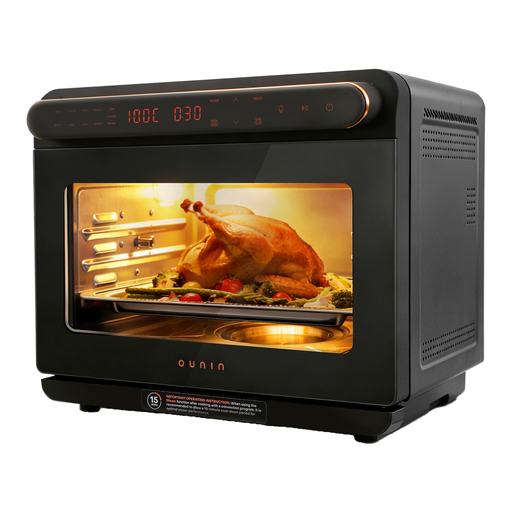
OUNIN steam combination countertop oven, 24 l, 10-in-1
This countertop model could be a freestanding option if you don’t have space for a built-in oven. Check that its features suit your recipe and the number of trays you plan to use.
The product title specifies a 1-l water tank, a stainless steel interior, steam baking, steaming and a rotisserie.
View at Joybuy
Frequently asked questions
Can I use any oven with several shelf positions for a large gathering?
No. Having several shelf positions doesn’t, on its own, confirm that the oven can bake several loaded trays at once. Check that your trays will fit and look for an explicit statement from the manufacturer. For the HB578GBS3, Siemens Hausgeräte specifies 3D hot air on up to three levels, while Severin’s reference to four shelf positions doesn’t confirm that it can bake several trays at once.
How does planning differ for dried apple rings and warm-baked slices?
First decide what you want to make, as the temperature and timing will differ. For its example recipe for drying apple rings, Bosch Hausgeräte recommends a maximum of 50 °C and a cooking time of four to eight hours. Don’t assume these settings will also suit warm-baked apple slices.
How should I assess electricity consumption when buying?
For a domestic oven covered by the energy label, you can compare factors such as its capacity and energy consumption per standard cycle for the heating methods listed. The European Commission excludes small and portable ovens from the scope referred to here. Wattage alone isn’t a like-for-like way to compare energy consumption per cycle.
What are my rights if an appliance is faulty in Germany, and is a manufacturer’s guarantee the same thing?
Your statutory rights are generally claims against the seller and are separate from any voluntary guarantee. Verbraucherzentrale explains that, for sales contracts made from 31 July 2026, choosing a repair for a faulty product may extend the statutory limitation period by 12 months once. This rule doesn’t apply retrospectively to earlier purchases.
What safety precautions should I take when positioning a countertop oven?
Always follow the instructions and required clearances for the particular appliance. A countertop oven isn’t designed for built-in installation just because it’s compact. Choose a suitable place for it and make sure guests, especially children, can’t easily reach its hot surfaces.


