For cooking several portions, a built-in oven is an obvious choice if your oven dishes fit on the usable shelves and you have a suitable housing unit. If you don’t have a suitable space for a built-in model, a freestanding fan oven could work, provided its capacity and footprint are large enough for your dishes. Also check the heating functions for the potato topping, and follow the recipe’s instructions for freezing and reheating: Good Food describes different methods.
Which oven might suit you
Batch cooks with several oven dishes
If you want to bake several portions in as few batches as possible, compare the external dimensions of your dishes with the usable shelves and accessories of the specific oven. Good Food describes dividing a lentil filling between several dishes.
Fans of a golden potato topping
If you want to brown the top after heating the pie through, check the available top-heat or grill functions and follow the recipe instructions. Good Food describes different ways to cook and reheat cottage pie.
Cooks without space for a built-in oven
If you don’t have a suitable space for a built-in oven, compare the actual usable dimensions of a freestanding model with the space available on your worktop and the model’s installation guidance.
What to look for when buying
First, check that your dishes fit in the usable oven space. Then compare the heating functions, kitchen space and energy use of the specific appliance.
| Consideration |
What to check when buying |
Who it matters most to |
| Space for batch cooking |
Compare the external dimensions of your filled dishes with the rack space, shelf positions and accessories included. |
If I’m cooking several dishes to stock up the freezer, I want to fit them in as few batches as possible. Around 36% of consumers put capacity for freezer batches first. |
| Heating through and browning |
Check the recipe against the fan or convection settings and the available top-heat and grill settings. |
I want the filling to heat through and the potato topping to brown as the recipe recommends. Around 29% of consumers prioritise cooking and browning results. |
| Space in the kitchen |
For built-in ovens, check the housing unit and appliance dimensions; for countertop ovens, check the footprint and installation guidance. |
If I don’t have space for a built-in oven or my worktop is limited, the appliance needs to fit the space available. Around 21% of consumers prioritise how well an appliance fits in their kitchen. |
| Energy use and cleaning |
For ovens covered by energy labelling requirements, compare fan-mode energy use per cycle on the same label basis; weigh up the cleaning method and how you’ll use the oven. |
If I often cook batches to stock up the freezer, I want to consider both energy use and the effort involved in cleaning. Around 14% of consumers put running costs and cleaning first. |
Common oven-buying misconceptions
-
Assuming oven capacity means all your dishes will fit
The capacity in litres alone won’t tell you whether your dishes will fit side by side or across several shelves.
Measure your dishes from the outside and compare their dimensions with the rack space, shelf positions and accessories supplied with the specific model.
If all the dishes won’t fit at once, you may need to bake in extra batches.
-
Mixing up recipe instructions for different freezing stages
Good Food describes both a pie frozen before baking and a recipe where the pie is frozen after baking. The cooking and reheating instructions are therefore not interchangeable.
Label each portion with its state when frozen, and follow the instructions for that recipe. For longer storage, the German Federal Institute for Risk Assessment recommends cooling hot food quickly to below 7 °C.
-
Comparing only the energy efficiency rating
Verbraucherzentrale points out that the appliance’s actual energy use matters too. A standardised cycle doesn’t automatically reflect the energy used to cook your own batch of pie.
Compare energy use in kWh per fan cycle using the same label basis, and consider how often you’ll actually fill the oven.
Key brands at a glance
Bosch
Bosch Hausgeräte Deutschland lists the HBA571BB4 as a built-in oven with pyrolytic and hydrolytic cleaning.
- The model’s dimensions are listed as 595 × 594 × 548 mm; a telescopic rail can be retrofitted.
- For your batch of pie, still check the dimensions of your dishes, the shelf positions and the accessories: the appliance dimensions don’t confirm that your dishes will fit inside.
Siemens
Siemens Hausgeräte Deutschland describes the HR776G1B1 as featuring steam boost, along with pyrolytic and hydrolytic cleaning.
- A telescopic rail can be retrofitted to this model.
- Steam boost and connectivity are only relevant when buying an oven for pie if you’d also use those features for other things.
Beko
Beko Deutschland lists a 72-litre capacity, eight heating functions and steam cleaning for the BBIM12300X.
- The model offers several heating functions to choose from.
- AeroPerfect is the manufacturer’s description of its hot-air distribution system, not independent proof of even browning across several filled dishes.
Rommelsbacher
Rommelsbacher’s BG 1805/E is a freestanding compact oven with a 42-litre capacity and fan-assisted settings.
- The manufacturer lists dishes of up to 31.5 cm in diameter and an overall width of 55 cm, including the feet.
- These figures don’t tell you whether several of your dishes for batch cooking will fit inside at once.
Severin
Severin offers the TO 2068, a compact countertop oven with fan assistance and a 20-litre capacity.
- Its compact design may suit smaller dishes rather than a large batch for stocking up the freezer.
- According to Severin, this model does not have Safe-Touch technology, so check the installation guidance and make sure your dishes fit particularly carefully.
Ovens to consider at Joybuy
The options below include built-in ovens with convection, as well as a freestanding mini convection oven for smaller dishes.
 No image available
Siemens HB978GMB1 studioLine iQ700 built-in oven, 60 × 60 cm
A built-in oven with convection may suit several dishes, provided they fit and you have a suitable housing unit. Professional installation is required.
Heating functions include 4D hot air, top and bottom heat, and grill.
View at Joybuy
 No image available
Bosch HBG578ES3 Series 6 built-in oven
A built-in oven with convection may suit your batch, provided your dishes, housing unit and usable shelves are all a good fit. Professional installation is required.
Features listed include 3D hot air, grill, and top and bottom heat.
View at Joybuy
 No image available
Siemens HB776G1B1 iQ700 built-in oven
A built-in oven may suit several dishes, provided your kitchen has a suitable housing unit and the oven is professionally installed.
The model features perfectCooking 4D, designed for cooking on several shelves at once.
View at Joybuy
 No image available
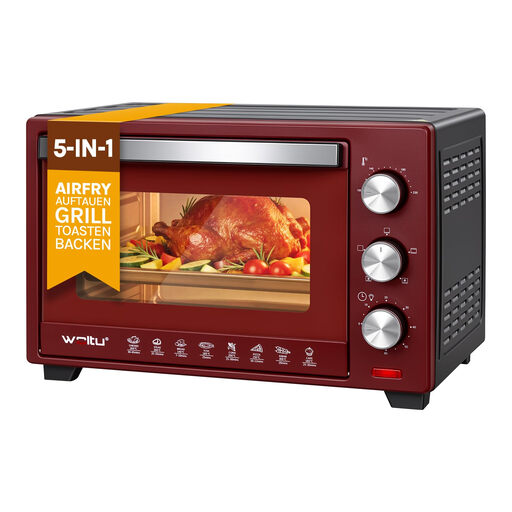
Woltu mini convection oven, 28 litres, red and black
A freestanding mini convection oven may suit smaller portions, provided your dish fits and you have enough space for the appliance.
Heating functions include top heat, bottom heat and a combined setting. It also has temperature control and a timer.
View at Joybuy
Frequently asked questions
Do I need to bake the lentil pie fully before freezing it?
No. Recipes may call for freezing at different stages. Good Food describes both a pie frozen before baking and a recipe where the pie is frozen after baking. Follow the cooking and reheating instructions for your chosen recipe rather than mixing the methods.
How do I reheat a frozen portion?
For a pie that’s already been baked, Good Food recommends defrosting it completely overnight, then heating it in the oven until piping hot throughout. The other recipe gives separate instructions for a pie frozen before baking; the timings won’t necessarily work for other dish sizes.
Is 42 litres enough for several oven dishes?
Not necessarily. The oven capacity alone doesn’t prove that several dishes will fit inside at once. Rommelsbacher lists dishes of up to 31.5 cm in diameter for the BG 1805/E; also check the dimensions and arrangement of your own dishes.
How do I compare the energy use of different ovens?
For appliances with an EU oven energy label, compare the energy use in kWh per standardised fan cycle on the same basis, and consider it alongside the oven capacity. Verbraucherzentrale recommends checking the appliance’s actual energy use; the standard cycle doesn’t directly reflect the energy used to cook a large batch of pie.
Does every compact oven need an EU oven energy label?
Not necessarily. The European Commission lists small ovens as examples of products outside the scope of the relevant oven regulations. Check how the specific appliance is classified rather than treating the absence of such a label as a fault.


