
Lieferung heute & morgen

Qualitätsgarantie

Willkommens-Angebote freischalten: KOSTENLOSE Lieferung | Bis zu 80 % RABATT | Kostenlose 30-Tage-JoyPlus-Testphase
App herunterladen
A built-in hob should fit into your existing worktop, allow you to cook several dishes at once and be straightforward to use every day. However, product descriptions can often lead to unsuitable purchases: power ratings are considered without checking the electrical connection, standard dimensions are simply assumed and safety features are confused with convenience functions.
This buying guide from the Joybuy Product Recommendation Officer explains which details really matter before buying a built-in hob and which models are suitable for different households.
A 60 cm built-in hob is often around 590 × 520 mm externally. For installation, however, it is the worktop cut-out size that matters. Several models, for example, require a cut-out of approximately 560 × 490 mm. Other appliances need different dimensions, such as 565 × 495 mm.
You should therefore measure the following before ordering:
A model that looks suitable may be unusable if the cut-out does not match the manufacturer’s specifications.
A hob with a power rating of 6,000 or 7,200 W requires a suitably specified electrical installation. Details such as 220–240 V hob, fuse rating and connection type must be checked against your existing electrical system. Some models are supplied without a plug for fixed connection.
In Germany, a standalone hob should be installed by a qualified electrician. An existing oven is not automatically the right connection solution. You should also check whether a power limitation or energy management function is provided.
A hob with touch control is easy to clean, but the controls can be sensitive to water, grease or wet fingers. The sensor area should be kept dry and clear of objects. Look for clearly visible displays, separate controls for each zone and an easy-to-read residual heat indicator.
An induction hob heats the magnetic base of the pan directly. You therefore need magnetically compatible pots and pans. A simple magnet test on the base will show whether your existing cookware is generally suitable. Aluminium, copper and glass cookware will only work if they have a magnetic base.
A ceramic hob, also known as an electric hob, heats the glass surface and is therefore compatible with a wider range of cookware materials. The surface remains hot for longer after switching off, making a residual heat indicator particularly important. Both options offer specific benefits:
For families and regular cooking, a 4-zone hob provides enough space for several pots. Two zones, on the other hand, make sense if your kitchen is small or you only cook occasionally. Flexible double or oval zones can accommodate different pan sizes, but they still require suitable worktop dimensions.
Always compare:
Nine power levels allow finer adjustment than a small number of broad settings. A hob with a timer can switch individual zones off after the set time. This is practical, but it does not replace supervision when heating oil or fat.
For induction models, automatic pan detection is important: the zone only operates when suitable cookware is detected. With ceramic hobs, by contrast, it is essential that the base of the pan is flat and sits cleanly on the surface.
A hob with a child lock prevents unintended inputs, but it does not lock the hot surface. You should also look for:
People with pacemakers or other electronic implants should follow the manufacturer’s safety instructions and seek medical advice if they are unsure. Induction hobs generate electromagnetic fields during operation.
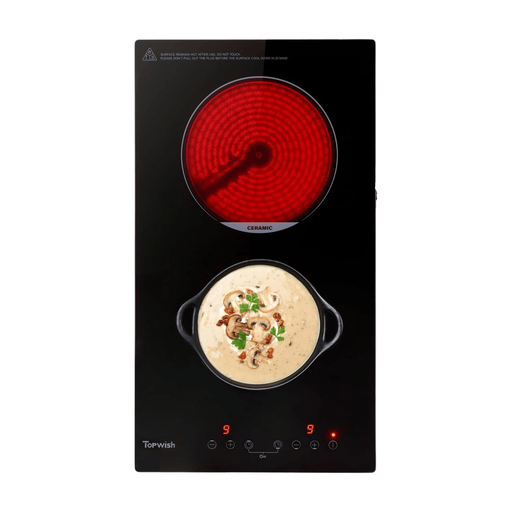
Why this product suits this profile: Measuring 29 × 52 cm, this compact ceramic hob is ideal for smaller kitchens or households with limited space.
The 260 × 490 mm cut-out size and 220–240 V connection are clearly specified. This makes it easier to check the installation requirements before buying.
Two cooking zones, nine power levels, timer of up to 90 minutes, child lock and residual heat indicator.
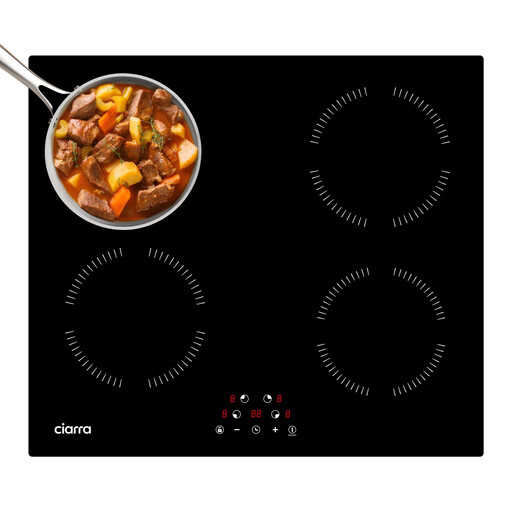
Why this product suits this profile: This 60 cm induction hob is designed for households that want to use four zones and separate timers in a standard format.
The product details explicitly state the external dimensions, a 560 × 490 mm cut-out, a 32 A fuse and total power of 6,000 W.
Four zones, nine power levels, touch control, pan detection, child lock and overheating protection.
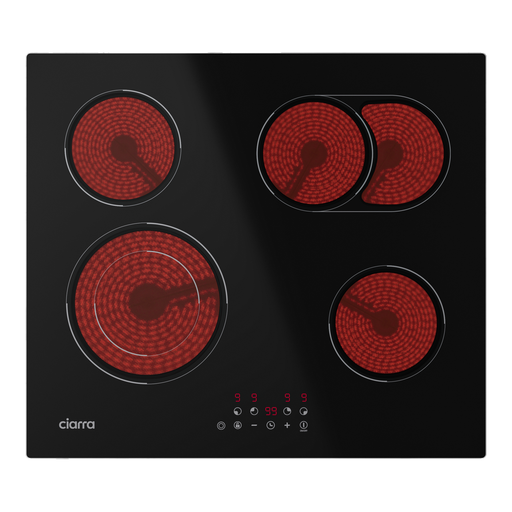
Why this product suits this profile: The flexible oval and dual-ring zones are ideal for households that use cookware in a variety of shapes.
The zone dimensions, nine power levels and 99-minute timer are clearly specified. This makes it easier to compare the hob with your own cookware.
Four zones, total power of 6,600 W, oval zone, dual-ring zone and touch control.
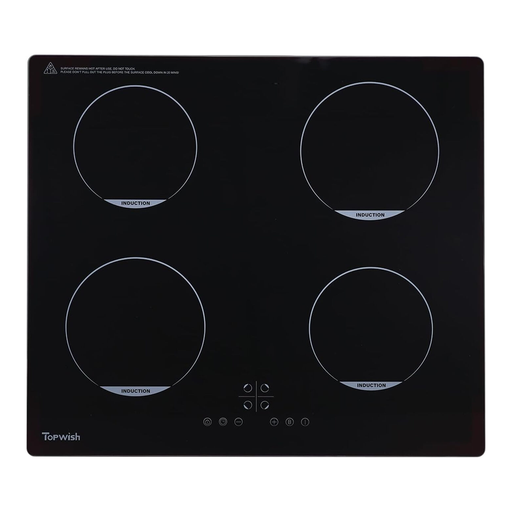
Why this product suits this profile: Four induction zones, a boost function and separate power levels are designed for preparing several dishes at the same time.
The appliance specifies the required 565 × 495 mm cut-out, 7,200 W power rating and connection without a plug. A qualified electrician can check the installation requirements accordingly.
Four zones, nine power levels, boost function, timer of up to 99 minutes and residual heat indicator.
We have put together a complete, regularly updated list of products that fully meet these strict selection criteria and the safety regulations applicable in the EU.
Many appliances with an external width of around 590 mm require a cut-out of approximately 560 × 490 mm. However, this is not a universal standard. The installation specifications for the individual model are always decisive. Measure your existing worktop before ordering.
A standalone hob has its own controls and is not necessarily linked to a particular oven. Even so, the connection rating, fuse, ventilation and installation dimensions must be suitable. The electrical installation should be carried out by a qualified professional.
Running costs depend on the power rating, usage time, cookware and electricity tariff. A higher rated output does not automatically mean proportionally higher consumption, as the heating element switches on and off or is regulated according to the selected power level. For a realistic estimate, multiply the appliance’s actual operating time by its power consumption and your electricity price.