
Lieferung heute & morgen

Qualitätsgarantie

Willkommens-Angebote freischalten: KOSTENLOSE Lieferung | Bis zu 80 % RABATT | Kostenlose 30-Tage-JoyPlus-Testphase
App herunterladen
A built-in hob needs to fit your worktop, your existing electrical connection and your everyday cooking habits. Yet product descriptions often lead to the wrong purchase: high wattages are equated with faster cooking, touch control is automatically assumed to be convenient, and a standard size is presumed without checking the actual cut-out in your worktop.
This guide explains which specifications really matter for a ceramic hob, induction hob or classic electric hob. Afterwards, you will find a selection of suitable models for different households.
A 60 cm hob is not automatically suitable for every 60 cm worktop cut-out. What matters are the installation dimensions. Typical appliances measure approximately 590 × 520 mm externally, while the worktop cut-out might be, for example, 560 × 490 mm or 565 × 495 mm.
Before buying, you should therefore compare three measurements:
If you are replacing an existing hob, the rating plate on your old appliance can also be helpful. If the dimensions differ, you may need to adjust the worktop.
A built-in hob with 4 zones rated at 6,600 or 7,200 watts can supply several cooking zones at once. However, the total power must match your connection. A high-performance appliance with a 32 A rating is not compatible with every existing connection.
In smaller kitchens, a built-in hob with 2 zones rated at 3,000 to 3,500 watts can be a more sensible choice. It takes up less space and is ideal for smaller households, galley kitchens or a worktop with limited width.
For running costs, what matters is the power, how long you use it and your electricity tariff. An appliance with a high maximum power rating does not constantly draw that power. When comparing, you should therefore also consider the heating method and how you plan to use it.
A hob with touch control can provide a smooth surface without protruding knobs. At the same time, sensor panels are sensitive to water, grease or dirty fingers. A dry control surface is important for reliable operation.
A hob with a timer can limit individual cooking processes. Check whether the timer can be assigned separately to each zone and what setting range the appliance offers. A child lock prevents accidental inputs depending on the model, but does not replace supervision during cooking.
An induction hob requires suitable magnetic cookware. A simple magnet test on the base of your pan gives a first indication: if the magnet sticks, the cookware is generally suitable for induction. The pan base should also be flat and match the size of the cooking zone.
A ceramic hob heats the glass surface or the heating element beneath it. It is usually less restrictive when it comes to choosing cookware, but the surface can stay hot for longer after cooking. A residual heat indicator is therefore particularly important.
It is not just the number of zones that counts. Also check their diameter and power. Smaller zones are suitable for small pans, while larger frying pans can benefit from extended or combined zones.
The Ciarra CRGBCH466T, for example, features an oval zone and a round dual-ring zone. According to the product specifications, this allows you to use oblong pans and pans of different sizes more flexibly. Nevertheless, you should still check the diameter and power specifications against your own cookware.
In the UK, a hob that requires a fixed connection must be installed in accordance with the installation instructions and current local wiring regulations. For appliances without a plug, a qualified electrician is required. Even with models that come with a plug, you must check the voltage, fuse rating, earthing and ventilation.
Pay particular attention to:
If you are unsure, have a qualified professional check your existing installation before buying.
The following models have been assigned to different usage scenarios based on the number of zones, installation dimensions, heating method, controls and safety features.

Why this product fits the profile: This compact 29 cm ceramic hob offers two zones and is ideal for smaller kitchens, single-person households or a limited worktop area.
The product specifications list the external dimensions and cut-out separately: 290 × 520 × 52 mm and 260 × 490 mm respectively. This makes it easier to check the installation plan.
2 zones, 3,000 W total power, 9 power levels, timer up to 90 minutes, child lock and residual heat indicator.

Why this product fits the profile: This 60 cm induction hob is designed for households that use multiple pans at once and want precise touch controls.
The specification states 565 × 495 mm as the cut-out and explicitly mentions a hardwired installation without a plug. The connection can therefore be planned in advance.
4 zones, 7,200 W maximum power, boost function, 9 levels, timer up to 99 minutes, child lock and pan detection.
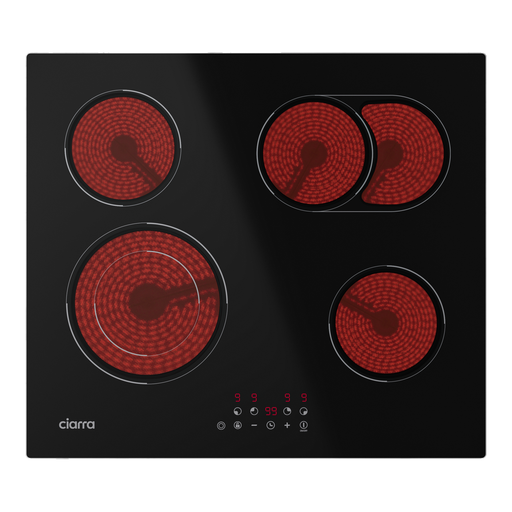
Why this product fits the profile: Four cooking zones and flexible oval and round dual-ring zones suit households that frequently use differently shaped cookware.
The zone dimensions, appliance measurements of 590 × 520 × 50 mm and cut-out of 560 × 490 mm are all clearly stated. This makes checking easier before a kitchen renovation.
4 zones, 6,600 W, 9 power levels, touch control, timer up to 99 minutes, plus residual heat indicator and overheat protection.
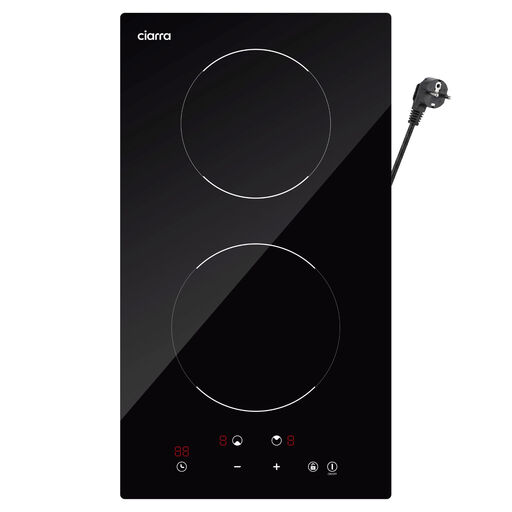
Why this product fits the profile: This slim 2-zone induction hob is ideal for rental kitchens, small households and anyone looking to switch to magnetic cookware.
The product description explicitly mentions induction-compatible cookware and a magnet test. This allows you to check compatibility before use.
2 zones, 3,000 W, 9 power levels, individual timers up to 99 minutes, child lock, pan detection and overheat protection.
We have put together a complete, regularly updated list of products that fully meet these strict selection criteria and the safety regulations in force in the EU.
That depends on your existing worktop cut-out and your cooking needs. A 60 cm hob usually offers four zones, while a 29 or 30 cm model with two zones takes up less space. Before buying, the appliance dimensions and cut-out dimensions must match.
The running costs depend on your electricity tariff, the power and how long you use it. Induction transfers heat directly via a magnetic field into suitable cookware, whereas a ceramic hob first heats the heating element and the glass surface. A general cost saving cannot be reliably stated without specific usage.
A fixed lifespan cannot be guaranteed for every model. It is influenced by daily usage, care, professional installation and the stress on the glass surface. Cracks, damaged cables or malfunctions should not be repaired yourself. In such cases, disconnect the appliance from the mains and contact a qualified professional.