Families with a large casserole dish
If you’re cooking a sausage bake in a casserole dish, compare its dimensions with the shelf and usable oven space.


A built-in oven is a good choice if you have a suitable housing unit and regularly cook large casseroles. If you don’t have space for a built-in model, a countertop oven may be enough, provided your dish fits and there’s sufficient clearance. Then check the shelf, heating functions, cleaning process and stated energy use per standard cycle. None of these details alone guarantees how your recipe will turn out.
If you’re cooking a sausage bake in a casserole dish, compare its dimensions with the shelf and usable oven space.
If you need a freestanding appliance, check that your casserole dish, available worktop space and connection are all suitable for the specific model.
If you regularly cook oven dishes, cleaning effort and the stated electricity use per standard cycle may influence your choice.
A good fit if: you have a suitable housing unit and regularly want to cook a large casserole dish or use several shelves for different dishes.
Things to consider: the housing unit dimensions and connection must suit the specific appliance. Using several shelves doesn’t guarantee a particular recipe will turn out as expected.
A good fit if: you don’t have a suitable housing unit and your dish fits inside the countertop oven with the required clearance.
Things to consider: the stated capacity alone won’t tell you whether the shelf, dish width and usable height are sufficient.
| What matters | What to check before buying | Who should pay particular attention? |
|---|---|---|
| Dish size | Compare the dish dimensions, including handles, with the shelf, runners and usable interior of the specific appliance. | If my family-sized dish needs to fit with its handles, I’ll carefully compare the dish with the oven interior. Around 36% of consumers put fit first. |
| Built-in or freestanding | Check the housing unit dimensions or available worktop space, as well as the installation details for the specific model. | Without a suitable housing unit, I’m more likely to consider a freestanding appliance; I’ll need to make sure there’s enough worktop space and that my dish fits. Around 29% of consumers prioritise an oven type that suits their kitchen. |
| Cleaning | Compare the cleaning method for the exact model and its instructions for accessories and wiping down the interior afterwards. | If I cook oven dishes often, I want to know how much cleaning is involved after cooking. Around 21% of consumers put cleaning first. |
| Energy use | Look at the kWh per stated standard cycle for each heating function separately from the capacity. Don’t use this figure to estimate the energy use of a particular casserole. The German consumer advice centre explains the energy-use figures per standard baking cycle, while the European Commission describes the information on the EU oven label. | If I use my oven regularly, I want to compare the stated energy-use figures without using them to calculate the cost of my recipe directly. Around 14% of consumers prioritise comparing energy use. |
The stated capacity doesn’t tell you whether a dish with handles will fit on the shelf or leave enough space inside the oven.
Measure your dish and compare its dimensions with the shelf, runners and usable interior of the exact model.
Pyrolytic and water-based cleaning methods work differently. After a pyrolytic cleaning cycle, you may still need to remove any residue.
Compare the cleaning process and the instructions for accessories in the manual for the model you’re considering.
A built-in oven must fit your existing housing unit; for a countertop model, the available space and usable interior are key.
Before buying, check the dimensions, connection details and whether a shelf is included with the specific model.
Built-in ovens with a range of features, including the HBA571BB4.
A built-in option with a range of heating and cleaning functions, including the BBA285PU1ZK.
Freestanding mini ovens, such as the TO 2058, don’t need a built-in housing unit.
Built-in ovens with a range of feature levels, including the BP3100B.
This selection includes built-in ovens as well as compact countertop and combination ovens. For each model, check that the heating function and interior suit your casserole dish.
 No image available
This built-in appliance could suit a family-sized casserole if you have a suitable housing unit.
71 l; 3D Hotair; pyrolytic cleaning.
 No image available
If you’re looking for a built-in oven for a family-sized casserole, check the dimensions of your housing unit first.
60 cm; 70 l.
 No image available
When choosing a family oven, check above all that the installation dimensions and usable interior suit your dish.
60 cm; 3D Hotair; AirFry.
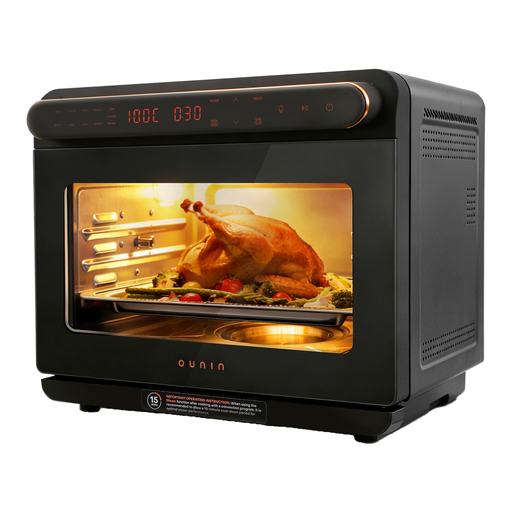 No image available
This countertop appliance is described as suitable for baking and steaming. Compare your dish dimensions with the usable interior.
24 l; 1 l water tank; 304 stainless steel interior.
 No image available
This countertop appliance is described as suitable for baking and grilling. Check that your casserole dish will fit inside.
32 l; 1,600 W; temperature range 100–250 °C.
Measure the dish, including its handles, and compare the dimensions with the shelf, runners and usable interior of the specific model. The stated capacity alone doesn’t confirm that it will fit.
Look for a fan function specifically stated to work across several shelves, and check that your dish and side dishes fit on the shelves provided. Bosch says the HBA571BB4 can be used on up to three shelves; this doesn’t guarantee a particular cooking time or level of browning for your recipe.
No. In its consumer advice on protection against Campylobacter, the German Federal Institute for Risk Assessment recommends a temperature of at least 70 °C for two minutes inside the food. If in doubt, use a meat thermometer. Also follow the guidance for the sausage you’re using.
No. Bosch says that any ash or residue left behind should be removed once the oven has cooled. Also follow the manual for the specific model for instructions on the cleaning process and accessories.
Not necessarily. The European Commission describes mandatory energy labelling for household ovens within the relevant scope, and specifically states that small ovens fall outside the scope described. So don’t assume the labelling requirement applies to every countertop appliance without checking.