Batch bakers
You bake a cake to enjoy over several working days and want to make sure your tin and planned batch will fit in the oven.


First, check whether you have a suitable space for a built-in oven or a permitted spot for a freestanding one. Then check the dimensions of your cake tin. A mini oven may be sufficient for a single batch that fits, while a built-in model may offer more capacity for larger tins and other baking tasks, depending on the model. Compare heating functions and energy information on a like-for-like basis. Extra programmes or self-cleaning are not automatically an advantage when you’re baking just one cake.
You bake a cake to enjoy over several working days and want to make sure your tin and planned batch will fit in the oven.
You’re looking for a freestanding oven and need to consider the size of your tin, the space available and the installation requirements for the specific appliance.
You’re replacing a built-in oven and want to weigh up the dimensions of the housing space, energy information and cleaning effort for your regular baking.
First check the space available and the dimensions of your cake tin. Then you can weigh up the heating function, energy information and cleaning effort to suit your baking routine.
| Consideration | What to check when buying | Who it matters most to |
|---|---|---|
| Heating function and controls | Check the recipe against the heating options and settings available on the specific model, such as top/bottom heat, fan-assisted cooking or fan cooking. | If you want to use a particular heating setting for regular bakes, check whether the oven lets you select it; around 28% of consumers put suitable heating functions first. |
| Tin size and batch size | Check the diameter or external dimensions of your tin, the usable oven space and the accessories included. Rommelsbacher specifies that the BGS 1400 accommodates baking tins up to 25 cm in diameter. | If you want your usual tin and planned amount of cake mixture to fit, the actual internal dimensions matter more than the capacity in litres alone; around 22% of consumers prioritise tin size and batch size. |
| Space and installation | For a built-in oven, check the dimensions of the housing space against those of the specific model. For a countertop oven, follow the installation requirements in its manual. | If you don’t have a suitable built-in space or have limited room, you’ll need to find an appropriate spot with the required clearance; around 22% of consumers focus first on space and installation. |
| Energy and costs | Compare energy information only for oven types where the comparison is appropriate. Wattage describes power input, not the electricity used in kWh for a baking session. | If you bake regularly and want to weigh up running costs as well as the purchase price, you’ll need comparable energy information; around 17% of consumers put energy and costs first. |
| Cleaning and ease of use | Check which parts can be removed, which surfaces are easy to reach and what cleaning system the specific model offers. | If you want to spend as little time as possible cleaning and handling the oven after baking, its everyday features matter; around 11% of consumers prioritise cleaning effort. |
The stated capacity in litres doesn’t tell you whether your cake tin will fit in terms of width and height.
Measure your tin and compare its dimensions with the stated usable oven space for the specific model.
If your tin doesn’t fit, you may need to buy another one or choose a different oven.
The Severin TO 2068 manual prohibits installation in a cupboard and specifies clearances of 12 cm at the sides and rear, and 30 cm above.
Read the installation instructions for your chosen model and measure the available space, including the required clearances.
An unsuitable spot may mean you need to rethink your kitchen layout.
A power rating in watts isn’t a measured energy consumption in kWh for your baking session. What’s more, the same labels don’t apply to every oven type you might compare.
Compare energy information only when it’s based on the same measurement method, and take into account how often you actually bake.
Built-in models are worth considering if you have a suitable housing space; the HBA571BB4 is one specific example.
Freestanding compact ovens may suit buyers with an appropriate surface and a tin that fits the oven cavity.
Freestanding mini ovens are another option if you don’t want to use a built-in space in your kitchen.
Built-in ovens are an option if you have a suitable space in your kitchen; the BBIM12300X is one specific model to consider.
This selection includes built-in ovens for suitable housing spaces and freestanding mini ovens. Before choosing, check that your cake tin fits the usable oven space; for countertop models, also check the installation requirements.
 No image available
For a kitchen with a suitable built-in space; check the appliance dimensions against your kitchen.
71 l; 3D Hotair, top/bottom heat and pyrolytic self-cleaning are listed in the product name.
 No image available
For baking in a kitchen with a suitable built-in space; check the housing dimensions before choosing.
70 l and 3 kW; fan cooking, grill, pizza function, AquaClean steam cleaning, LED display with timer and ECO mode are listed in the product name.
 No image available
For a kitchen with a suitable housing space; check the appliance dimensions and installation requirements before buying.
The product name lists AirFry and 3D Hotair.
 No image available
A freestanding oven for a suitable cake tin; measure the oven cavity and check the required clearances for the intended spot.
32 l, 1600 W, timer, crumb tray and a temperature range of 100 to 250 °C are listed in the product name.
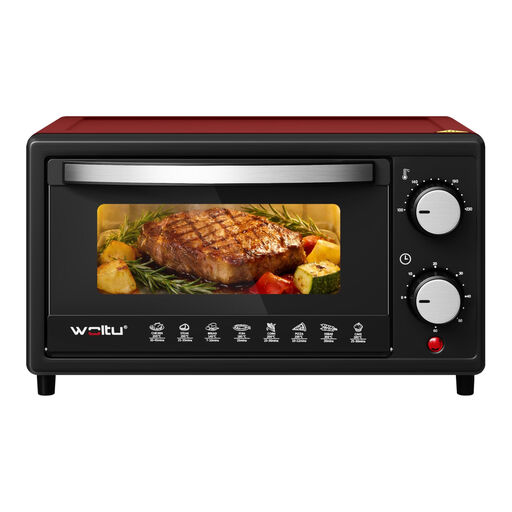 No image available
For a small cake, provided the tin and ingredients fit in the oven cavity; check the appliance’s installation requirements too.
10 l, pizza function and a temperature range of 100 to 230 °C are listed in the product name.
It depends on the internal dimensions of the specific model and the size of your tin. Check the stated tin size and the manual rather than relying on the capacity in litres alone. Rommelsbacher specifies that the BGS 1400 accommodates baking tins up to 25 cm in diameter; this doesn’t apply to all mini ovens.
Not simply because the appliance is compact. The Severin TO 2068 manual prohibits installation in a cupboard and specifies clearances of 12 cm at the sides and rear, and 30 cm above. Other appliances have their own installation requirements.
The absence of a label doesn’t automatically mean that an appliance uses a lot of energy or breaks the rules. The European Commission lists small and portable ovens as outside the scope of the Ecodesign regulation referred to here; Rommelsbacher explains that its compact ovens weighing less than 18 kg don’t carry an EU energy label. So check the labelling in the context of the specific type of appliance.
No. Under § 443 BGB, a guarantee is in addition to statutory liability for defects. For ordinary purchases, § 438 BGB generally sets a two-year limitation period for the specified claims relating to defects, starting from delivery; special statutory cases should be checked separately. Gesetze im Internet lists both provisions.
Don’t put an old appliance in your household rubbish. Verbraucherzentrale lists local collection points where you can drop it off free of charge, and explains that retailers must take back appliances under certain legal conditions. Larger appliances are taken back by the retailer on a like-for-like basis when you buy a new one.