Regular nut snackers
If you often eat nuts after a workout, choose a pack size that matches how much you actually get through. For opened packs of shelled nuts, the Verbraucherzentrale recommends storing them in an airtight container in the fridge.


A large pack of nuts can be a handy regular snack after a workout, provided you’ll use it all and can store any opened nuts safely. Whether plain nuts or a mix is the better choice for your snack depends on the ingredients, nutritional information and, where relevant, the allergen information on the specific pack.
If you often eat nuts after a workout, choose a pack size that matches how much you actually get through. For opened packs of shelled nuts, the Verbraucherzentrale recommends storing them in an airtight container in the fridge.
If you’re looking for plain nuts or want to keep track of the salt in your snack, compare the ingredients list and nutritional information for each option rather than relying on its name alone.
If you need to avoid certain nuts, peanuts or other allergens, check the ingredients and allergen information on the specific pack. The term ‘nut mix’ doesn’t tell you which types of nuts it contains.
First, think about how much you can use. Then check the pack information to see which ingredients and nutritional values suit your snack.
| Criterion | What to check | Who it matters to |
|---|---|---|
| Pack size | Compare the pack weight with how much you use; only compare similar types of nuts and product varieties. | If I eat nuts regularly, I want to be able to finish a larger pack before the quality starts to suffer. This is the main benefit for around 33% of shoppers. |
| What’s in your snack | Check protein, carbohydrates and fat per 100 g, as well as the suggested serving size. | After a workout, I want to know how the nuts fit in with the rest of my snack. This is the top priority for around 27% of shoppers. |
| Ingredients and salt | Check the ingredients list and salt per 100 g, especially for seasoned varieties and mixes. | I’m looking for a particular combination and don’t want to assume what’s in a product based on its name alone. Around 20% of shoppers focus on this first. |
| Storage and allergens | Plan how you’ll store the nuts once opened; if you have allergies, check the ingredients, highlighted allergens and any precautionary ‘may contain’ information on the pack. | I need to be able to store an opened pack properly, or I need to avoid certain allergens. This is the main concern for around 20% of shoppers. |
Pack size alone doesn’t make different types of nuts or processing methods comparable. A mix may contain different ingredients from plain nuts.
Before choosing a larger pack, compare the weight, type of nut, roasting method and ingredients of products in the same category.
When you open a bulk pack, consider how long it will take you to use it. The Verbraucherzentrale recommends storing opened packs of shelled or chopped nuts in a container in the fridge.
Choose a quantity that suits your usual consumption and, if needed, transfer opened nuts to an airtight container. Don’t eat nuts that are mouldy, infested with pests or smell rancid.
The term ‘post-gym snack’ doesn’t tell you how much a particular serving contributes to the protein and carbohydrates in your snack as a whole.
Read the nutritional information per 100 g, take the suggested serving size into account and consider the other foods in your snack.
A nut mix may contain several different types of nuts. Ingredient information and voluntary ‘may contain’ warnings also serve different purposes.
If you have an allergy, check the labelling on each specific pack; don’t rely on the general product category.
ALDI SÜD sells a range of products under the FARMER NATURALS brand, including plain nuts in 500 g packs.
Lidl’s own-brand range includes plain nuts, dried fruit and seasoned snack varieties.
Seeberger offers plain nuts, as well as other varieties and mixes.
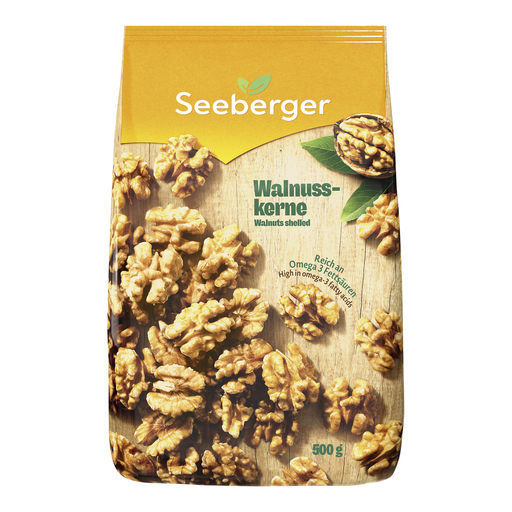
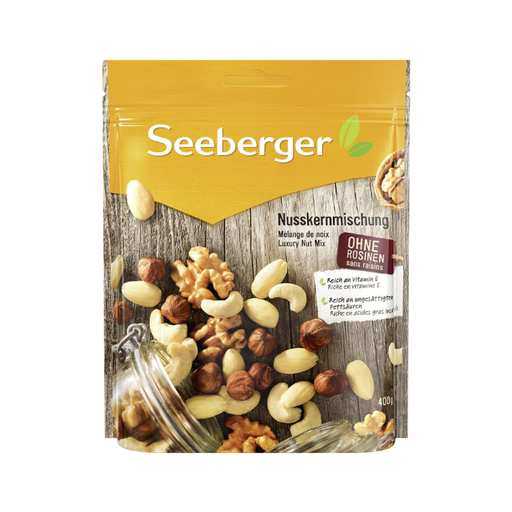
This selection includes two 500 g packs of single-nut varieties and a 400 g nut mix without raisins. For a post-workout snack, the main differences are the type of nuts, the mix and the pack size.
 No image available
For shoppers who regularly plan to snack on walnut kernels and can use up a 500 g pack.
If you have allergies, check the ingredients and allergen information on the specific pack. Store opened shelled nuts in an airtight container.
 No image available
For shoppers who would prefer whole almonds rather than a nut mix for their snack.
500 g pack. If you have allergies, check the pack labelling and plan how you’ll store the opened pack.
 No image available
For shoppers who prefer a mix without raisins instead of a single type of nut.
400 g pack. Check the pack to see which types of nuts it contains, which allergens are highlighted and how to store it once opened.
There’s no one-size-fits-all answer: it depends on what you want your snack as a whole to contain. Compare the nutritional information for the nuts per 100 g with your planned serving size, and factor in the other parts of your snack.
A 500 g pack is a good fit if you eat nuts regularly and can store the opened pack safely. For opened packs of shelled nuts, the Verbraucherzentrale recommends an airtight container in the fridge.
As the Verbraucherzentrale and Federal Centre for Nutrition explain, opened packs of shelled or chopped nuts should be sealed in an airtight container and kept in the fridge if possible. Don’t eat nuts that are mouldy, infested with pests or smell rancid.
The European Food Safety Authority notes that nuts and peanuts must be labelled as allergens in the EU when used as ingredients. If you have an allergy, read the ingredients and allergen information on the specific pack. A voluntary ‘may contain’ warning doesn’t mean that traces are definitely present.