
Lieferung heute & morgen

Qualitätsgarantie

Willkommens-Angebote freischalten: KOSTENLOSE Lieferung | Bis zu 80 % RABATT | Kostenlose 30-Tage-JoyPlus-Testphase
App herunterladen
A bulk pack of cereal bars can make it easier to keep supplies for the family, office or days out. At the same time, it is easy to assume that every bar containing oats or cereals is automatically a balanced snack. However, pack size, ingredients, nutritional values and allergens are the key factors when choosing the right product.
A cereal bar multipack may look inexpensive at first glance. So do not compare only the total price. Also check:
For example, a pack containing 24 bars of 40 g each contains 960 g. Other bulk packs may contain 1,200 g, even though the number of bars appears similar. Comparing the price per 100 g provides a more reliable basis.
A cereal bar can contain oats or grains and still have comparatively high levels of sugar or chocolate. The complete ingredients list is what matters. Ingredients are generally listed in descending order by weight. If glucose syrup, sugar or chocolate appear near the beginning, they make up more of the recipe than a wholegrain ingredient listed further down.
Sugar-free cereal bars should also be checked carefully. “No added sugar” does not necessarily mean “sugar-free”: some products contain naturally occurring sugars or sweeteners such as maltitol. Consuming larger quantities of sweeteners may also have a laxative effect. Follow the information provided on the packaging.
An oat bar is not automatically vegan, gluten-free or high in protein. It may contain milk chocolate, whey powder, honey, wheat or barley malt. Even with vegan cereal bars, it is worth checking the ingredients and allergen information, as traces of milk, nuts or peanuts may be present.
For everyday household supplies, large boxes containing individually wrapped bars are a practical choice. Individual packaging protects the product during transport and makes distribution easier in the office or at school. Smaller formats such as 18.5 or 20 g may be suitable for short breaks, while 40 or 50 g bars provide a larger portion.
Pay attention to the actual quantity. “24 x 40 g” and “24 x 50 g” indicate different total weights. For cereal bars for days out, sturdy packaging and storage at a suitable temperature are also important. Products containing chocolate should be kept in a cool, dry place.
Pay particular attention to:
Depending on the recipe, a muesli chocolate bar may contain considerably more chocolate, sugar and fat than an uncoated oat bar. This is not a quality judgement, but a factual distinction for different preferences and uses.
Comparing products per 100 g makes different pack sizes easier to assess on a consistent basis. For everyday use, the value per bar is also helpful. For the products below, for example, the stated energy values range from 192 kcal per 100 g for Corny Haferkraft Zero Peanut Butter to 423 kcal per 100 g for Corny Big Strawberry & White Chocolate.
With protein bars, check the actual protein content. According to the product information, Corny Protein Crunchy Vanilla & White Choc Flavour contains 30 g of protein per 100 g. The product name alone is therefore less informative than the nutrition table.
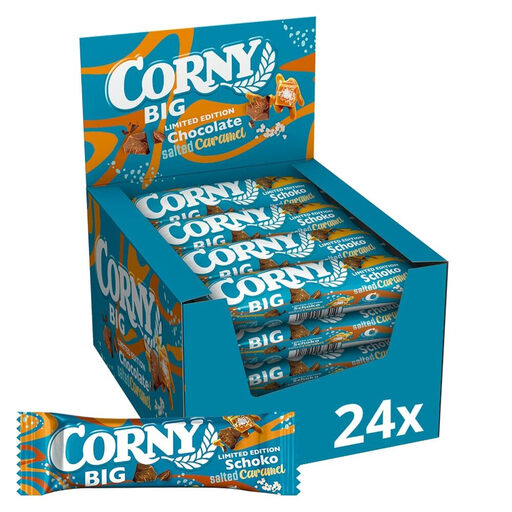
Why this product suits this profile: The stock-up box contains 24 individually wrapped bars of 40 g each, weighing 960 g in total. This makes it suitable for households, offices or regular breaks.
The precise number of bars and individual weight make it easier to compare with other bulk packs. The ingredients and allergen information indicate gluten and milk, as well as possible traces of peanuts and nuts.
24 bars, 960 g total weight, milk chocolate at 20% and 5.0 g of protein per 100 g according to the product information.
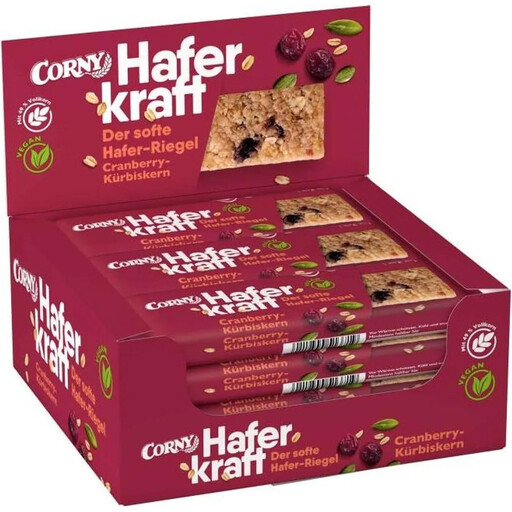
Why this product suits this profile: According to the product description, the recipe is vegan and contains 48% wholegrain oats, cranberries and pumpkin seeds. The lack of a chocolate coating can be practical for days out.
The vegan claim is supported by a detailed ingredients and allergen list. However, possible traces of milk, nuts and peanuts are still stated.
12 bars of 50 g each, 600 g total weight, 0.17 g of salt and 24.7 g of sugar per 100 g according to the product information.

Why this product suits this profile: This 12-pack is aimed at shoppers looking for a vegan recipe and low sugar content in the nutrition table. Each bar weighs 50 g.
The “no added sugar” claim is accompanied by information about naturally occurring sugars. Maltitol is included as a sweetener; if you have an intolerance, the packaging information is decisive.
49% wholegrain oats, 1.2 g of sugar and 192 kcal per 100 g according to the product information; contains peanuts and oats.

Why this product suits this profile: The pack contains 12 portions of 45 g each. According to the product information, each bar provides 30 g of protein per 100 g and 3.2 g of sugar per 100 g.
The advertised protein content can be checked directly in the nutrition table. The ingredients list also indicates milk, soya, wheat, barley and other possible allergens.
30 g of protein, 394 kcal and 34 g of polyols per 100 g according to the product information; palm-oil-free according to the product description.
We have put together a complete, regularly updated list of products that fully meet these strict selection criteria and the safety regulations applicable in the EU.
Cereal bars should generally be stored in a cool, dry place and protected from heat and moisture. With chocolate coatings, heat can alter the texture and appearance. You will find the best-before date on the relevant packaging. Once an individual wrapper has been opened, the bar should be eaten promptly.
For families and offices, a box of individually portioned bars is a practical choice. For hiking, cycling or warm days, varieties without a chocolate coating may be more convenient. If you have allergies or follow a particular diet, always rely on the current packaging information, as recipes may change.
That depends on how much you consume. For a single household, 8 to 12 bars may be sufficient. Families, offices or regular consumers are more likely to benefit from 24 bars. The key consideration is whether the pack will be used up before the best-before date.
Cereal bars are portioned snacks and can be a convenient snack between meals when you are out and about. They do not automatically replace a balanced meal. Compare the energy content, sugar, fat, protein and fibre according to your personal needs.
Divide the total price by the number of bars and also compare the price per 100 g. Take the individual weight, ingredients, pack size and preferred flavour into account. This allows you to compare a cereal bar box, a cereal bar multipack and smaller portion packs objectively.