People with coeliac disease looking for butter biscuits
A biscuit option labelled gluten-free is their first priority. Only then does it make sense to compare sugar content and portion size.


If you have coeliac disease, the specific pack should be labelled gluten-free before you consider a butter biscuit; a sugar-reduction claim alone is not enough. Then compare the sugar content per 100 g: LEIBNIZ Butterkeks –30 % Zucker contains wheat flour, while the gluten-free butter biscuits considered here are not labelled as reduced in sugar.
A biscuit option labelled gluten-free is their first priority. Only then does it make sense to compare sugar content and portion size.
They need to check two details separately: the gluten-free label on the current pack and the sugar content in the nutritional information. A claim about less sugar does not replace the gluten-free label.
Availability in your local shop and the current packaging also matter. An online range alone does not tell you which pack is available in store.
If you have coeliac disease, first check the gluten-free label and ingredients on the specific pack. Then compare the sugar content per 100 g and any other features that matter to your household.
| What matters | What to check when buying | Who it matters to |
|---|---|---|
| Gluten-free suitability for coeliac disease | The gluten-free label and ingredients list on the current pack; if it contains oats, check that they are labelled gluten-free. | If I’m buying biscuits because I have coeliac disease, I need to confirm they’re suitable before comparing sugar content. This would be the main concern for around 50% of consumers. |
| Sugar content | Sugar in g per 100 g for comparable types of biscuit, and any sugar-reduction claim for that specific product. | I want to compare sugar content within the gluten-free selection without treating a lower individual figure as proof of a stated sugar reduction. This would be the top priority for around 30% of consumers. |
| Buying again and ingredients | Availability in your area, portion size, and the ingredients, allergen information and trace warnings on the pack. | The household needs to be able to buy the right biscuit again, and it must meet any other ingredient requirements too. For around 20% of consumers, this would be the most important consideration after checking that the product is gluten-free. |
According to the manufacturer, LEIBNIZ Butterkeks –30 % Zucker contains wheat flour. Its sugar claim does not make it a gluten-free option for people with coeliac disease.
First check the gluten-free label on the specific pack, then compare the nutritional information.
Schär lists 16 g of sugar per 100 g for its gluten-free butter biscuit, while LEIBNIZ lists 24 g per 100 g for its gluten-free Minis. Comparing these two products does not prove that either has a stated sugar reduction.
Use the figures to compare products, and only treat “reduced in sugar” as a product claim if it is stated for the biscuit in question.
Gluten-free does not answer every question about a recipe: Schär also lists milk and egg in its butter biscuit. Trace warnings or sweeteners may also be relevant for other types of biscuit.
Check the ingredients list, allergen information and any relevant consumption advice on the pack to make sure it meets your needs.
REWE points out that products are not available in every store. The pack you actually buy is the definitive source for ingredients and nutritional information.
Check availability in your area and read the current packaging before buying.
Two different product lines are relevant here: Butterkeks –30 % Zucker and Minis gluten- & laktosefrei.
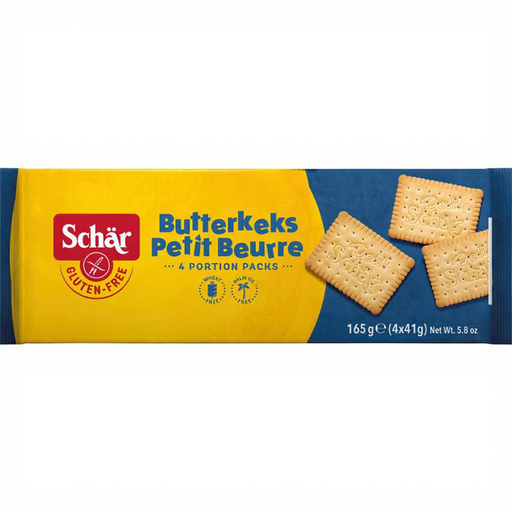
Schär offers a butter biscuit described as gluten-free and wheat-free.
Alnavit is an alternative if you’re open to a gluten-free oat biscuit rather than a butter biscuit.
REWE’s gluten-free range can help you find different types of biscuit; the online selection includes LEIBNIZ Minis and Schär butter biscuits, among others.
This Schär butter biscuit is part of the selection of butter biscuits labelled gluten-free. If you’re also watching your sugar intake, compare the nutritional information on the current pack; this does not mean the product is reduced in sugar.
 No image available
A butter biscuit described as gluten-free, suitable for consideration if you have coeliac disease; check the label on the current pack to confirm.
Schär’s product information lists 16 g of sugar per 100 g, with milk and egg as ingredients. The sugar content alone does not indicate a sugar reduction.
No. According to LEIBNIZ, this product contains wheat flour. The stated sugar reduction does not mean that the butter biscuit is gluten-free.
No. Schär lists 16 g of sugar per 100 g for its gluten-free butter biscuit, while LEIBNIZ lists 24 g per 100 g for its gluten-free Minis. These figures alone do not amount to a sugar-reduction claim for either product.
Not necessarily. As Lebensmittelverband Deutschland explains, a statement about sugar content alone does not tell you the energy value of the whole food. Compare the relevant nutritional information to check.
The German Coeliac Society describes its “Einkaufen mit Zöliakie” database as a supplement to allergen labelling for products sold in Germany. Still check the current pack; a product with the same name sold in another country may have a different recipe.