For shoppers with a strict sugar-free requirement
The sugar content per 100 g is key. Ingredients and information about sweeteners also matter when choosing, because ‘sugar-free’ doesn’t tell you whether a biscuit will suit your dietary needs.


If ‘sugar-free’ is a firm requirement for your premium range, Coppenrath Feingebäck’s sugar-free butter biscuit could be an option: the manufacturer states that it contains less than 0.5 g of sugar per 100 g. You should also check the sweeteners and ingredients. If organic credentials take priority, the verified dmBio spelt butter biscuit offers another option, but it contains 20 g of sugar per 100 g, so it isn’t sugar-free. Leibniz Butter Biscuits Less Sugar doesn’t meet this requirement either, with 12 g of sugar per 100 g.
The sugar content per 100 g is key. Ingredients and information about sweeteners also matter when choosing, because ‘sugar-free’ doesn’t tell you whether a biscuit will suit your dietary needs.
Look for clear proof of organic certification. Check the sugar content separately: the dmBio spelt butter biscuit we reviewed contains 20 g of sugar per 100 g.
A butter biscuit with less sugar could be a good fit if it doesn’t need to be sugar-free. The Leibniz Butter Biscuits Less Sugar we reviewed still contain 12 g of sugar per 100 g.
First, decide whether being sugar-free is a firm requirement for your range, or whether organic credentials or a lower sugar content take priority. Then compare the ingredients, allergens and labelling on the specific pack.
| Criteria | What to check before buying | Who it matters to |
|---|---|---|
| Strictly sugar-free | Check the sugar content per 100 g, as well as the ingredients and any information about sweeteners. Lebensmittelklarheit states that ‘sugar-free’ means no more than 0.5 g of sugar per 100 g. | If I specifically want to add a sugar-free butter biscuit to my range, ‘less sugar’ isn’t enough. This strict requirement takes priority for around 42% of shoppers. |
| Organic credentials and ingredients | Check the organic certification, inspection body and ingredients; assess the sugar content separately. | If organic credentials are the deciding factor, I want to see proof on the specific product. Organic comes first for around 33% of shoppers. |
| Less sugar | Compare the sugar content per 100 g and don’t mistake a reduction claim for ‘sugar-free’. | I’m happy with a butter biscuit that contains less sugar, even if it isn’t sugar-free. Around 25% of shoppers put this reduction first. |
According to REWE, the Leibniz Butter Biscuits Less Sugar we reviewed contain 12 g of sugar per 100 g. Lebensmittelklarheit, by contrast, states that ‘sugar-free’ means no more than 0.5 g per 100 g.
If you have a strict requirement, check the sugar content in the nutritional information rather than relying on the claim on the front of the pack.
For its sugar-free butter biscuit, Coppenrath Feingebäck states that it contains 26 g of polyols per 100 g and warns that excessive consumption may have a laxative effect.
Check the sweeteners and any related information on the pack too. The sugar content alone doesn’t tell you about all the nutritional values or how well the product may suit you.
The dmBio spelt butter biscuit carries organic certification from inspection body DE-ÖKO-001, but contains 20 g of sugar per 100 g.
Treat organic certification and sugar content as separate selection criteria.
The sugar-free Coppenrath butter biscuit we reviewed contains wheat and soya lecithin; the dmBio spelt butter biscuit contains spelt and milk ingredients.
Check the current ingredients and allergen information for each specific product, and make it easy for shoppers to find.
The butter biscuit we reviewed is an option if sugar content is your main selection criterion.
The spelt butter biscuit we reviewed is a useful organic comparison, but it isn’t a sugar-free option.
The Butter Biscuits Less Sugar we reviewed could suit a range without a strict sugar-free requirement.
This selection includes sugar-free Viennese sand ring biscuits as an alternative bake, as well as butter biscuits with less sugar or organic spelt. Sand rings aren’t classic butter biscuits, and the three products suit different preferences.
 Image unavailable
A sugar-free bake made with butter, but these sand rings aren’t a substitute for classic butter biscuits. Before adding them to your range, check the nutritional information, sweeteners and any required organic certification on the specific pack.
 Image unavailable
For a range where less sugar is enough and sugar-free isn’t a requirement. The reduction claim in the product name doesn’t mean sugar-free; check the sugar content per 100 g and the ingredients on the pack before choosing.
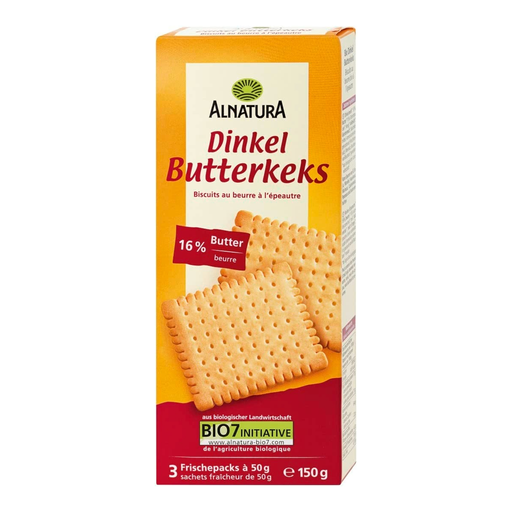 Image unavailable
For a range where organic credentials matter more than being sugar-free. Check the organic certification, sugar content and current allergen information separately on the pack.
Lebensmittelklarheit states that ‘sugar-free’ means no more than 0.5 g of sugar per 100 g. Check the nutritional information for the specific product, and if it contains sweeteners, check how these are labelled too.
No. The Leibniz Butter Biscuits Less Sugar described by REWE contain 12 g of sugar per 100 g, which is above the level Lebensmittelklarheit gives for ‘sugar-free’.
The Verbraucherzentrale generally doesn’t consider products with sweeteners and sugar substitutes suitable alternatives for children. So don’t base your choice on a ‘sugar-free’ claim alone; check the ingredients and portion size too.
The butter biscuits described here don’t demonstrate that combination: Coppenrath Feingebäck states that its sugar-free butter biscuit contains less than 0.5 g of sugar per 100 g, while the dmBio spelt butter biscuit we reviewed is labelled organic but contains 20 g of sugar per 100 g. If you need both qualities, check that both are stated on the same specific pack.