Keeping an eye on nutrition during coffee breaks
If you regularly have biscuits with your morning coffee, you can compare sugar, energy and saturated fat using the nutritional information per 100 g. The portion you actually eat matters just as much.


Classic butter biscuits are a familiar choice for your morning coffee break. If you’re interested in wholegrain or lower-sugar options, though, check the information for the specific product. The name ‘Digestive’ alone tells you nothing about its nutritional values. If you need to avoid gluten or particular allergens, check the ingredients and ‘may contain’ information on the pack.
If you regularly have biscuits with your morning coffee, you can compare sugar, energy and saturated fat using the nutritional information per 100 g. The portion you actually eat matters just as much.
For this choice, look for a stated wholegrain content or the fibre value of the specific biscuit. Wholegrain content alone doesn’t tell you how much sugar, fat or salt the product contains.
If you need to avoid ingredients such as gluten, milk or soya, check the information for the exact variant. ‘May contain’ warnings for egg or lupin can also be important when choosing.
First, decide what matters most for your coffee break: nutritional values, a stated wholegrain recipe, suitable allergen information or a multi-pack that’s easy to portion. Then compare the relevant details on the specific pack.
| Criterion | What to check when buying | Who it matters to |
|---|---|---|
| Sugar and energy | Compare sugar and energy per 100 g with your planned portion; don’t assume that a claim such as ‘less sugar’ means a low energy value. | If biscuits are a regular part of my morning coffee, I don’t want to judge their sugar and energy content by the front of the pack alone. Around 36% of consumers put this comparison first. |
| Wholegrain and fibre | Check the stated wholegrain content and fibre per 100 g; also take sugar, fat and salt into account. | A clearly stated wholegrain recipe matters more to me than the word ‘Digestive’ in the name. Around 29% of consumers put this requirement first. |
| Ingredients and allergens | Check the current ingredients list and information about gluten, milk, soya, egg, lupin and possible traces against your own requirements. | If I need to avoid particular ingredients, the labelling for each variant determines whether it’s suitable for me. This is the top priority for around 21% of consumers. |
| Pack size and storage | Check the pack size and whether it contains individually wrapped portions; check the ingredients and nutritional values on the pack you’re actually buying. | For regular coffee breaks, I want to choose a pack whose size and portions suit how much I get through. Around 14% of consumers look at this first. |
A wholegrain content doesn’t rule out higher fat or salt levels. For McVitie's Digestive The Original, REWE lists 16% wholemeal wheat flour, as well as 21.3 g of fat and 1.3 g of salt per 100 g.
Alongside wholegrain and fibre, check sugar, fat, saturated fat and salt per 100 g.
For the LEIBNIZ Butter Biscuit with ‘30% less sugar’, ALDI SÜD lists 12 g of sugar and 422 kcal per 100 g. The sugar reduction doesn’t tell you the biscuit’s overall nutritional value.
Compare the nutritional information per 100 g and consider how much you plan to eat.
According to REWE, Schär Digestive Choc is gluten- and wheat-free, but contains milk chocolate and soya. Schär Landtaler Digestive may contain traces of lupin and egg.
Check the ingredients and ‘may contain’ information on the pack of each variant, rather than assuming that its product category guarantees other qualities.
EDEKA points out that online information may differ from the packaging. ALDI SÜD says that its BISCOTTO Butter Biscuit may come from different suppliers.
Use product pages to narrow down your options, then read the ingredients and nutritional information on the pack you’re actually buying before making your choice.
As well as classic butter biscuits, there’s a variant labelled ‘30% less sugar’. This gives you a clear starting point if you want to compare sugar levels within this biscuit range.
Digestive The Original is an option if you’re looking for a stated wholemeal wheat content and want to compare the nutritional values of the specific product.
With Schär’s Digestive biscuits, the exact variant matters: the information about milk and other ingredients differs between Landtaler Digestive and Digestive Choc.
The 400 g pack of butter biscuits is a classic option if you’re not looking for a special wholegrain or gluten-free recipe.
EDEKA lists these butter biscuits in a 400 g pack containing two individually wrapped 200 g portions.
These two LEIBNIZ butter biscuits offer different options for your coffee break: one variant has a stated sugar reduction, while the other has a stated wholemeal wheat content. The wholegrain variant is not described as a Digestive biscuit.
 No image available
This variant is an option for your coffee break if you’re looking for a butter biscuit with a stated sugar reduction. The product description lists 12 g of sugar, 9.6 g of fat and 422 kcal per 100 g; ‘less sugar’ doesn’t mean a low energy value.
According to the product description, the biscuits contain wheat, egg and milk. Check these details against the labelling on the pack being offered.
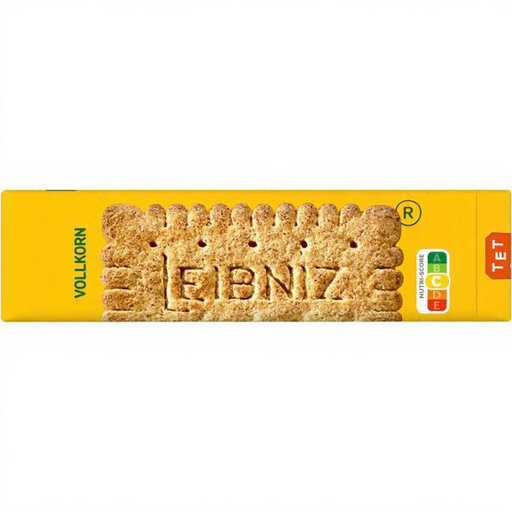 No image available
If a stated wholegrain content matters to you, the product description lists 67% wholemeal wheat flour. It also lists 20 g of sugar and 447 kcal per 100 g; the wholegrain content alone doesn’t tell you what to make of these nutritional values.
According to the product description, this variant contains wheat and milk; it may contain egg. The listed ingredients don’t include butter, despite its being in the product name. If butter is important to your choice, check the ingredients on the specific pack.
You can’t infer any effect on digestion from the name alone. If you’re choosing a Digestive biscuit, compare the specific ingredients, fibre and other nutritional values rather than relying on the name.
No. A sugar-reduction claim doesn’t mean the product has a low energy value. For the LEIBNIZ butter biscuit labelled this way, ALDI SÜD lists 12 g of sugar and 422 kcal per 100 g, so compare both figures on the pack.
Not necessarily: according to REWE, Schär Digestive Choc is gluten- and wheat-free, but contains milk chocolate. Schär Landtaler Digestive is described as gluten- and lactose-free. The ingredients and ‘may contain’ information for the specific variant are what matter.
Compare the ingredients and labelled allergens, as well as sugar, fat, saturated fat and energy per 100 g. A stated wholegrain content or fibre value can help with this particular choice; for your coffee break, you can also relate the nutritional values to the portion you plan to eat.