
Lieferung heute & morgen

Qualitätsgarantie

Willkommens-Angebote freischalten: KOSTENLOSE Lieferung | Bis zu 80 % RABATT | Kostenlose 30-Tage-JoyPlus-Testphase
App herunterladen
A portable wallbox promises flexibility: fast charging at home without a permanent installation, at a holiday home, or at a friend's house. However, the market is crowded and full of products whose marketing promises often don't hold up in practice. As a Joybuy Product Recommendation Officer, I'll help you identify the crucial features and make an informed decision based on facts, not advertising slogans.
Before you invest, you should be aware of the typical traps that can lead to disappointment and unnecessary expenses.
To avoid a poor investment, focus on these three objective criteria.
The maximum charging performance is directly dependent on the power connection. An 11kW portable wallbox requires a red CEE 16A socket (three-phase/industrial). This is the standard for fast AC charging in the private sector.
An 11kW Type 2 charging cable is the vehicle-side standard in Europe and is compatible with almost all modern electric cars and plug-in hybrids.
A high-quality smart EV charging cable is more than just a cable with a plug. It is a protective device between the power grid and your vehicle. Look for the following features:
A portable EV charger with an app is useful when it solves specific problems. These include:
Here are three recommendations tailored to different user profiles and their requirements.
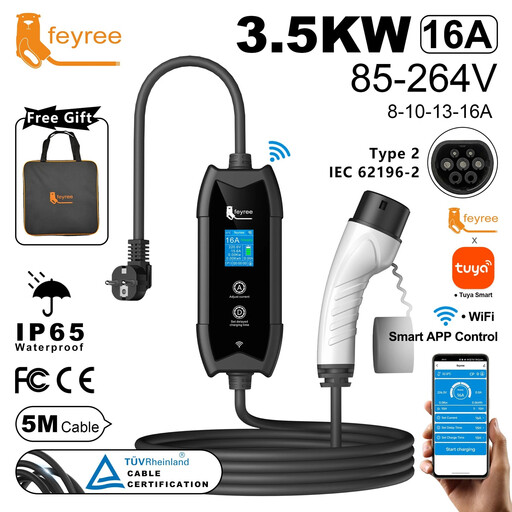
Why This Fits Their Persona: Ideal for plug-in hybrid owners or as a reliable secondary device for on-the-go charging. It offers the most important smart features for charging at a household or blue CEE socket without breaking the bank.
The app focuses on the useful function of scheduled charging to save on electricity costs, avoiding superfluous gimmicks.
Offers app control and adjustable charging current (8A-16A) at a very accessible price point. The LCD screen displays all key charging data directly on the unit.
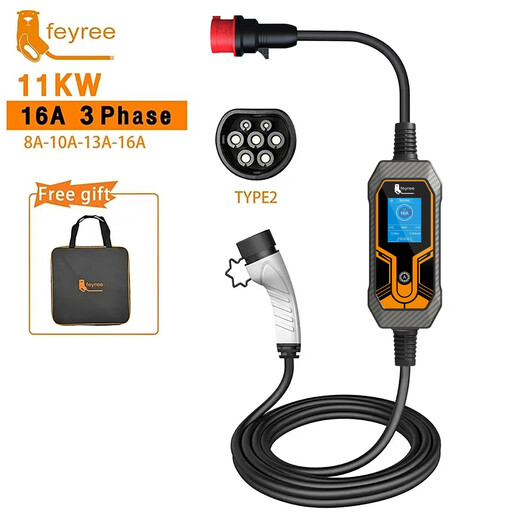
Why This Fits Their Persona: Perfect for EV drivers who have a CEE 16A socket at home and are looking for a straightforward, fast, and safe charging solution. This device is a classic wallbox for the CEE socket.
This model deliberately omits app connectivity, focusing on its core function: reliable 11 kW charging. It delivers full power without the complexity of smart features.
Robust construction from ABS material and comprehensive protection features (overcurrent, overvoltage, overheating). The LCD screen provides all necessary charging information at a glance.
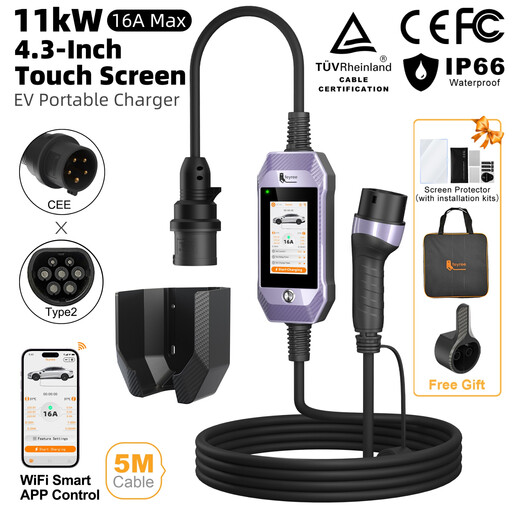
Why This Fits Their Persona: For users who want maximum control and data analysis. Ideal for high-mileage drivers and tech enthusiasts who want to optimise and track charging sessions in detail, whether at home or on the road.
The smart features here are not a gimmick. The app allows for detailed charge scheduling and logging, enabling true cost optimisation. The touchscreen also offers intuitive operation directly on the device.
A combination of 11 kW power, comprehensive app control (Tuya Smart App), a touchscreen interface, and detailed charging history. Dual temperature monitoring and the integrated RCD (Type B) provide a high level of safety.
We have compiled a complete, up-to-date list of products that fully meet these strict selection criteria and relevant safety regulations.
Can I use a portable 11kW wallbox with a standard household socket?
No, to achieve the full charging power of 11 kW, a three-phase CEE 16A industrial socket (red socket) is mandatory. On a standard household socket (Schuko), the charging power is limited to about 2.3 kW to prevent overloading the circuit. Many portable chargers come with adapters, but the maximum power is always determined by the socket.
Is a portable wallbox as safe as a permanently installed one?
Yes, provided you choose a high-quality product. A good portable wallbox has the same integrated safety mechanisms as a permanently installed one, including residual current protection (RCD Type A + 6mA DC), overheating protection, and overcurrent protection. Safety also depends significantly on the quality of the socket it is connected to, which should be installed and checked by a qualified electrician.
What is the lifespan of a portable charger?
The lifespan heavily depends on the build quality and how it is handled. Models with a high IP rating (e.g., IP66), robust housings, and high-quality cables are designed for long-term use. To maximise its lifespan, the cable should not be bent or driven over, and the control box should be protected from extreme heat and mechanical stress. With proper use, such a device can function reliably for many years.