
Lieferung heute & morgen

Qualitätsgarantie

Willkommens-Angebote freischalten: KOSTENLOSE Lieferung | Bis zu 80 % RABATT | Kostenlose 30-Tage-JoyPlus-Testphase
App herunterladen
An A5 notebook is compact enough for a rucksack, work bag or desk, while still offering plenty of space for lecture notes, to-do lists, journaling or sketches. The choice may seem simple at first glance. However, differences in paper, binding and features determine whether the notebook remains practical in everyday use.
Decorative notebooks or those marketed as “high quality” can present some typical purchasing pitfalls:
Paper weight is given in grams per square metre (g/m²). A lined notebook with 100 g/m² paper has a different paper quality from a model with 70 or 80 g/m². Many types of paper are suitable for ballpoint pens and pencils. With fountain pens, rollerball pens or wet markers, buyers should look more closely.
When choosing a fountain-pen-friendly notebook, the following details are relevant:
The LAMY B3 product description specifies 90 g/m² paper and suitability for various writing instruments, including fountain pens. This is a specific product detail, but it does not replace an individual writing test using your own ink.
An A5 hardcover notebook protects its pages better in bags and is suitable for long-term notes. The rigid cover can also provide a more stable writing surface. However, the model is usually less flexible and may be slightly heavier.
An A5 softcover notebook is easier to carry and fits more readily around other items in a bag. This style can be practical for frequent journeys between school, university and work. A durable binding and a cover that does not crease easily are important.
With both versions, it is worth checking the binding. A thread-sewn design can help the notebook lie flat when open. This is particularly relevant for a journaling notebook if you want to write or create designs across two-page spreads.
A notebook with an elastic closure stays together more securely when closed. This can prevent loose sheets from falling out or pages from becoming bent in your bag. A notebook with a bookmark makes it easier to switch between several projects or entries.
Useful additional features may include:
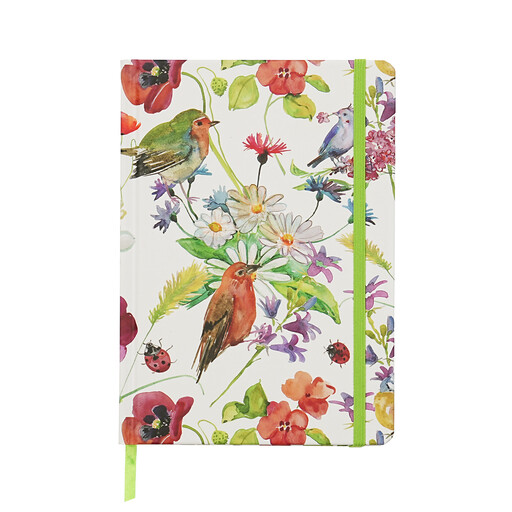
Why this product suits the profile: This lined notebook offers a classic A5 format for school, university, the office and everyday notes. The hard cover is designed for regular use without requiring additional organisational systems.
The specifications clearly state 192 pages or 96 sheets, 100 g/m² offset paper, a ribbon bookmark and an elastic closure. This makes the key purchasing details transparent.
The product description lists a hardcover, lined cream paper, 192 pages, a ribbon bookmark and an elastic closure.
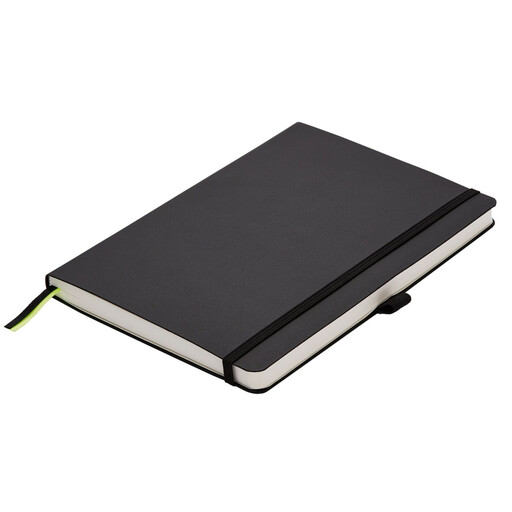
Why this product suits the profile: This model combines a flexible soft cover with features for organised work notes. It is suitable for professionals, writers and anyone who regularly carries their notebook with them.
The features are clearly specified: 192 pages, 90 g/m² paper, a pen loop, two ribbon bookmarks, a paper pocket and an elastic closure. This makes it easier to check the details before buying.
According to the product details, it features a flexible cover, ivory paper, thread-sewn binding and several organisational features.
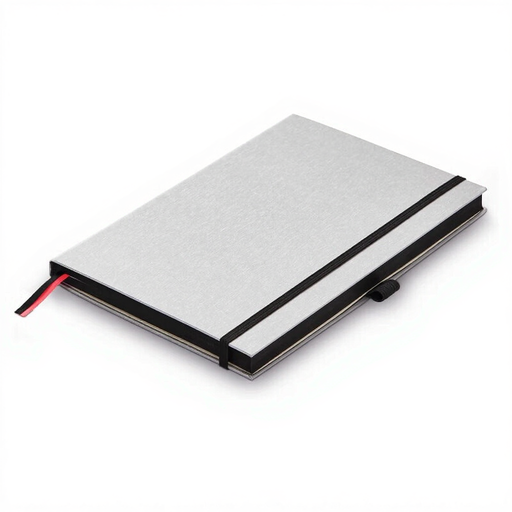
Why this product suits the profile: This plain notebook is aimed at creatives, artists, mind-map users and journaling enthusiasts who do not want to be restricted by lines.
The product description explicitly states that the pages are plain. This makes it clear before purchase that there are no lines for taking notes.
The listed product features include a black hardcover, approximately 90 g/m² chamois-coloured paper and thread-sewn binding.
A lined notebook supports structured notes, minutes and longer texts. For pupils, students and professionals, lined paper is usually the straightforward choice. Anyone using an A5 journal for reflection and daily entries may also benefit from lines.
A plain notebook offers more freedom for drawings, diagrams, mind maps and typographic designs. For writers, illustrators and creatives, it makes sense when text and sketches need to share the same page. Before buying, you should be clear about how you plan to use it, as missing lines cannot be added afterwards.
A notebook as a gift should have a design that suits the recipient without features that are too specialised. A hardcover with cream-coloured paper, a ribbon bookmark and an elastic closure is suitable for many writing situations. Floral fabric covers with embossing or foil details can be a decorative option. Clear information about the format, page count and paper remains important.
For everyday use, buyers should also bear the following in mind:
We have put together a complete, regularly updated list of products that fully meet these strict selection criteria and the safety regulations applicable in the EU.
The standard A5 format measures approximately 14.8 × 21 cm. Depending on the manufacturer, the external dimensions may vary slightly. A model measuring 14.5 × 21 cm is also within the usual practical range, but this should be taken into account when choosing bags or covers.
That depends on how you intend to use it. Fewer pages are sufficient for brief notes and appointments. A notebook for university, work or journaling can be used for longer with 192 pages. You should check whether the stated figure refers to pages or sheets: 96 sheets equal 192 pages.
Not all paper is equally suitable. Details such as 90 g/m², 100 g/m² or “ink-resistant” provide an initial indication. The specific combination of fountain pen and ink affects the result. You should therefore check the product description and, with more delicate paper, test an inconspicuous page first.