
Lieferung heute & morgen

Qualitätsgarantie

Willkommens-Angebote freischalten: KOSTENLOSE Lieferung | Bis zu 80 % RABATT | Kostenlose 30-Tage-JoyPlus-Testphase
App herunterladen
A cake tin should suit not only your recipe but also your regular baking routine. If you focus solely on a non-stick coating or a low price when buying, you often overlook important details: Does the diameter match the recipe quantity? Is the clasp actually leak-proof? Can the tin go in the dishwasher? And how delicate is the surface in everyday use?
As Joybuy's Product Recommendation Officer, I filter product specifications according to practical criteria. The selection below helps home bakers avoid typical buying mistakes and find a cake tin for their particular purpose.
A 20 cm cake tin is suitable for smaller households, compact cakes and recipes with reduced ingredient amounts. A 26 cm cake tin is a common everyday size. For family celebrations or larger cakes, a 28 cm cake tin or 30 cm cake tin may be more appropriate.
Important: the diameter alone tells you little about the capacity. A deep springform tin holds significantly more batter than a shallow round cake tin with the same diameter. Before buying, you should therefore compare diameter, height and volume.
A cake tin with non-stick coating can make releasing the cake easier. However, the coating only remains functional if the care instructions are followed. Some models are not dishwasher-safe, while others only allow the base to be cleaned in the dishwasher.
Metal knives, sharp objects and abrasive scourers can damage the surface. If you notice visible scratches, the tin should no longer be used. A light greasing before first use may also be recommended, depending on the model.
For cheesecakes, sponge cakes with liquid batter or cake bases, a stable ring is crucial. A springform tin with a side clip and removable base makes releasing easier, but must be correctly closed before baking. For particularly runny batters, baking paper or suitable sealing may also be necessary.
Steel and carbon steel conduct heat relatively directly and are dimensionally stable if the material is sufficiently thick. Carbon steel can warp if used incorrectly; therefore, the tin should not be used on the hob or over direct heat.
A silicone cake mould is lightweight, flexible and space-saving. It can often be folded or rolled, but needs a stable support in the oven, especially with runny batter. The stated temperature range must always be checked against your own recipe. For the models mentioned here, the specifications range up to 240 °C, 250 °C or 280 °C, depending on the product.
Check before buying whether the entire tin or only the base is dishwasher-safe. Some coated metal tins should only be cleaned by hand with warm water, mild washing-up liquid and a soft sponge. Hot tins must not be placed on cold or wet surfaces. Always use oven gloves when removing them.
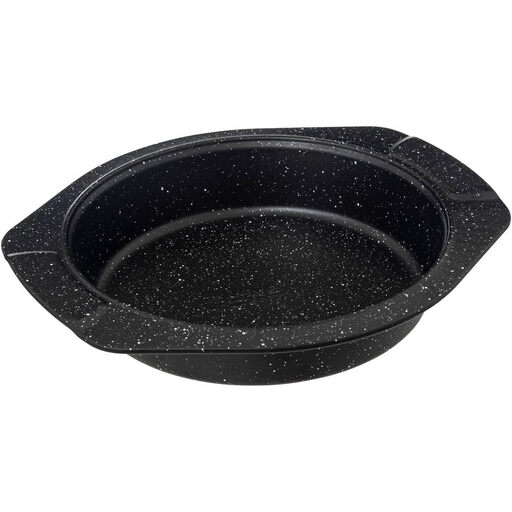
Why this product suits the profile: The common 26 cm size is suitable for many standard recipes and regular family use.
The product details explicitly state the diameter, height, volume and hand-washing requirement. This makes it easier to assess recipe size and care effort before buying.
26 cm diameter, steel construction, non-stick coating and oven suitability.
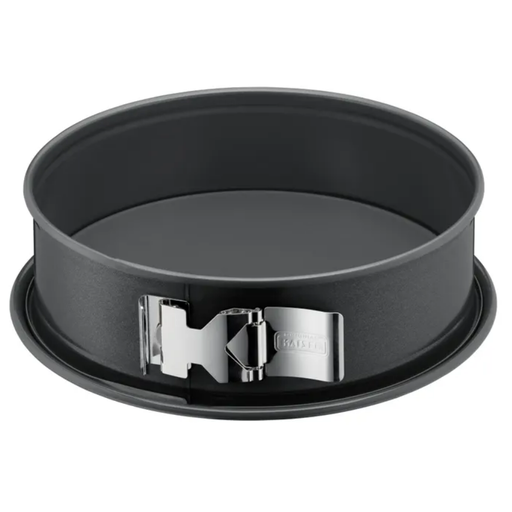
Why this product suits the profile: The 30 cm format with 4 litres capacity is designed for larger cakes, tarts and multiple portions.
The SafeClick clasp and stated leak-proof design address the common weak point of leaky springform tins. The temperature limit is 250 °C according to the product details.
Steel body, non-stick coating, leak-proof base and 10-year guarantee according to the product description.
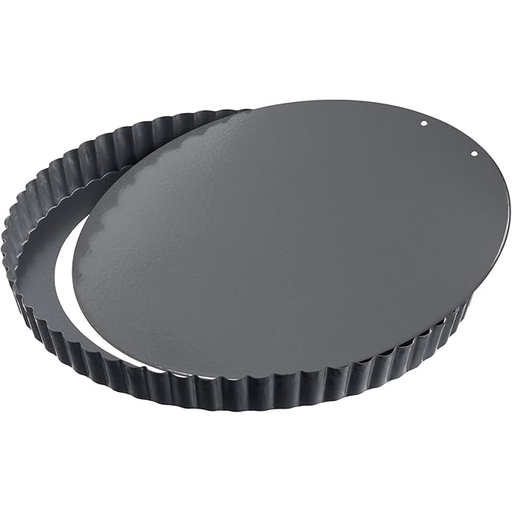
Why this product suits the profile: The quiche tin with 32 cm diameter is designed for tarts, quiches and shallow baked dishes.
The removable base makes releasing delicate bases easier. The product details also indicate hand-washing and use up to 250 °C.
32 cm diameter, removable base, enamelled base and coated steel.
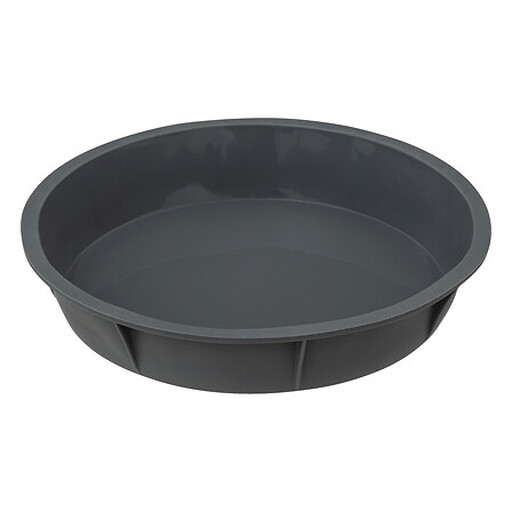
Why this product suits the profile: The flexible silicone cake mould can be stored in a space-saving way and is intended for oven and freezer use according to the product description.
The flexible mould reduces storage space requirements. Since silicone is less stable than metal when filled, it should be placed on a baking tray or rack.
30 × 30 × 6 cm, food-grade silicone, flexible storage and dishwasher suitability according to the product details.
We have compiled a complete, regularly updated list of products that fully meet these strict selection criteria and the safety regulations in force in the EU.
For many standard recipes, a round cake tin of 26 cm or a springform tin with a similar diameter is practical. A removable base and a well-sealing ring make releasing easier. Before first use, you should read the care and temperature instructions from the respective manufacturer.
The lifespan depends on material thickness, temperature, cleaning and tools used. Avoid severe temperature shocks, abrasive cleaners and sharp metal objects. If the coating is damaged, the tin should be replaced. A guarantee statement, for example 10 years on individual models, describes the conditions of the respective manufacturer and should not be equated with a general durability promise.
Both materials have different properties. Metal tins are generally dimensionally stable and conduct heat directly. Silicone cake moulds are lightweight, flexible and space-saving, but need a firm support when filling. What matters most is the recipe type, storage space, temperature range and your personal cleaning habits.