
Lieferung heute & morgen

Qualitätsgarantie

Willkommens-Angebote freischalten: KOSTENLOSE Lieferung | Bis zu 80 % RABATT | Kostenlose 30-Tage-JoyPlus-Testphase
App herunterladen
Whether you’re opening parcels, trimming cardboard, crafting, renovating or working in the kitchen, cutting tools need to suit the material and how often you use them. A craft knife for delivery boxes has different requirements to a paper trimmer for A4 documents or a pair of mitre shears for PVC profiles.
If you only focus on a low price or marketing buzzwords, you can easily end up buying something that doesn’t meet your actual needs. The criteria below will help you avoid common mistakes and choose the right product for your home, office, workshop or trade.
Paper, corrugated cardboard, film, fabric, PVC and wood all differ significantly in hardness, thickness and cutting resistance. A narrow 9 mm craft knife is handy for fine cuts and light packaging, but can reach its limits with thick corrugated cardboard or tough materials. For heavier cuts, 18 mm blades or specialist scissors are often more suitable.
A craft knife set with replacement blades can be economical if the blade format is easy to reorder. What really matters, however, is compatibility, safe storage and the blade-change mechanism. With snap-off blades, you should also check whether the individual segments break off cleanly and whether the slider locks the blade securely.
A handle that looks compact doesn’t tell you much about how it actually handles. For longer tasks, non-slip surfaces, the right handle width and controlled blade guidance are important. With scissors, you also need to consider the opening action, the distance between the finger holes and suitability for the material in question.
For light craft work, paper and thin films, 9 mm blades are often sufficient. For cardboard, carpet, foam boards or packaging materials, 18 mm blades offer more surface area and can be guided more steadily.
The term SK5 steel blades refers to a carbon tool steel. On its own, however, it is not a complete guarantee of quality. Also pay attention to blade thickness, coating, cutting edge geometry and the availability of suitable replacement blades. When changing blades, do not continue using blunt or damaged segments.
A craft knife should have a clear blade-locking mechanism. The slider must not move unintentionally during cutting. Also useful are a fully retractable blade and an end cap for safely snapping off segments.
With mitre shears or a universal cutter, a lock for storage is important. For electrical appliances such as an all-purpose slicer, you should also consider finger protection, stable feet, a safety switch and the ability to disconnect the appliance from the mains before cleaning.
A paper trimmer should match the maximum paper size. The A4 model shown is designed for formats up to 210 × 297 mm and has angle markings for 45°, 60°, 75° and 90°, among others. An integrated or fold-out cutting guide can save time on repeated trims.
For profiles, seals and soft trims, an adjustable cutting angle is crucial. According to the product description, the FLORA GUARD mitre shears cover a range from 45° to 135°. This makes them more interesting for specific fitting and adjustment work than an ordinary craft tool.
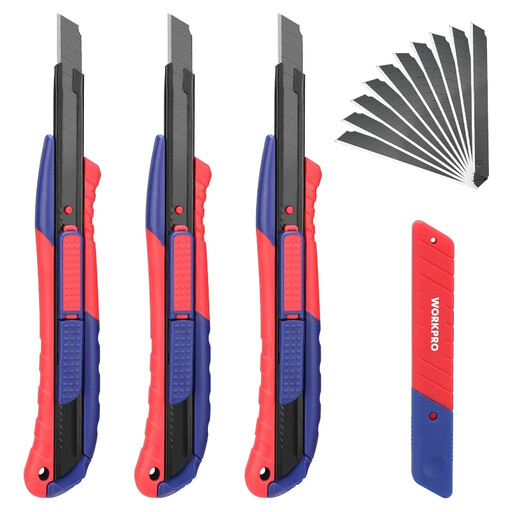
Why this product fits the profile: This set is aimed at households, offices and occasional craft projects where you need several cutters for parcels, cardboard and paper.
The product details specify a standard 9 mm size, an ABS/TPR handle and ten included SK5 replacement blades. This makes the format and refills clearer to assess than with an unspecified set.
Three cutters, 10 replacement blades and a non-slip handle for everyday cutting tasks.
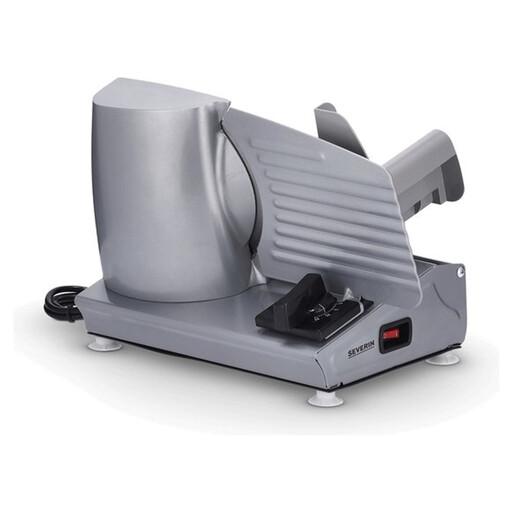
Why this product fits the profile: For households that want to slice bread, cheese, cold cuts or vegetables with an adjustable cutting thickness, this electric all-purpose slicer offers a clearly defined kitchen purpose.
The details mention finger protection, a safety switch, non-slip suction feet and an adjustable cutting thickness from 0 to 15 mm. This makes it easier to check safety-related features.
180-watt motor, two removable stainless steel blades and cutting thickness adjustment up to 15 mm.
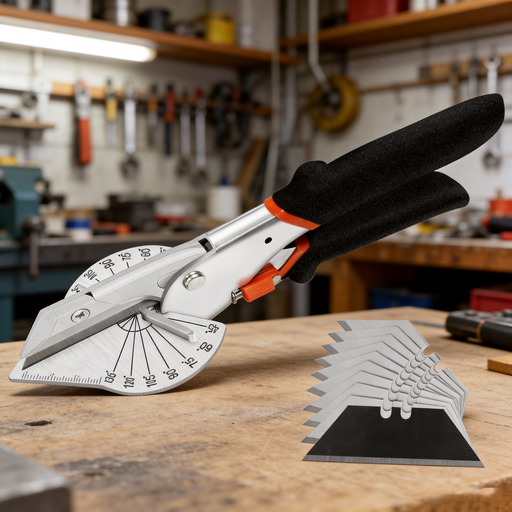
Why this product fits the profile: These mitre shears are designed for angled cuts on soft materials such as PVC, rubber, plastic and soft wood.
The adjustable range from 45° to 135° and the engraved scale make the intended use more concrete. Ten replacement blades are included according to the product description.
SK5 blades, aluminium handle with non-slip PPC cover and angle adjustment for repeatable cuts.
We have put together a complete, regularly updated list of products that fully meet these strict selection criteria and the safety regulations in force in the EU.
9 mm blades are generally suitable for paper, films, thin cardboard and precise craft work. 18 mm blades offer more stability with thicker cardboard, packaging materials and similar tasks. The material and cutting length should always match the blade.
It is not possible to give a reliable fixed lifespan. It depends on the material, volume of cuts, pressure and the surface underneath. Change a blade as soon as the cut requires more force, becomes uneven or the tool drifts from the intended line.
A paper trimmer is practical for many straight, uniform cuts, especially with A4 paper, photos and cardboard. Scissors are better suited to flexible contours, fabrics, packaging and short cuts. For angled cuts on profiles, a suitable pair of mitre shears is the more appropriate choice.