
Lieferung heute & morgen

Qualitätsgarantie

Willkommens-Angebote freischalten: KOSTENLOSE Lieferung | Bis zu 80 % RABATT | Kostenlose 30-Tage-JoyPlus-Testphase
App herunterladen
Anyone looking to buy a dishwasher needs to compare more than just width, brand and price. A model may seem suitable at first glance, but disappoint in everyday use because of missing connections, impractical baskets or high running costs. The following selection by the Joybuy Product Recommendation Officer provides an objective overview of the key criteria and shows which dishwasher is right for each type of household.
A mini dishwasher or countertop dishwasher requires little surface area, but it still needs a stable, level surface and enough room for the door to open, as well as for air intake and exhaust. A model without a fixed water connection cannot automatically be used everywhere: a suitable solution must still be available for draining the wastewater.
With a freestanding dishwasher, the tap, drain and socket should be within reach. An under-counter model can be installed beneath a worktop, but it is not the same as a fully integrated built-in dishwasher. Integrated models also require a suitable furniture door panel to be planned.
Many programmes sound appealing, but are rarely used in everyday life. More important are a suitable Eco programme, a short programme for lightly soiled dishes and an intensive option for pots and pans. Programme duration also matters: an energy-efficient dishwasher often takes several hours to complete its Eco programme. This is not a sign of a fault, but part of its economical operating method.
In open-plan living areas or small flats, a difference of just a few decibels can be significant. Values of around 41 to 44 dB(A) are considered comparatively unobtrusive in everyday home use, but should always be assessed in relation to the specific installation location.
For drying, automatic door opening, a heat exchanger or selectable extra drying are practical features. Plastic containers may nevertheless remain damp for longer than ceramic or glass items.
Before buying, measure the width and height of the recess, the appliance depth and the space available when the door is open.
The manufacturer’s stated number of “place settings” is intended as a comparison figure. Large pots, pans and bowls can reduce the capacity that is actually usable. Height-adjustable baskets and fold-down plate supports are therefore more important than the number alone.
The EU energy label classifies appliances from A to G. For a fair comparison, check consumption per 100 Eco cycles and water consumption per cycle. A model with lower consumption may be more economical in the long term if used frequently, even if its purchase price is higher.
For example, the Bosch SMD6ECX12E is specified as using 54 kWh per 100 cycles and 9 litres of water per Eco cycle. According to the product data, the homeX DWFS601444C-S uses 75 kWh per 100 cycles and 10 litres of water per cycle. These figures refer to the respective Eco programme and should not be taken as representative of every programme.
A dishwasher with AquaStop or a comparable water protection system can limit the risk in the event of a fault affecting the water inlet. Nevertheless, hoses must be connected correctly and checked regularly. Automatic water shut-off does not replace professional installation.
Other useful features include:
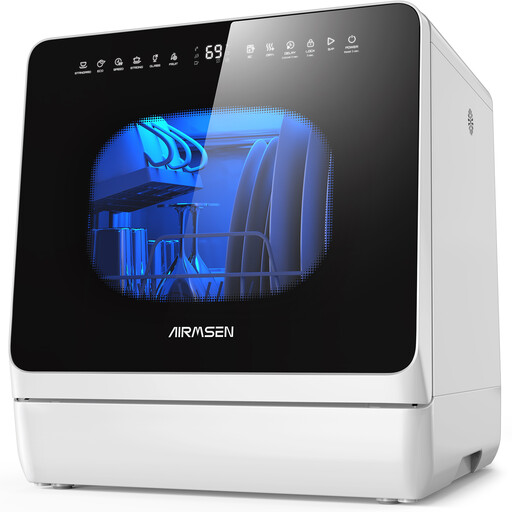
Why this product suits this profile: This countertop dishwasher has an integrated 4.9-litre water tank and, according to the product description, can be used without a fixed water connection. Measuring 42.8 × 42.5 × 45.7 cm, it is suitable for small kitchens, flats or mobile households.
This design reduces installation requirements. Before buying, you should still check the available surface, power supply and a safe way to drain wastewater.
8 programmes, 29-minute quick programme, child lock, delay-start function and integrated water softener.
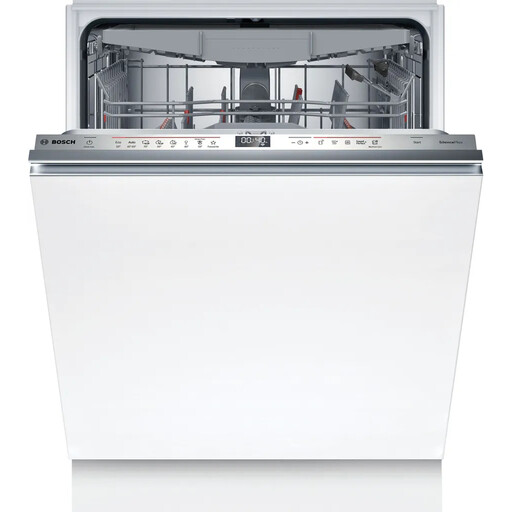
Why this product suits this profile: This fully integrated dishwasher offers 14 place settings, 42 dB(A), an energy efficiency rating of A and Home Connect. It is suitable for families and open-plan kitchens, provided a suitable installation recess is available.
The specifications for noise, water and energy consumption make comparisons easier. For integration, you must check the door-panel dimensions, connections and installation height separately.
14 place settings, cutlery drawer, AquaStop, 54 kWh per 100 Eco cycles and Efficient-Dry technology according to the product data.
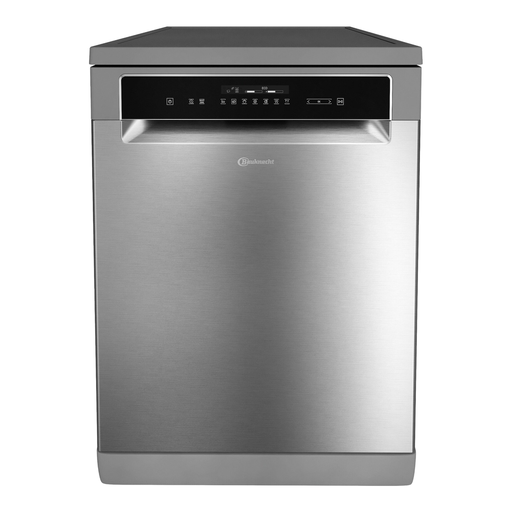
Why this product suits this profile: With 14 place settings, 10 standard programmes and a sensor programme, this freestanding model is aimed at families and households that regularly need to wash large or differently soiled loads.
The 60 cm design and flexible interior reduce the risk of having to rewash large items by hand. A MultiZone function is available for smaller loads.
41 dB(A), PowerClean, ActiveDry, cutlery drawer, LED interior lighting, sensor programme and full water protection according to the product description.
A freestanding or integrated dishwasher generally requires a water inlet, a drain and an earthed socket. Multi-socket adaptors and extension leads should not be used. If you live in rented accommodation, check in advance whether you are permitted to modify the water connection.
You can use this simple calculation to work out running costs:
Consumption per 100 cycles ÷ 100 × electricity price per kWh = electricity cost per wash cycle
You will also need to factor in water, detergent, rinse aid and, where applicable, dishwasher salt. Filters, spray arms and the door seal should be cleaned regularly, as deposits can affect performance and water drainage.
We have put together a complete, regularly updated list of products that fully meet these strict selection criteria and the safety regulations applicable in the EU.
Some mini and countertop dishwashers have an integrated water tank. The water is then added manually. The wastewater must still be drained safely into a sink or suitable drain. You should also check the available surface and the required height.
Service life depends on usage, water hardness, maintenance, loading and the availability of spare parts. Regularly cleaning the filter, using the correct amount of detergent and avoiding overloading can reduce wear. A definitive service life cannot be determined from the product data alone.
The key factors are electricity consumption per 100 Eco cycles, water consumption per wash cycle, electricity and water prices, and how often the appliance is used. Compare these figures directly on the energy label and in the technical specifications, rather than considering only the purchase price.