
Lieferung heute & morgen

Qualitätsgarantie

Willkommens-Angebote freischalten: KOSTENLOSE Lieferung | Bis zu 80 % RABATT | Kostenlose 30-Tage-JoyPlus-Testphase
App herunterladen
If you want to buy LED lamps, you will find countless options for living spaces, work areas, hallways and outdoor areas. Product names often sound similar, but can differ considerably in brightness, fitting, colour temperature, controls and installation. Three common buying mistakes are particularly likely to result in the wrong purchase:
Brightness is measured in lumens (lm). A lamp producing 800 lumens will generally be brighter than a 400-lumen model, regardless of its wattage. Wattage, on the other hand, indicates the amount of power consumed.
When choosing energy-efficient LED lighting, you should also check the EU energy label. The figure “kWh/1,000 h” shows how much energy the product uses over 1,000 hours of operation. The actual annual cost can be estimated using this formula:
Consumption in kWh × your electricity price = running cost
A 6 W bulb uses approximately 6 kWh over 1,000 hours of operation. The energy efficiency rating should always be considered alongside the lumen output, as a low wattage alone does not guarantee sufficient brightness.
E27 LED bulbs have a widely used screw fitting and are suitable for many ceiling, floor and table lamps. E14 LED lamps have a smaller screw fitting and are often used in bedside lamps, chandeliers and decorative light fittings.
Before buying, you should check:
According to the product specifications, some LED lamps must not be used in fully enclosed light fittings. Trapped heat can affect their service life. For damp areas or outdoor use, an explicitly suitable IP rating is required.
Colour temperature is measured in Kelvin (K):
The CRI or Ra value indicates how naturally colours appear under the light. A value of Ra 80 or above is standard for many domestic applications.
With dimmable LED lamps, it is important to distinguish between three options: dimming via a compatible wall dimmer, via a remote control or via an app. Smart LED lamps also often require 2.4 GHz Wi-Fi. With RGB LED lamps, colour control may also be important, while a warm-white LED lamp is designed to create a classic warm lighting atmosphere.
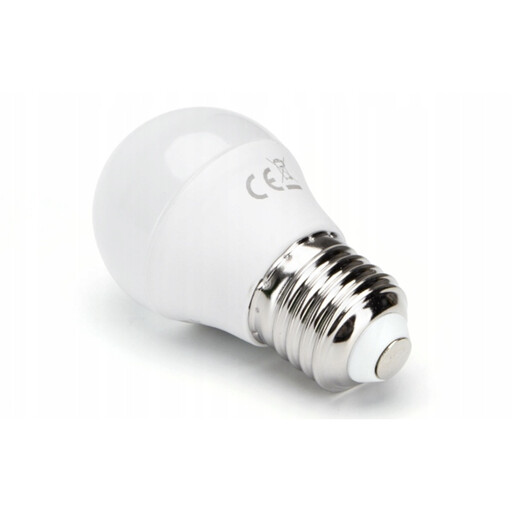
Why this product suits this profile: Suitable for table, wall or pendant lamps with an E27 fitting, this compact bulb provides warm white light at 3000 K and 510 lm.
The E27 fitting, dimensions of 45 × 80 mm and non-dimmable design are clearly stated. This allows you to check compatibility before buying.
6 W power consumption, 510 lm, 3000 K and a 200° beam angle.
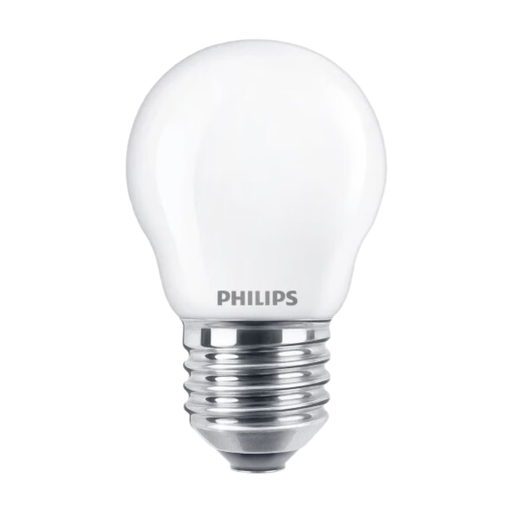
Why this product suits this profile: The matt P45 design is intended for decorative indoor light fittings and creates a warm white light at 2700 K.
The product specifications explicitly state 250 lm, 2.2 W, E27 and “non-dimmable”. This allows you to rule out an unsuitable wall dimmer in advance.
A stated service life of 15,000 hours, 20,000 switching cycles and a matt glass surface.
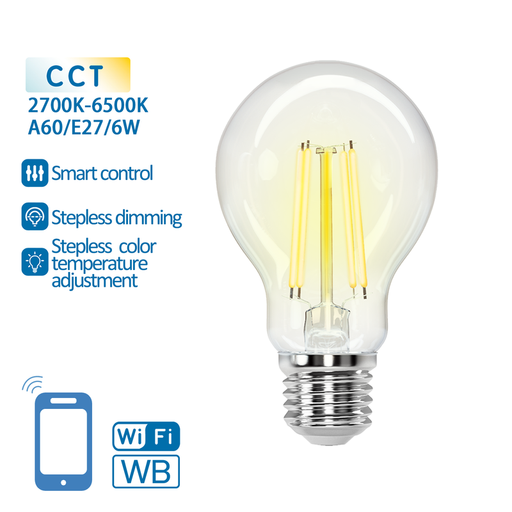
Why this product suits this profile: This smart LED lamp combines app control with Alexa and Google Home compatibility and covers a range from 2700 to 6500 K.
According to the product description, it connects directly via 2.4 GHz Wi-Fi without requiring an additional hub. Before buying, check whether your home network supports this frequency.
6 W, 850 lm, 360° light distribution and dimmable white tones via the app.
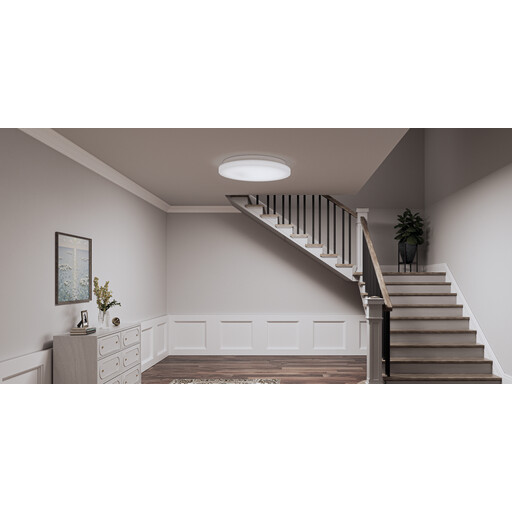
Why this product suits this profile: A ceiling lamp with a presence sensor can be useful in hallways, entrances or rooms where automatic lighting without a wall switch is preferred.
Presence detection is highlighted as a key feature. Before installation, consider the room size, ceiling height and any potential obstructions.
Ceiling installation and a presence sensor function designed for automatic lighting.
For cupboards, kitchen worktops and stairways, an LED lamp with a motion sensor is often more practical than a light that remains switched on continuously. When comparing a rechargeable LED lamp, look at the battery capacity, charging connection and expected runtime. With a sensor night light, check whether it has a motion sensor or a dusk sensor.
According to the product specifications, Joybuy’s ultra-slim LED cupboard light uses a PIR sensor, USB charging, an 800-mAh battery and three colour temperatures. This type of solution can be installed without drilling. For use in the kitchen or hallway, the adhesive surface should be clean, dry and strong enough to support it.
A 10,000-lux daylight lamp, on the other hand, is not intended as a general room light. The Medisana LT 460 and Beurer TL 20 are specified as providing a light intensity of approximately or up to 10,000 lux. These devices should only be used in accordance with the instructions; if you have eye discomfort, an eye condition or take certain medicines, it is advisable to seek medical advice before use. Avoid looking directly into the light source.
We have put together a complete, regularly updated list of products that fully meet these strict selection criteria and the safety regulations applicable in the EU.
Warm-white LED lamps with a colour temperature of around 2,700 to 3,000 K are often used in bedrooms. The brightness required depends on the room size, number of light fittings and how you use the space. A reading lamp requires different lumen levels from a central ceiling light.
Many products have a stated service life of between 15,000 and 25,000 hours. This figure is a product specification and depends, among other things, on the operating temperature, switching cycles, ventilation and mains quality. With integrated lamps, check before buying whether the light source can be replaced.
The key factors are wattage, daily usage and the electricity price. A 10 W lamp uses around 10 kWh over 1,000 hours of operation. For a realistic comparison, you should therefore consider not only the purchase price but also the lumen output, energy consumption and expected service life.