
Lieferung heute & morgen

Qualitätsgarantie

Willkommens-Angebote freischalten: KOSTENLOSE Lieferung | Bis zu 80 % RABATT | Kostenlose 30-Tage-JoyPlus-Testphase
App herunterladen
LED recessed spotlights create a flush, modern ceiling look for living rooms and kitchens, hallways, offices or retail spaces. Before you buy, though, it’s worth taking a close look at the technical specifications. Terms like “dimmable”, “waterproof” or “smart” don’t always mean the same thing from one model to the next.
What matters isn’t just the visible diameter of the LED ceiling spot. For installation, the key measurement is the cut-out size, or the hole diameter. A model with a 145 mm outer diameter might, for example, need a hole of 120 to 130 mm. If you’re renovating, measure the existing ceiling hole carefully before ordering.
The installation depth also matters. A shallow LED recessed spotlight around 30 mm deep can work for suspended ceilings with limited space. Even so, you still need to account for the connection terminals, driver and the necessary heat dissipation.
With conventional dimmable recessed spotlights, you need to check which dimming technology is supported. Some 230 V models work with a compatible trailing-edge dimmer and, according to the product specs, allow brightness control from 10 to 100 per cent.
Smart versions, on the other hand, can only be dimmed via an app, gateway or voice control. According to the product description, the Aigostar Smart LED Recessed Spotlight 18W CCT does not support an external wall dimmer. If you want to keep using an existing dimmer switch, clarify this point before you buy.
The IP rating is given by the IP code. IP20 is intended for dry indoor areas and is not suitable for bathrooms or damp outdoor spaces. IP44 offers protection against splashing water and can be suitable for certain wet rooms, provided you consider the installation zone and local regulations. IP65 indicates a higher level of protection against dust and water jets.
The IP rating doesn’t replace proper planning. In wet areas, lights should be installed by a qualified electrician in line with current installation rules.
The wattage describes the power consumption, not directly the brightness. For comparison, the luminous flux in lumens is more meaningful. In the selection, you’ll find, for example:
A beam angle of 120 degrees distributes the light relatively widely. Even so, position several spots so that work surfaces, walkways and seating areas are evenly lit.
A CCT recessed spotlight lets you choose between different colour temperatures. Typical ranges are:
With a recessed spotlight that offers warm white, neutral white and cool white, you make your selection either via a switch on the light housing or electronically through an app. An RGB+CCT LED spot adds coloured light to these white tones. That’s interesting for scenes and accent lighting, but not essential for permanent task lighting.
An LED recessed spotlight 230 V is connected directly to the mains supply of 220 to 240 V, provided the product specifications explicitly state this. Before installation, switch off the circuit at the fuse box and secure it against being switched back on.
For hardwired lights, a qualified electrician is required. In addition, buyers should look out for the following details:
The stated lifespans of 25,000 or 30,000 hours are product specifications and depend, among other things, on operating conditions, heat generation and switching frequency.
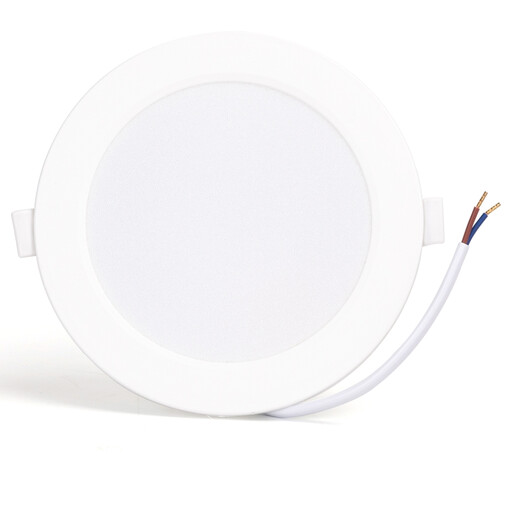
Why this product fits the profile: At 6 W, 600 lm and with a cut-out of 100 to 110 mm, this model is designed for smaller rooms, hallways and individual light points. The colour temperature can be adjusted between 2700 and 6500 K.
The specifications clearly state the luminous flux, cut-out size and IP20. This means you can check in advance whether the spot is suitable for dry indoor installation and fits your existing hole.
Bluetooth Mesh, app control, 120-degree beam angle and a stated lifespan of 30,000 hours.
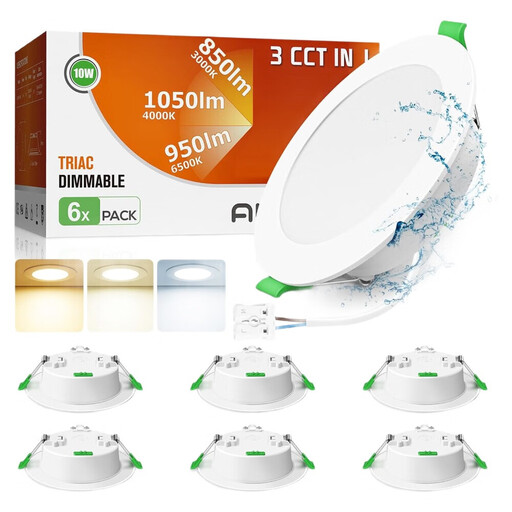
Why this product fits the profile: This model combines aluminium and polycarbonate, 1050 lm, three colour temperatures and a shallow build of 34 mm. According to the product specs, the cut-out is 90 to 100 mm.
The dimming function is tied to a compatible trailing-edge dimmer. This limitation prevents an unsuitable dimmer from causing flickering or malfunctions.
Direct 220 to 240 V connection, 3CCT selection and IP44 for suitable damp indoor areas.
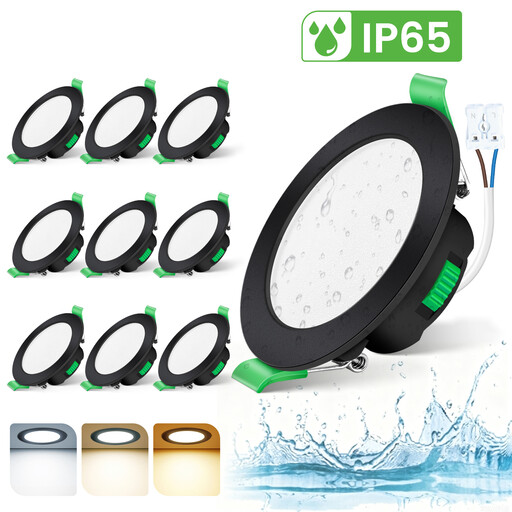
Why this product fits the profile: The 6-pack is ideal for renovations, multiple rooms or commercial spaces. According to the product specs, this model needs a hole of 67 to 75 mm and is 29 mm deep.
The IP65 rating, direct 230 V connection and specific cut-out range make the usage limits clear. For direct water jets or permanently wet areas, you should still check the installation plan separately.
3CCT switch, dimmable with a compatible trailing-edge dimmer, 600 lm and a stated lifespan of 30,000 hours.
We’ve put together a full, regularly updated list of products that fully meet these strict selection criteria and the safety regulations in force in the EU.
The consumption basically matches the stated wattage. A 9 W model running for ten hours uses about 0.09 kWh. The actual cost depends on the operating time and your individual electricity tariff. Smart lights may also have a standby consumption; with some Aigostar models, this is stated as up to 0.5 W.
For a direct connection to 220 to 240 V, a qualified electrician should carry out the installation. Before any work, switch off the circuit at the fuse box. You also need to check the cut-out, IP rating, heat dissipation and dimmer compatibility.
Many models in this selection state a lifespan of 25,000 to 30,000 hours, along with a specific number of switching cycles. These are manufacturer figures under defined conditions. High temperatures, a lack of ventilation or unsuitable electrical components can affect the actual service life.