
Lieferung heute & morgen

Qualitätsgarantie

Willkommens-Angebote freischalten: KOSTENLOSE Lieferung | Bis zu 80 % RABATT | Kostenlose 30-Tage-JoyPlus-Testphase
App herunterladen
The effectiveness of an adhesive bond depends critically on selecting the right product. Factors such as material composition, surface texture, and the expected load are crucial for a durable repair. UHU offers a portfolio of adhesives with chemical and physical properties optimized for specific applications. This guide analyzes the technical differences to help you select the most functionally appropriate product.
The choice of an adhesive should be based on an analysis of your project's requirements. The three key criteria are the adhesive's consistency, material compatibility, and the specific properties of the bond.
Viscosity, or the thickness of an adhesive, significantly determines its application behavior.
Not every adhesive adheres equally well to all materials. The surface energy and porosity of the material are decisive factors here.
For repairs on items exposed to moisture or mechanical stress, special properties are required.
Based on technical specifications and typical household applications, we present three products from the UHU range.
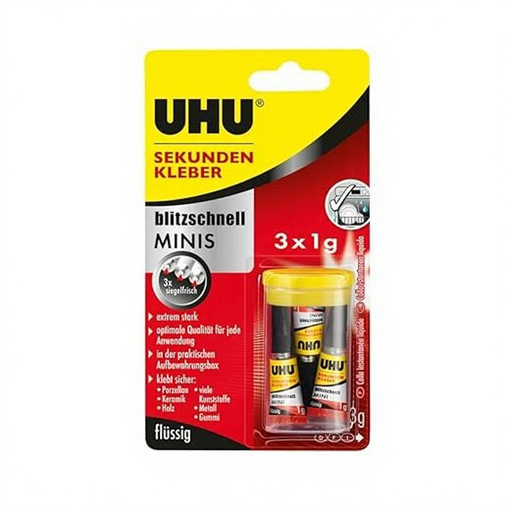
Why we recommend this product: The gel consistency of this adhesive solves a core problem of liquid glues: uncontrolled running. It enables precise work on vertical surfaces. Its manufacturer-stated dishwasher resistance makes it a functional option for repairing kitchen utensils made of ceramic or plastic.
Advantages:
Who it's for: Users who need to repair porous materials or objects on vertical surfaces, such as a broken mug handle or a picture frame.
To the product: UHU Super Glue Gel Ultra Fast Minis
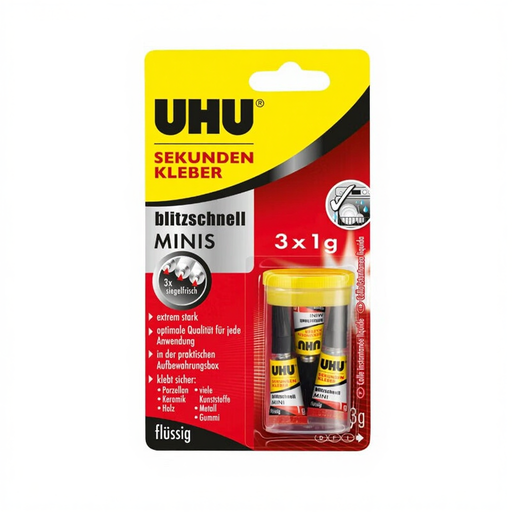
Why we recommend this product: This liquid super glue utilizes capillary action to penetrate the tightest joints and cracks. This results in a mechanically stable and visually inconspicuous bond, especially on smooth, perfectly-fitting break lines.
Advantages:
Who it's for: Users looking to repair precisely-fitting, non-porous parts such as broken plastic casings, metal components, or hard plastic toys, where the bond line needs to be as invisible as possible.
To the product: UHU Super Glue Mini Liquid

Why we recommend this product: This adhesive is formulated as a contact cement and retains its flexibility after curing. This property is essential for repairing items subject to constant movement and flexing, such as shoe soles.
Advantages:
Who it's for: Individuals who need to durably and flexibly repair a detached shoe sole, a torn leather belt, or a damaged handbag.
To the product: UHU Shoe and Leather Glue Tube
If your project extends beyond a simple repair and you need materials for larger craft or model-making projects, you can find a wider selection of adhesives and accessories in our Arts, Crafts & Sewing category.
1. How long does UHU super glue take to cure? The curing time depends on several factors. Handling strength, the point at which the parts no longer need to be held in place, is often reached within seconds to a few minutes. Final strength, when the bond reaches its maximum load-bearing capacity, can take up to 24 hours, depending on the material, air humidity, and the amount applied. Higher air humidity accelerates the cyanoacrylate reaction.
2. Is UHU glue waterproof? Water resistance varies by product. The UHU Super Glue versions (Gel and Liquid) featured here are classified by the manufacturer as waterproof glue and even dishwasher-safe. The UHU Shoe Glue is specifically designed to withstand moisture and weathering. However, the actual durability of the bond always depends on the materials being joined and proper application.
3. How can UHU super glue be removed from skin? If super glue gets on your skin, it is important not to forcibly pull the bonded skin apart. The recommended method is to use acetone (found in most nail polish removers) or to soak the affected area in warm, soapy water. With patience, the glue can then be slowly rubbed or rolled off.