
Lieferung heute & morgen

Qualitätsgarantie

Willkommens-Angebote freischalten: KOSTENLOSE Lieferung | Bis zu 80 % RABATT | Kostenlose 30-Tage-JoyPlus-Testphase
App herunterladen
If you want to buy a nut mix, you will find a wide choice online: mixed nuts, trail mix, roasted nuts, salted nuts, nut and fruit mixes, and flavoured Korean almonds. However, the products can differ considerably in terms of ingredients, serving size, sugar content, salt levels and allergens. Eye-catching packaging or a “protein snack” label is therefore not enough to base your purchase on.
A “nut mix” may consist mainly of peanuts. In trail mix, a significant proportion is often made up of raisins or other dried fruit. If you expect a particularly high nut content, check the percentages listed in the ingredients.
It is also worth taking a closer look at seasoned products: sugar, honey, syrup, maltodextrin or flavourings can alter the taste. “Honey & Salt”, for example, does not mean that the recipe is sugar-free.
A small portion pack may seem easy to understand, but it tells you little about the actual composition. For a fair comparison, energy, fat, saturates, carbohydrates, sugars, protein and salt per 100 grams are more useful. Nuts naturally provide a lot of energy. In mixes containing chocolate, sugar or honey, the carbohydrate and sugar content may be higher still.
Nuts, peanuts and soya are among the ingredients that should be checked particularly carefully before buying. A product may also carry a statement such as “May contain traces of other nuts”. If you have allergies or intolerances, always rely on the current labelling on the packaging. Nuts and kernels can also pose a choking hazard to young children.
First, consider what the snack is intended for. A classic nut and fruit mix with raisins is suitable for people who enjoy combining sweet and savoury elements. A mix without dried fruit is more suitable for those who prefer the pure flavour of nuts. Roasted nuts may have a more intense flavour because of the oil, salt and seasoning.
With flavoured products such as Korean almonds, check whether they contain milk, soya, wheat or other ingredients. This is particularly important if you are looking for vegan snacks. Product information may vary depending on the batch, so check the label before eating.
Protein content is an objective comparison value for a protein snack, but it is not the only measure of whether a product is suitable. According to the product information, the Max Mix Roasted Nut & Edamame Snack Mix contains 25 grams of protein per 100 grams, for example. According to its labelling, the Seeberger Roasted & Salted Premium Nut Mix contains 24 grams of protein per 100 grams.
Sweet mixes generally contain more sugar. According to the product description, the Seeberger Pleasure Nut & Fruit Mix contains 29 grams of sugar per 100 grams, while the Seeberger Studentenfutter Trail Mix is listed as containing 32 grams. These figures should not be interpreted as a health assessment; they simply help you choose according to your personal dietary goals.
Resealable bags are practical for the office, university or commuting. Individual portions, such as the ChaCha Daily Nuts with 5 packs of 23 grams each, make portioning easier. Larger bags, such as 300 or 500 grams, may be suitable for families or sharing, but once opened they must be stored in a dry, cool place and preferably in an airtight container.
Pay attention to the best-before date and any instructions regarding consumption after opening. For Max Mix, it is recommended that the contents be consumed within two to three days of opening. The bag should be resealed and protected from heat and moisture.
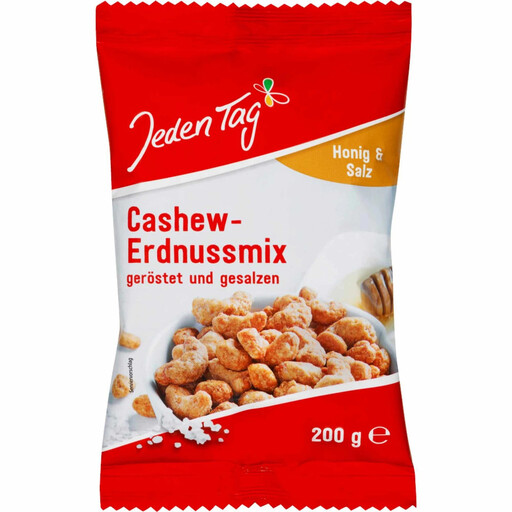
Why this product suits the profile: The 200-g bag combines cashews and peanuts with honey and salt, making it suitable for effortless snacking or sharing.
The ingredients list specifies 33% cashews, 32% peanuts and 3% honey. This makes the mix easier to assess than a blend whose proportions are not disclosed in detail.
200-g pack; according to the product information, 15 g of protein and 0.82 g of salt per 100 g.
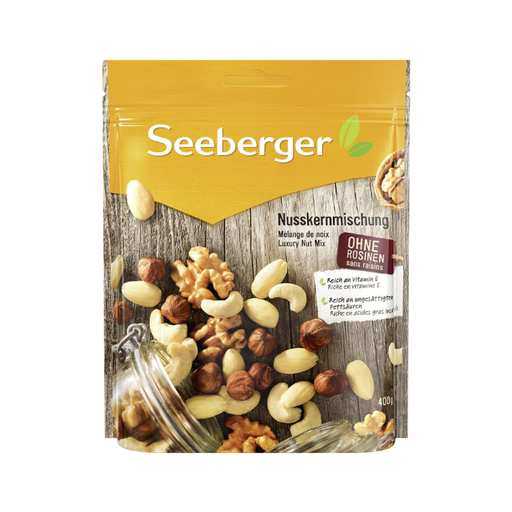
Why this product suits the profile: The 400-g mix focuses on nut kernels and, according to the product information, contains no raisins.
The declaration lists hazelnuts, blanched almonds, cashews and walnuts. However, the statement about possible traces of other nuts should still be taken into account.
Large 400-g pack; according to the labelling, 20 g of protein and 0.02 g of salt per 100 g.
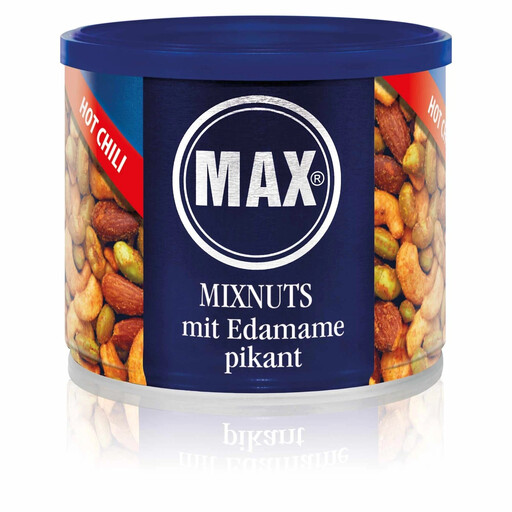
Why this product suits the profile: The combination of roasted almonds, cashews and edamame is aimed at people looking for a savoury, vegan-friendly protein snack.
The product description states the protein content as 25 g per 100 g and lists almonds, cashews and soya beans as allergens. Precautionary statements about traces of peanuts and other nuts are also provided.
250-g pack; according to the information provided, 589 kcal, 25 g of protein and 1.3 g of salt per 100 g.
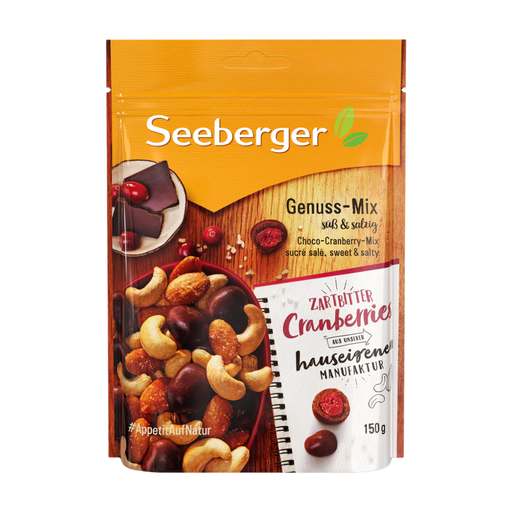
Why this product suits the profile: Cashews, blanched almonds, cranberries and chocolate combine sweet, fruity and salty elements in a 150-g pack.
The ingredients list specifies 24% dark chocolate couverture and 11% cranberries. If you are looking for a low-sugar nut mix, you should take this composition into account.
Practical 150-g pack; according to the product information, 12 g of protein and 0.37 g of salt per 100 g.
Before buying, you can check the following points:
We have put together a complete, regularly updated list of products that fully meet these strict selection criteria and the safety regulations applicable in the EU.
Resealable bags or individual portions are practical for eating on the go. Trail mix or a nut and fruit mix provides a combination of nuts and dried fruit. If you prefer mess-free portioning, choose products containing several small packs.
This depends on the recipe, packaging and storage conditions. Once opened, nuts should be kept in a cool, dry place in an airtight container. Where specific instructions are provided, such as a recommendation to consume the product within two to three days, follow the manufacturer’s guidance. A rancid smell or changed flavour are reasons not to consume the product.
No. Protein content varies depending on the type of nut and the composition of the mix. According to the nutrition table, products containing edamame or a high proportion of nuts may contain more protein than mixes with lots of dried fruit, chocolate or cereal ingredients. The decisive figure is the stated value per 100 grams.