
Lieferung heute & morgen

Qualitätsgarantie

Willkommens-Angebote freischalten: KOSTENLOSE Lieferung | Bis zu 80 % RABATT | Kostenlose 30-Tage-JoyPlus-Testphase
App herunterladen
A freezer can provide additional storage space when fridge compartments are not sufficient or when you regularly freeze larger quantities. However, when buying a freezer, capacity is not the only factor that matters. The design, installation location, energy consumption and ease of use all determine whether the appliance will remain suitable for your household in the long term.
A large freezer may look spacious in product images, but thick walls, drawer runners or awkwardly designed compartments can mean it offers less usable space than expected. Therefore, check the stated net capacity in litres, rather than just the external height.
For single-person households or small kitchens, a small freezer with a capacity of 60 to 85 litres may be sufficient. Families, households that store provisions or people who regularly batch-cook, on the other hand, often need 170 to more than 280 litres. A large freezer should only be chosen if the space will genuinely be used.
A No Frost freezer circulates cold air and reduces ice formation inside the appliance. This means that suitable models do not need to be manually defrosted regularly. Nevertheless, the door seal, ventilation areas and interior still need to be cleaned.
Appliances with Low Frost or MinFrost systems can also reduce ice formation, but depending on how they are used, they may still need to be defrosted occasionally. So check the specific defrosting technology rather than relying solely on the term ‘frost-free’.
The energy efficiency classes for fridges and freezers range from A to G. Under the current EU system, a class D appliance is classified differently from an older model with the previous labelling system. The annual energy consumption in kWh is also important when it comes to running costs.
Therefore, always compare:
An energy-efficient freezer with a larger capacity may consume more electricity overall than a smaller class E appliance. The figures should therefore always be considered in relation to the actual capacity.
A freestanding freezer can be positioned flexibly in the kitchen, utility room or cellar. A traditional upright freezer generally makes efficient use of floor space and offers drawers or flaps for organised storage.
A chest freezer is suitable for storing large quantities and can provide considerable storage space for the same floor area. However, it needs room for the lid to open and is less convenient for finding smaller individual items. Compact upright models are often more practical for flats, offices or holiday homes.
If you need fridge and freezer compartments in one appliance, you can choose a fridge with freezer compartment or a fridge freezer. Bear in mind that the freezer section is often significantly smaller than that of a separate appliance.
A freezer for the garage must be suitable for the temperatures in that environment. Not every model can be operated in an unheated room. Check the stated climate class and permitted temperature range.
According to the manufacturers’ product information, some models in the selection are designed for unheated rooms with ambient temperatures down to approximately −15 °C. This does not automatically mean that every cellar or garage is suitable. Adequate ventilation clearances, a dry, level surface and protection from direct moisture are still required.
Freezing capacity is specified in kilograms per 24 hours. It shows how much fresh food the appliance can freeze within one day under the specified conditions. A fast-freeze function temporarily lowers the temperature further and is useful when placing larger quantities of fresh food in the appliance at once.
The storage time during a power cut may also be relevant. This depends on how full the appliance is, how often the door is opened and how well it is insulated. A temperature alarm alerts you when the internal temperature rises, but it does not replace checking the food after a prolonged power cut.
A freezer with a reversible door gives you greater flexibility when planning your space. Before buying, check whether you can reverse the door yourself or whether this requires a service technician.
For open-plan kitchens or offices, noise levels of around 34 to 40 dB are particularly relevant. The perceived noise level depends on the room’s acoustics, the floor and the compressor cycles. Transparent drawers, flaps and separate compartments make sorting easier and help you avoid spending a long time searching with the door open.
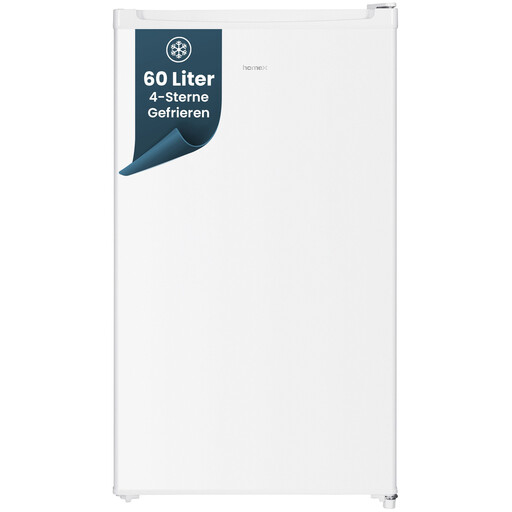
Why this product suits this profile: According to the manufacturer’s product information, this compact appliance offers 60 litres of usable capacity, two transparent drawers and a shelf. This makes it suitable for single-person households, offices or holiday flats with limited floor space.
The clear capacity specification prevents a small appliance from being confused with a full-size family freezer. The reversible door makes installation easier.
60 litres of usable capacity, 4-star classification, freezing capacity of 2.8 kg per 24 hours and a noise level of 40 dB.

Why this product suits this profile: According to the product information, this freestanding No Frost freezer offers 286 litres of usable capacity, an electronic display and several separate storage areas.
No Frost reduces maintenance; the stated energy efficiency class D and 34 dB allow for an objective comparison rather than judging the appliance on design alone.
286 litres, No Frost system, freezing capacity of 17 kg per 24 hours, Fast Freeze and a reversible door.
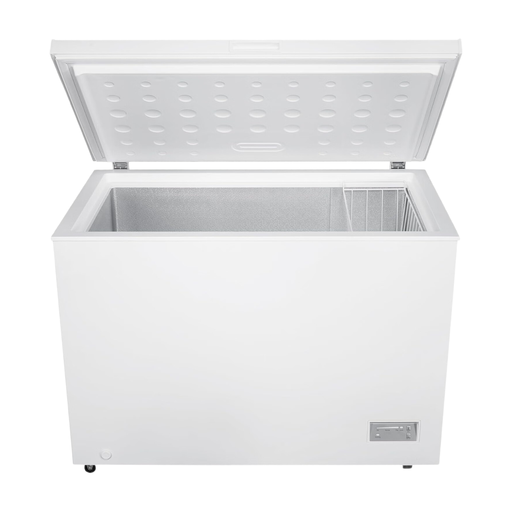
Why this product suits this profile: For storing provisions in a cellar, utility room or garage, this chest freezer offers 308 litres of usable capacity and four wheels for easier repositioning, according to the product information.
The SN-T climate class is specified for a broad range of ambient temperatures. A temperature alarm makes rising internal temperatures visible.
308 litres, freezing capacity of 16 kg per 24 hours, 4-star classification, 40 dB and four transport wheels.
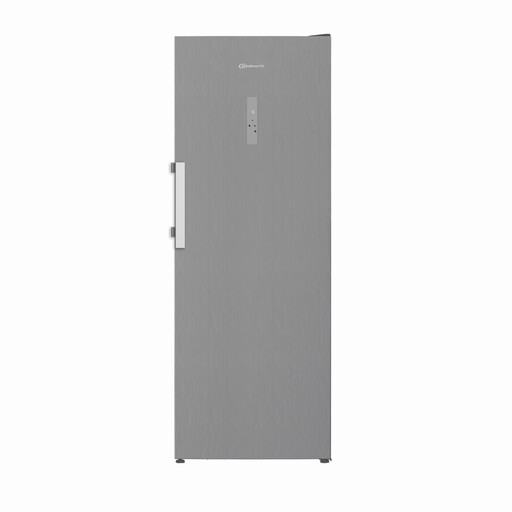
Why this product suits this profile: This model is aimed at households with high storage needs. According to the product information, the 404-litre interior can also be used as a fridge with the Multi-Zone function.
The flexible configuration prevents a very large appliance from sitting unused if your needs change. No Frost reduces the need for manual maintenance.
404 litres, freezing capacity of 19 kg per 24 hours, energy efficiency class D, 38 dB and app control.
We have put together a complete, regularly updated list of products that fully meet these strict selection criteria and the safety regulations applicable in the EU.
As a general guide, around 50 to 80 litres of usable capacity per person may be suitable. Your actual requirements depend on how often you shop, whether you store provisions and your cooking habits. You should also measure the available floor space and allow for the necessary ventilation clearances.
This depends on the climate class and permitted ambient temperature range. Many standard appliances are designed for heated indoor spaces. For a garage or unheated cellar, choose a model whose manufacturer explicitly states that it is suitable for the relevant temperature range. The appliance must be positioned in a dry, stable and adequately ventilated location.
Calculate the annual electricity cost using the formula: annual consumption in kWh × electricity price per kWh. An appliance with annual consumption of 190 kWh would cost around 66,50 Euro per year based on an assumed electricity price of 0,35 Euro per kWh. The actual amount depends on your individual tariff and usage. Make sure the door closes properly, keep ventilation areas clear and choose an appliance of a suitable size.