
Lieferung heute & morgen

Qualitätsgarantie

Willkommens-Angebote freischalten: KOSTENLOSE Lieferung | Bis zu 80 % RABATT | Kostenlose 30-Tage-JoyPlus-Testphase
App herunterladen
A juicer can make preparing fresh drinks easier. However, unclear advertising claims, choosing the wrong appliance and underestimating the cleaning involved often lead to disappointing purchases. What matters is not just the motor power, but whether the design, feed chute, capacity and cleaning requirements suit your habits.
A high power rating alone says little about how much juice can be extracted from apples, carrots or leafy vegetables. A centrifugal juicer usually works quickly, but can leave more residue when processing fibrous vegetables. A slow juicer, also known as a cold-press juicer, processes ingredients more slowly using a pressing or auger mechanism.
The actual juice yield also depends on the fruit, its ripeness, the size of the pieces and the strainer. Claims such as “over 90 per cent” or “up to 99 per cent” should therefore be understood as manufacturer specifications rather than a general value for every ingredient.
A juicer with a large feed chute can reduce the need to pre-cut ingredients. However, hard stones, peel and unsuitable ingredients still need to be removed. The EUHOMY model is specified with a 135 mm feed chute, while the Bear YZJ-F01D6 has an 80 mm opening. These dimensions are useful if you often process apples, cucumbers or larger pieces of fruit.
However, a wide opening does not replace the pusher or the need to observe the maximum filling level. In smaller kitchens, an appliance with a large feed chute may also require more worktop space.
Many juicers consist of several removable parts: the feed chute, pressing unit, strainer, juice container and pulp container. The finer the strainer, the more important it is to rinse it immediately after use. Dried-on fruit fibres make cleaning considerably more difficult.
You should therefore look for:
A slow juicer or cold-press juicer is worth considering if you regularly combine fruit and vegetables and are happy to accept slower processing. According to the product specifications, the Bear YZJ-F01D6 operates at 130 watts and is designed for a maximum of 15 minutes of use per session.
A centrifugal juicer is more suitable for households that want to process larger quantities quickly. The WOOX appliance has 600 watts of power and a wide feed chute with three feed channels. According to the usage instructions, ingredients such as bananas, mangoes, avocados, sugar cane and corn are not suitable for this appliance. Such restrictions should be checked before buying.
For oranges, lemons and other citrus fruit, an electric citrus juicer is often sufficient. It works without cutting blades and is designed to press halved fruit. A full-size fruit and vegetable juicer is not necessarily required for this task.
A small juice container may be sufficient for one person or occasional preparation. Families can benefit from a larger capacity, provided the appliance has enough space on the worktop.
The product specifications vary:
Bear in mind that “capacity” may refer to the juice container, blending cup or total holding volume, depending on the manufacturer.
For an electrical appliance used with food, 220–240 volts, a suitable power supply and the manufacturer’s instructions are all important. The motor housing of the appliances mentioned must not be immersed in water. Unplug the appliance before disassembling and cleaning it.
A BPA-free juicer may appeal to buyers who pay close attention to the materials used in food-contact parts. The Bear CZJ-A04B1 is explicitly described as using BPA-free material. When buying, you should also check which components actually come into contact with the juice and whether a German-language instruction manual and details of the responsible person in the EU are provided.
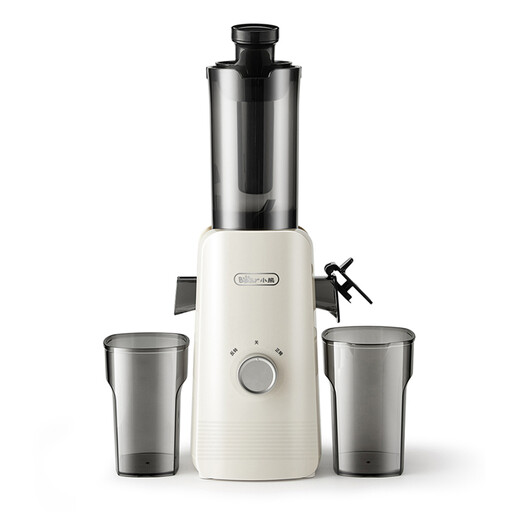
Why this product suits the profile: This compact model is designed for regular individual or small portions, combining an 80 mm feed chute with a 0.8-litre container.
The product description lists three removable main components and a cleaning brush. This keeps the design straightforward.
130-watt motor, separate juice and pulp collection, and a stated maximum operating time of 15 minutes per use.
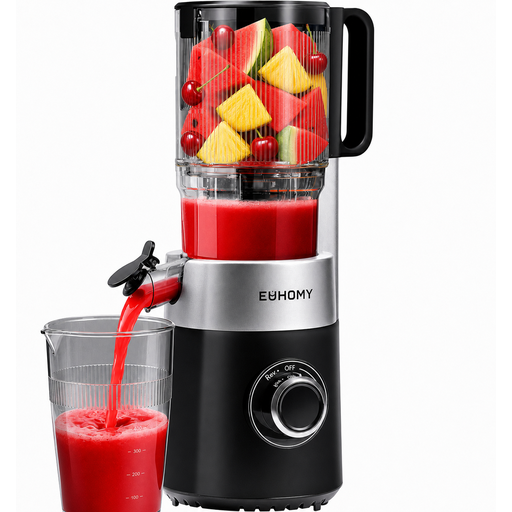
Why this product suits the profile: The combination of a large feed chute, 1.8-litre capacity and slow-pressing method is appealing to households that prepare juice regularly.
The product description mentions a three-stage design and a triple filtration system. Nevertheless, you should check exactly how cleaning is carried out before buying.
135 mm feed chute, 1.8-litre capacity and, according to the manufacturer, a 220-watt motor with an operating noise level of 60 decibels.

Why this product suits the profile: The higher rated power and three feed channels are designed for quickly processing suitable fruit and vegetables.
The usage instructions clearly identify unsuitable ingredients. This helps to prevent blockages and unnecessary strain on the filter.
600-watt rating, wide feed chute, stainless-steel filter and BPA-free design according to the product name.
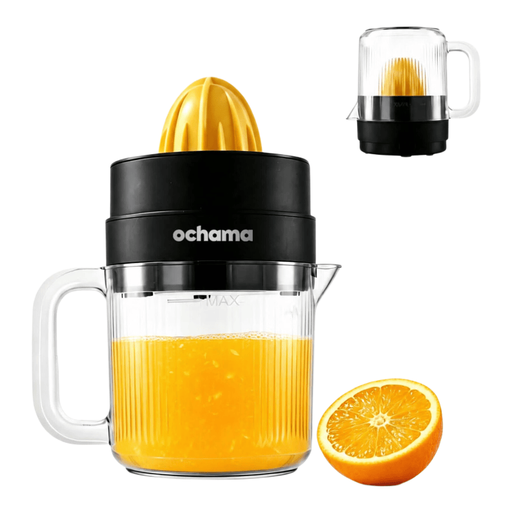
Why this product suits the profile: If you mainly juice oranges, lemons or mandarins, this specialised appliance offers a 1.4-litre capacity.
The absence of blades and the removable parts suit its intended use with citrus fruit. Hard objects, ice cubes and stones must not be used.
30 watts, pulp separation and removable components according to the product description; the motor housing must not be cleaned with water.
A portable juicer such as the Royalstar Juicing Cup is designed for small quantities on the go or at work. The 300 ml cup has an integrated 1200-mAh battery and starts with a double click. According to the product description, it is suitable for soft ingredients such as watermelon, berries or banana, which should first be cut into pieces measuring around 1 to 1.5 cm. This appliance is therefore not a substitute for a juicer designed for larger quantities or hard vegetables.
We have put together a complete, regularly updated list of products that fully meet these strict selection criteria and the safety regulations applicable in the EU.
The lifespan depends on how often it is used, the ingredients, cleaning and compliance with the operating limits. Hard stones, unsuitable fibres and overloading can put strain on the filter and motor. Rinse the removable parts immediately after use and observe the information on the maximum operating time.
It can be a sensible choice if you regularly process different types of fruit and vegetables and need a larger quantity of juice. Check the container size, feed chute and cleaning time in advance. If you only juice oranges and lemons, an electric citrus juicer is often sufficient.
In addition to electricity consumption, the main costs are for fruit, vegetables and potential replacement parts such as strainers or pressing augers. Wattage alone does not determine the total cost. An appliance that processes ingredients efficiently and is used regularly can be more economical in everyday use than a model that is rarely used because it is complicated to clean.