
Lieferung heute & morgen

Qualitätsgarantie

Willkommens-Angebote freischalten: KOSTENLOSE Lieferung | Bis zu 80 % RABATT | Kostenlose 30-Tage-JoyPlus-Testphase
App herunterladen
If you’re looking to buy a pressure washer, you’ll find models with very different pressure ratings, water flow rates and accessory packages. However, the “Bar” figure alone isn’t enough to judge whether a machine is suitable for your car, patio or garden. What really matters is how the unit is built, which nozzles are included, and whether the performance matches the task at hand.
Many product descriptions quote the maximum achievable pressure. This value isn’t necessarily maintained during normal, continuous use. That’s why buyers should also look at the working pressure, the water flow per hour and the motor power.
A pressure washer with 150 Bar can be suitable for vehicles and smaller outdoor areas. For heavily soiled patios or larger paths, the combination of pressure and flow rate is more important than any single peak figure.
A foam nozzle, rotating brush or surface cleaner can make the job easier. However, the accessories need to match the surface you’re cleaning. A turbo nozzle concentrates the water jet intensely, so it isn’t suitable for delicate paintwork, wooden surfaces or loose grouting.
Before you buy, it’s worth checking the components that are actually included: high-pressure hose, spray gun, adjustable nozzle, detergent tank and, where applicable, a patio cleaner.
A cordless pressure washer is flexible to use, but it needs a charged battery and often a bucket or another water source. For longer cleaning sessions, the run time can be limited. For a large patio or several vehicles, a mains-powered electric model is often more practical.
When choosing, you should consider three values together:
An electric pressure washer with 1,300 to 2,000 watts can be designed for typical household, car and garden jobs. Models with higher power and greater flow rates are aimed more at frequent or more demanding use.
A pump with an aluminium housing is often listed in product specs as a sign of durable construction. In addition, an automatic start-stop system, wheels and a sturdy handle are practical features. The start-stop system only activates the motor when the spray gun trigger is pulled, which can reduce water consumption and unnecessary running time.
Also pay attention to the length of the high-pressure hose and power cable. A larger working radius means you won’t have to move the unit around as often. Hose reels or tidy storage options help prevent kinks and trip hazards.
For a car, the water jet shouldn’t be directed too close to the paintwork, seals or tyres. An adjustable nozzle and a pressure washer with a foam nozzle can make the pre-wash easier. Detergent should only be used according to the manufacturer’s instructions and in line with surface compatibility.
For patios and gardens, surface cleaners, rotating brushes and adjustable nozzles are useful. On wood, sensitive coatings and brittle grouting, always test a low-pressure setting on an inconspicuous area first.
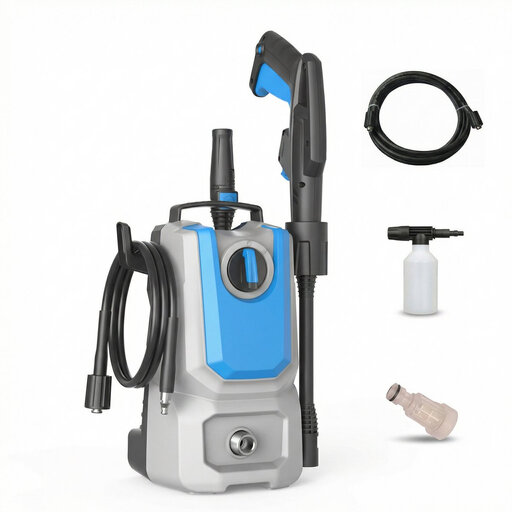
Why this product fits the profile: This compact unit is designed for regular household tasks such as cleaning bikes, cars and garden furniture, and can be stored away without taking up much space.
The product data lists a working pressure of 60 Bar alongside the maximum pressure of 90 Bar, as well as a 5-metre hose. This makes it easier to assess the performance realistically.
1,300-watt motor, aluminium pump, adjustable spray gun and automatic start-stop system.
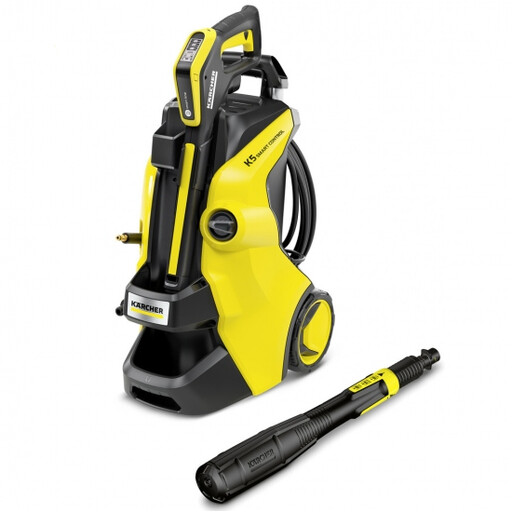
Why this product fits the profile: This model combines documented technical data with app connectivity and is suitable for cars, patios, bikes and outdoor steps.
Alongside a maximum pressure of 145 Bar, the working pressure of 125 Bar, maximum flow rate of 500 l/h and an aluminium pump construction are all specified.
Bluetooth control, 3-in-1 multi-jet lance, wheels and water-cooled induction motor according to product specifications.
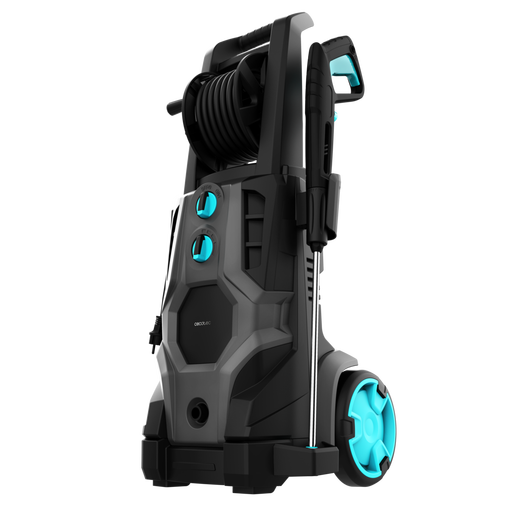
Why this product fits the profile: The combination of 3,200 watts, 225 Bar permissible pressure and 540 l/h is designed for larger outdoor areas and frequent use.
The technical specifications are listed together. This allows you to assess the high pressure rating in relation to power and water flow.
Aluminium HardPump, 9-metre working radius, anti-dirt filter plus quick couplings and foam soap bottle.
A mains-powered pressure washer makes sense if you regularly clean patios, paths, fences or several vehicles. Models like the Lugia High-Pressure Cleaner with 1,600 watts, 135 Bar and 430 l/h combine a mid-range performance level with accessories such as a surface cleaner, rotating brush, turbo nozzle and external foam cannon.
A cordless pressure washer is better suited to mobile, short tasks: bike washing, spot-cleaning the car, watering or jobs where there’s no mains socket. With the EAFC model, bucket operation and self-priming are provided as water sources. The actual run time depends on the battery, the load and the water supply.
Before use, check the hose, connections, gun and power cable for damage. Wear safety goggles and non-slip footwear. Never direct the water jet at people, animals, electrical appliances or the machine itself.
For a pressure washer for your car, the rule is: rinse off coarse dirt first, keep a sufficient distance and don’t use unsuitable cleaning agents. After use, remove any remaining water from the unit and hose. Frost can damage the pump and hoses.
We’ve put together a complete, regularly updated list of products that fully meet these strict selection criteria and the safety regulations in force across the EU.
For car washing, pressure alone isn’t the deciding factor. An adjustable nozzle, sufficient distance and a suitable foam nozzle are more important than the highest possible peak value. The water jet should not be directed straight at seals, damaged paintwork or sensitive components.
The lifespan depends on how often it’s used, the materials, how well it’s maintained and how it’s stored. A pump with an aluminium housing, a start-stop system and frost-free storage can improve the technical conditions for regular use. Ultimately, the manufacturer’s specifications and following the operating instructions are what matter most.
The running costs come from electricity and water consumption. For a rough estimate, multiply the motor power in kilowatts by the operating time and your electricity rate. The automatic start-stop system can reduce unnecessary motor running time during short breaks.