
Lieferung heute & morgen

Qualitätsgarantie

Willkommens-Angebote freischalten: KOSTENLOSE Lieferung | Bis zu 80 % RABATT | Kostenlose 30-Tage-JoyPlus-Testphase
App herunterladen
Baby toys should entertain, invite little hands to grasp, and support development at the right stage. However, the range on offer includes many products with similar promises: educational toys, motor skills toys, rattles, teething rings, baby activity centres and interactive toys. For parents, grandparents and relatives, it is not always immediately clear which features actually matter in everyday use.
As a Joybuy Product Recommendation Officer, I filter product information according to clear, understandable criteria. What counts is not the sheer number of functions or eye-catching colours, but rather age recommendation, safety, material, cleaning and the specific purpose of use.
A toy with music, lights, buttons and several play modes may seem versatile. For a baby, however, such features can be overwhelming. In the first few months, a grasping toy or a simple rattle often suits a baby's abilities better than a complex electronic product.
Pay attention to the manufacturer's age recommendation. It is not just a marketing gimmick. If a product contains small parts, it must not be used by younger children, even if the child is already able to grasp skilfully.
Textile surfaces, battery compartments and grooves can be more time-consuming to clean in daily use than you might expect. With a teething ring, for example, it is important to know whether it can be washed or cleaned in the dishwasher. Other products may only be wiped down with a damp cloth.
Before buying, you should check:
A baby walker, a large activity centre or a race track needs more floor space than a grasping toy. In a flat with narrow doorways, a rolling toy can quickly become impractical. For use in the garden, it is also important to consider whether the ground is level and whether the product is specifically designed for outdoor use.
The age label must match the child's developmental stage. For babies aged 0 to 3 months, lightweight products without loose small parts are particularly suitable, such as a soft hanging toy or a simply shaped grasping toy. Toys from 6 months may place additional demands on grasping, turning and exploring, but should still be checked regularly for damage.
For products intended for children aged three and over, the warning about small parts is especially relevant. This also applies if there are younger siblings in the household.
Look out for:
A CE marking is mandatory for toys sold in the EU. It indicates that the manufacturer declares compliance with the applicable requirements. However, it does not replace your own checks for cracks, loose parts or wear and tear.
A motor skills toy should suit the type of play you have in mind. A product with manual elements, for example, is good for grasping, turning and matching. Musical toys offer sounds and melodies in addition, but require batteries and should have an easily accessible volume control.
Also check whether batteries are included, how long cleaning takes, and whether the toy may only be used under supervision.
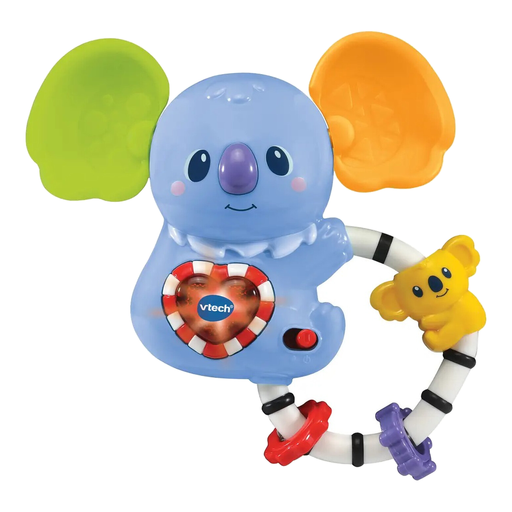
Why this product suits the profile: The Koala Rattle is recommended from 3 months according to the product information, combining grasping elements with songs, melodies and a motion sensor. It is more compact than a large baby activity centre and is ideal for short play sessions.
The age recommendation and compact size make selection easier. The battery compartment is described as child-safe; however, the rattle should still be checked regularly for damage.
Three songs, 15 melodies, sounds and a light-up button; one AAA battery is reportedly included.
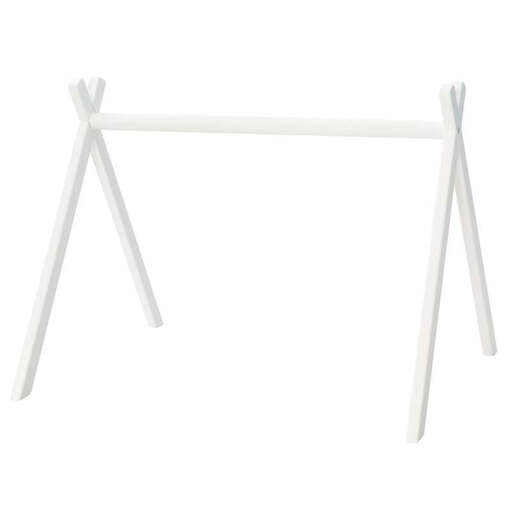
Why this product suits the profile: This play arch made from lacquered wood is designed for babies from 3 months, according to the product description, and offers space for looking, grasping and discovering. The surfaces can be wiped clean.
The minimalist design avoids overloading with electronic functions. Before each use, the screws and hanging elements should be checked.
Dimensions approximately 52 × 70 × 50.5 cm, wipe-clean surfaces and expandable play sets available separately.
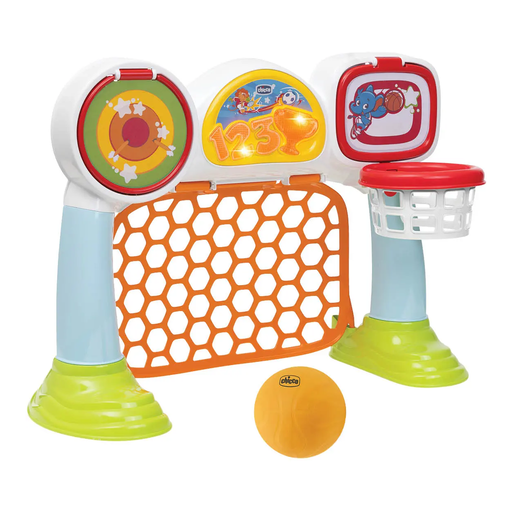
Why this product suits the profile: This electronic 3-in-1 activity game is designed for children aged 2 to 5 years and combines football, basketball and target throwing. It is ideal for families looking for active play options indoors or in the garden.
The three play modes are clearly described. Due to the ball and possible small parts, the age limit must be observed; direct supervision is explicitly required.
Sensors react to the ball; requires two AA batteries, which are not included.
We have put together a complete, regularly updated list of products that fully meet these strict selection criteria and the safety regulations in force in the EU.
From 3 months, lightweight grasping toys, rattles, soft hanging toys and simple play arches are suitable. What matters is an appropriate age recommendation, no loose small parts, and a shape that the baby can grasp safely. With electronic toys, you should also consider the volume and the battery compartment.
This depends on the age rating, material and condition. A grasping toy can remain interesting across several developmental stages, whereas a product with a very narrow age range will be replaced sooner. As soon as you notice cracks, loose parts, damaged seams or a battery compartment that does not close securely, the toy should no longer be used.
In addition to the purchase price, you may need to factor in batteries and replacement parts. So check the battery type before buying and whether batteries are included. Products without electronics generally incur no ongoing battery costs; with musical toys, a volume control is also a handy feature.