
Lieferung heute & morgen

Qualitätsgarantie

Willkommens-Angebote freischalten: KOSTENLOSE Lieferung | Bis zu 80 % RABATT | Kostenlose 30-Tage-JoyPlus-Testphase
App herunterladen
A bookcase should safely support your books, make sensible use of the space available and complement your interior style. In practice, however, certain common purchasing decisions can lead to disappointment: the bookcase is too deep for its intended location, the compartments are not large enough for files, or the construction becomes unstable despite attractive product images.
This guide explains which details matter before buying a bookcase and which types of shelving are suitable for living rooms, bedrooms, hallways, kitchens or home offices.
A bookcase often looks more compact or larger in photographs than it actually is in the room. That is why you should check not only the width and height, but also the shelf depth. A narrow bookcase measuring 20 to 30 cm deep may be sufficient for paperbacks and decorative items. Larger depths may be needed for coffee-table books, ring binders or storage boxes.
You should also measure skirting boards, radiators, doors and windowsills. With a corner shelf, both wall sections and the distance from power sockets must be taken into account.
A freestanding shelf can be placed flexibly, but taller designs should also be secured to the wall. Tip protection is particularly important in households with children or pets. Heavy items should be placed in the lower compartments. This reduces the load in the upper section and improves stability.
Pay attention to the stated maximum load per shelf and the total load capacity. These figures are not interchangeable: a bookcase with several levels may support a high overall load, while each individual shelf may be able to hold considerably less.
“Wood effect” does not necessarily mean solid wood. MDF, chipboard or coated wood-based materials are often used. This is not inherently a disadvantage, but the material should be suitable for how you intend to use the furniture. A solid-wood bookcase, a coated storage shelf and a bamboo shelf differ in terms of weight, care, surface finish and sensitivity to moisture.
When reviewing product details, the material, surface treatment, edge finishing and care instructions are therefore more important than general advertising claims.
First, make a note of what you want to store in the bookcase:
A room-divider shelf should have a sufficiently broad base and should only be as tall as necessary, so that light and sightlines are not unnecessarily restricted. Wall mounting should be planned for particularly tall furniture.
Compare the stated load capacity with the actual weight of your belongings. Books are heavier than their volume might suggest. Distribute them evenly and place particularly heavy items at the bottom. For decorative objects, you should check not only the load capacity but also the size of the surface they will stand on.
For example, the 180 cm-high industrial shelf made from MDF and metal states a load capacity of up to 34 kg per shelf. The corner shelf with seven levels specifies up to 45 kg per level. Such figures only apply when the unit is correctly assembled, placed on a level surface and loaded evenly.
Check whether the furniture needs to be assembled and whether a second person is required. Wall shelves need suitable wall plugs and screws, depending on the type of wall. The fixings supplied are not necessarily suitable for every wall.
Coated surfaces can often be cleaned with a soft, dry cloth. With bamboo shelves, wooden bookcases and veneered panels, you should avoid excessive moisture. For kitchen use, also check whether the surface is resistant to splashes according to the product description.
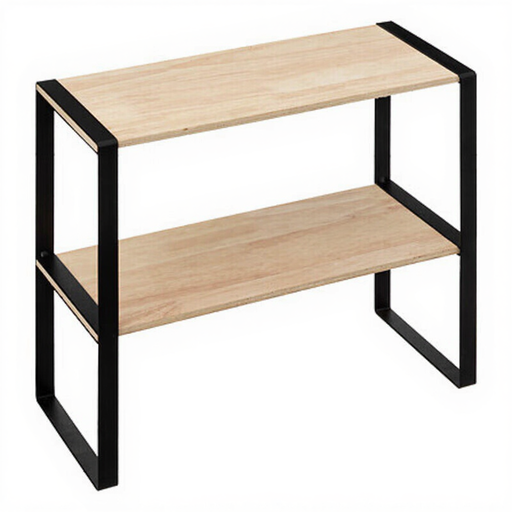
Why this product suits the profile: With two levels, this compact shelving unit is ideal for small spaces, such as beside the bed, on a sideboard or as a kitchen shelf.
The stated dimensions of 40 × 30 × 35 cm and total load capacity of 10 kg make planning easier. Its low height reduces the risk of tipping compared with tall freestanding shelves.
Two storage surfaces, freestanding use and an easy-care engineered-wood finish.
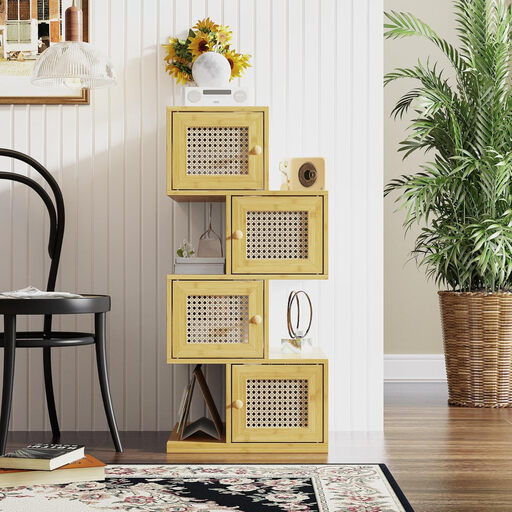
Why this product suits the profile: Measuring 85 × 40 × 25,4 cm, this bamboo shelf combines open compartments with rattan doors, making it suitable for the living room, bedroom or hallway.
The compact dimensions help prevent buying a unit that is too deep. Closed sections keep personal belongings out of direct view.
A bamboo frame, four compartments and a combination of open and closed storage.
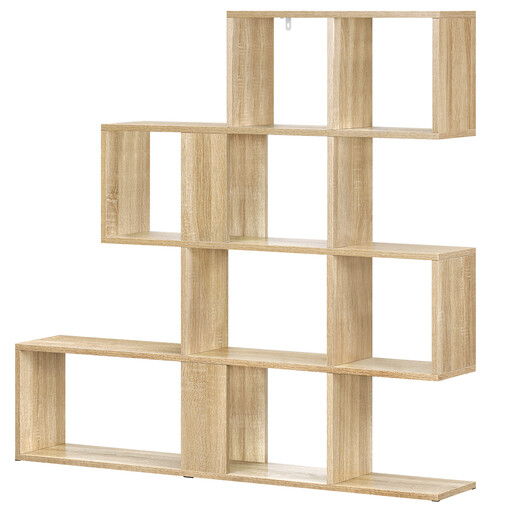
Why this product suits the profile: With four levels, eleven open compartments and dimensions of 115 × 109,5 × 19,5 cm, this shelf is suitable for books, plants and decorative items, or as a room divider.
The shallow depth makes efficient use of floor space. Anti-slip pads and the included tip-prevention kit support correct positioning; the wall fixing should be used.
Eleven open compartments, a stated maximum load capacity of 70 kg and versatile use in living areas, offices or kitchens.
A desktop shelf such as the MyGift model with three levels can also be used on a desk. Its stated depth of 6.7 inches is equivalent to approximately 17 cm. The shelf heights can be adjusted, although assembly is required.
We have put together a complete, regularly updated list of products that fully meet these strict selection criteria and the safety regulations applicable in the EU.
Around 20 to 25 cm is sufficient for many paperbacks. Larger hardbacks, ring binders and boxes often need more space. The key factor is the largest item you regularly intend to keep on the shelf. Leave a little extra room so that books do not catch or become difficult to remove.
With tall or narrow furniture, tip protection is advisable and may be required according to the product specifications. Use the intended fixings and choose wall plugs suitable for the wall material. Heavy items should be placed at the bottom; children must not climb on the shelves.
Its service life depends on the material, load, assembly, moisture and care. Evenly distributing the weight, placing the unit on a level surface and observing the stated load limits all reduce mechanical strain. Damaged shelves, loose connections or an unstable wall fixing should be checked promptly.