
Lieferung heute & morgen

Qualitätsgarantie

Willkommens-Angebote freischalten: KOSTENLOSE Lieferung | Bis zu 80 % RABATT | Kostenlose 30-Tage-JoyPlus-Testphase
App herunterladen
Choosing the right cooker hood is crucial for a clean and pleasant kitchen atmosphere. But the market is confusing and filled with technical jargon that often complicates rather than clarifies. Many buyers focus on a single feature, like extraction power, while overlooking critical factors that affect daily use. The result is often a costly mistake.
This guide will help you navigate the common pitfalls. We'll focus on the objective criteria that truly matter, showing you how to find a model that perfectly suits your needs and your kitchen.
Before we dive into the technical details, let's look at the three most common mistakes that lead to dissatisfaction.
To avoid these traps, you should focus on three core parameters. These determine the performance, efficiency, and everyday usability of your future cooker hood.
The airflow rate indicates how many cubic metres of air the hood can circulate per hour. A rule of thumb is that the power should be sufficient to exchange the kitchen air 6 to 12 times per hour. For a 15 m? kitchen with a 2.5 m ceiling height (room volume: 37.5 m?), a rate of 225 to 450 m?/h would be a good benchmark.
However, the relationship to the noise level is crucial. Calling a cooker hood quiet is subjective, but a good benchmark is a value below 60 decibels (dB) on the highest normal setting. Models that significantly exceed this level can be perceived as disruptive during prolonged use. Pay attention to the manufacturer's specifications, which are often listed separately for each power level.
The Energy Efficiency Class is a standardised EU label that indicates a device's annual energy consumption. A hood with an Energy Efficiency Class of A+++ uses significantly less electricity than a model in class B or C. For an appliance that runs almost daily, this makes a noticeable difference on your electricity bill. The low annual energy consumption, often only 10-15 kWh/a for A+++ models, not only saves you money but also protects the environment.
The design determines not only the look but also the functionality and ergonomics in your kitchen.
Based on these objective criteria, we have identified some models that are particularly well-suited for specific user profiles and kitchen situations.
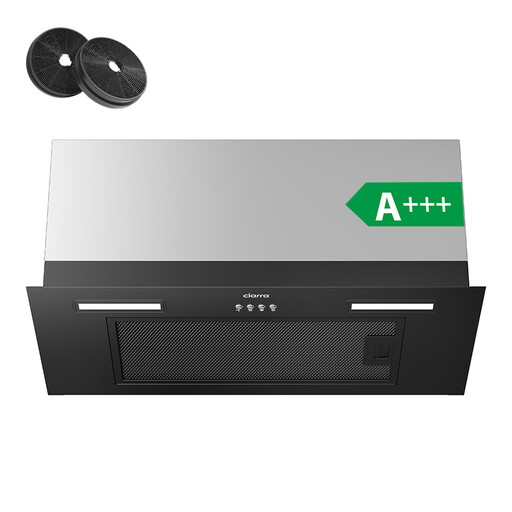
Why it's a perfect fit: Ideal for users seeking a powerful yet invisible solution for a modern, handleless kitchen. The unit disappears completely into the upper cabinet, maintaining a seamless, minimalist aesthetic.
Supports both extraction and recirculation modes, thus avoiding the operating mode mistake. Its A+++ efficiency with an annual consumption of just 9 kWh/a prevents the hidden costs trap of high electricity bills.
Combines a very high airflow rate for a built-in hood of 650 m?/h with the highest Energy Efficiency Class A+++. The washable aluminium filter reduces maintenance costs.
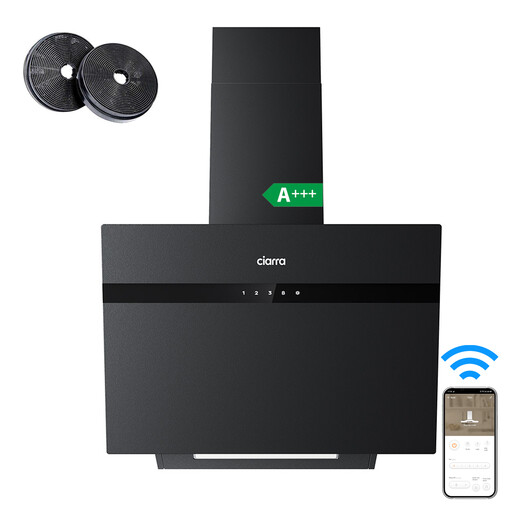
Why it's a perfect fit: For users who want to enhance their kitchen with a functional design object. The angled design, the matte and writable glass front, and the control via app and Wi-Fi appeal to a modern, tech-savvy audience.
Despite a high performance of 650 m?/h, the noise level remains in a comfortable range at 58 dB, avoiding the noise trap. The washable grease filter minimises ongoing costs.
Combines A+++ energy efficiency with smart control via Wi-Fi/App. The writable, matte glass surface is a unique feature for creative kitchens.
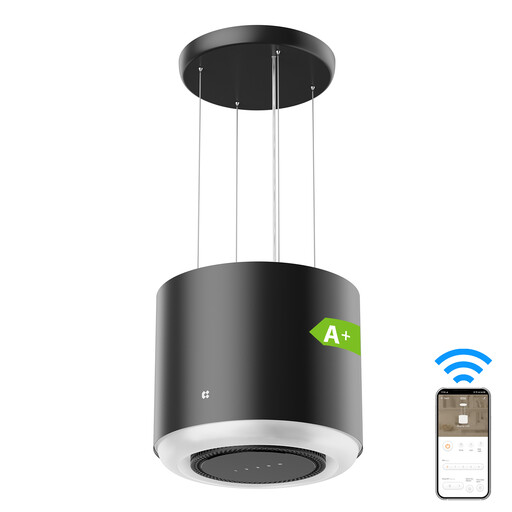
Why it's a perfect fit: Specifically designed for open-plan kitchens with a cooking island. Its free-hanging design is reminiscent of a modern light fixture, becoming a focal point rather than obstructing the line of sight. Perfect for social cooking evenings.
Designed as a pure recirculation model, it bypasses the complex and often impossible installation of an extraction duct for a central cooking island. The noise level is well-balanced at 62 dB for its 550 m?/h performance.
Unique, pendant-light design for kitchen islands. Offers smart control via app and customisable LED lighting that serves as both task and ambient light.
We have compiled a complete, up-to-date list of products that fully meet these strict selection criteria and all relevant safety regulations.
1. How loud should a cooker hood be? A good benchmark for a cooker hood to be considered quiet is under 60 dB on its highest setting. Models around 50-55 dB are considered very comfortable. Always check the manufacturer's specifications, as the noise level varies with each power setting.
2. How often do you need to change the activated carbon filter on a recirculation hood? The lifespan of an activated carbon filter depends heavily on cooking intensity. As a general rule, it should be replaced every 3 to 6 months. Some modern filters are regenerable and can be "refreshed" in the oven, extending their life. You can find this information in the respective filter's product description.
3. Do I need my landlord's permission for a recirculation cooker hood? Usually not. Since a recirculation cooker hood does not require structural changes like a wall vent, it is ideal for rental properties. The filtered air is directed back into the room. Therefore, installation is typically possible without permission. In contrast, an extraction hood always requires the consent of the landlord or homeowners' association.