
Lieferung heute & morgen

Qualitätsgarantie

Willkommens-Angebote freischalten: KOSTENLOSE Lieferung | Bis zu 80 % RABATT | Kostenlose 30-Tage-JoyPlus-Testphase
App herunterladen
Anyone looking to buy honey will find a wide selection of varieties, brands and pack sizes online. However, there are clear differences between blossom honey, forest honey, organic honey and Manuka honey in terms of flavour, consistency, origin and price. Eye-catching packaging or a term such as “natural” is therefore not enough to assess a product properly.
A product with honey flavouring does not have to consist of 100% honey. For example, the product description for Asbal Suzme Bal Honey Syrup 486 g states that it contains a mixture of at least 10% honey and glucose-fructose syrup. If you are looking for pure honey, you should therefore check the ingredients list. For an unadulterated product, this will generally list only honey or the specific honey variety.
Snacks such as honey butter crisps should not be included in the same comparison group as edible honey either. They contain additional ingredients and flavourings, as well as declarable allergens such as soya, depending on the product.
Liquid honey is easy to measure and is suitable for tea, muesli or pancakes. Creamy honey, on the other hand, is spreadable and stays on your toast at breakfast. Its consistency depends, among other things, on the honey variety, water content and natural crystallisation.
Crystallised honey is not automatically spoiled. Crystallisation is a natural process. A jar can be warmed carefully in a bain-marie. However, excessively high temperatures can affect its sensory characteristics.
Organic honey must be produced and labelled in accordance with the requirements of the EU Organic Regulation. An organic seal relates to the production method, not to any medicinal effect or automatically more intense flavour.
For Manuka honey, details such as UMF and MGO are values used to classify the product. They are not health claims. According to the product information, Manuka Doctor UMF 18+ / 690+ MGO is independently tested for this labelling and consists of 100% monofloral New Zealand Manuka honey. The product is a food, not a medicine.
The ingredients list is the quickest quality filter. Pure blossom honey, forest honey or lime blossom honey should not list any additional type of sugar. The variety designation provides clues about the flavour:
Look for the country of origin or information stating whether the product is a blend of EU and non-EU honeys. For example, Alnatura Organic Forest Honey 500 g lists its origin as EU and non-EU; the product also bears the organic inspection body number DE-ÖKO-001.
According to the product description, Alnatura Organic German Blossom Honey 500 g is made in Germany and produced in accordance with Bioland guidelines. Such information allows for a more objective assessment than general terms such as “pure and natural” or “from sunny landscapes”.
For a family household, 500 g honey can be more economical and practical if the product is used regularly on bread, in tea and for baking. Smaller 250 g jars are suitable for varieties that only appear on the table occasionally, such as Manuka or lime blossom honey.
Portion packs such as Langnese Honey Minis Summer Blossom Honey 5 × 20 g are suitable for lunch boxes, travelling or guests. A squeezy bottle such as Langnese Flotte Biene makes clean dispensing easier, while a jar is often better suited to keeping a supply at home.
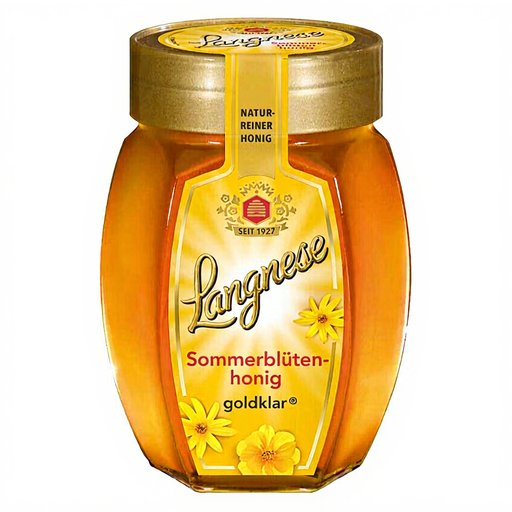
Why this product suits this profile: The 500 g pack is suitable for households that want to use a mild summer blossom honey regularly on bread, in tea, muesli or pancakes.
The ingredients list names honey as the sole ingredient. This clearly distinguishes it from syrup blends containing honey.
500 g contents, made in Germany and versatile for everyday use.
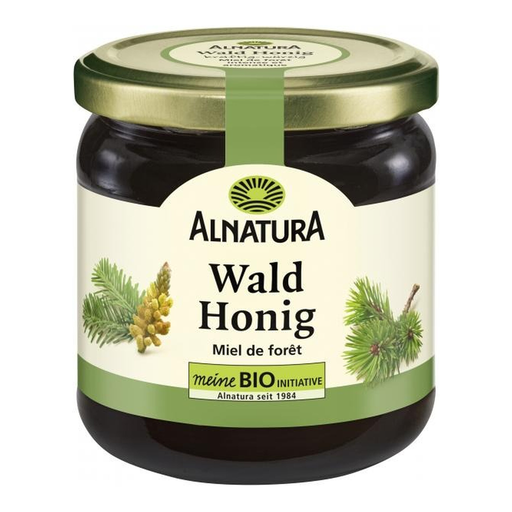
Why this product suits this profile: This robust forest honey is aimed at buyers who value organic labelling, glass packaging and a spicy flavour.
The organic claim is supported by DE-ÖKO-001 and the reference to the EU Organic Regulation.
Organic forest honey, 500 g contents and a liquid consistency for bread, drinks and dressings.
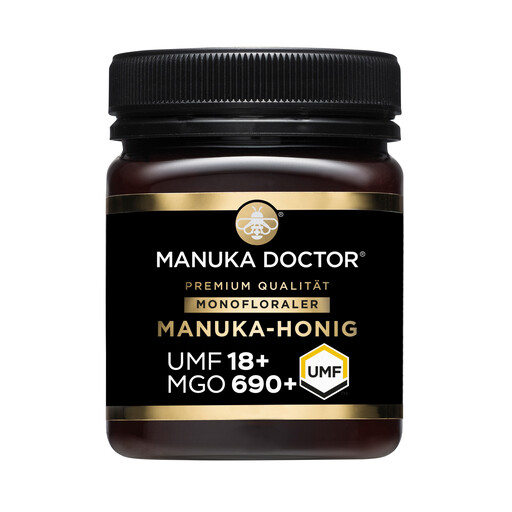
Why this product suits this profile: The 250 g pack is suitable for buyers specifically looking for monofloral Manuka honey with stated UMF and MGO values.
The product information states that it contains 100% monofloral Manuka honey and gives the values UMF 18+ and MGO 690+, rather than making an unexplained health claim.
100% Manuka honey, 250 g contents and documented UMF/MGO labelling.
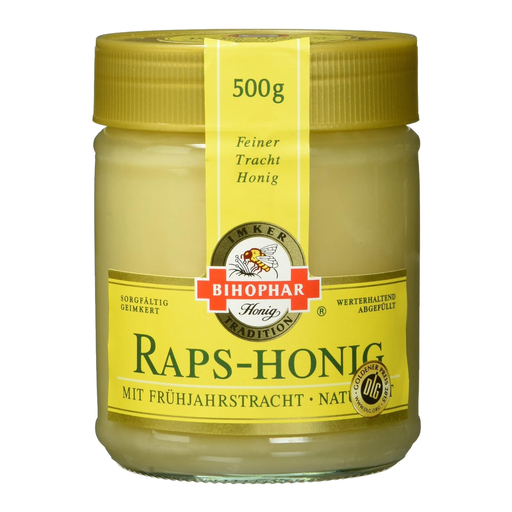
Why this product suits this profile: This creamy rapeseed honey is aimed at families who prefer a pale, spreadable honey for their daily breakfast.
The creamy consistency is explicitly stated as a product characteristic and is not attributed to an artificial additive.
500 g contents, 100% rapeseed honey and a spreadable texture for bread, yoghurt and desserts.
We have put together a complete, regularly updated list of products that fully meet these strict selection criteria and the safety regulations applicable in the EU.
Honey should be stored in a dry place, tightly sealed and protected from direct light at room temperature. Refrigeration is normally not necessary and can speed up crystallisation. If possible, use a clean, dry spoon to prevent additional moisture from getting into the jar.
Honey is a natural sweetener, but it consists mainly of sugar. The nutritional information for many products is around 75 g of sugar per 100 g. If you have diabetes, it may be advisable to discuss its use with your healthcare professional.
Important for families: honey and raw honey products are not suitable for children under twelve months. If you are allergic to bee products or pollen, follow the ingredients and safety information on the packaging.
When unopened and stored correctly, honey generally keeps for a long time. The best-before date on the individual jar is the key reference. After opening, the lid should be closed tightly again. Changes in colour, aroma or consistency can occur in a natural product.
Crystallisation depends on the honey variety and the ratio of different types of sugar. Rapeseed honey often becomes creamy, while acacia honey and many liquid forest honeys remain pourable for longer. Honey that has set can be liquefied carefully in a warm bain-marie.
Mild blossom honey or acacia honey goes well with tea, yoghurt and baked goods without overpowering other flavours. Forest honey and lime blossom honey offer a more distinctive flavour profile. For choosing between products, the ingredients list, consistency, pack size and intended use are more important than general advertising claims.