
Lieferung heute & morgen

Qualitätsgarantie

Willkommens-Angebote freischalten: KOSTENLOSE Lieferung | Bis zu 80 % RABATT | Kostenlose 30-Tage-JoyPlus-Testphase
App herunterladen
By Joybuy Product Recommendation Officer
A kitchen knife should cleanly chop vegetables, portion meat and perform reliably in everyday use. Yet shoppers often pick products whose most important qualities only become apparent during daily use. Three typical pitfalls are especially worth noting:
If you’re choosing kitchen knives for a British household, catering or regular dinner parties, it’s worth matching the actual product details to your intended use.
The knife shape determines which movements are safe and controlled:
A longer blade isn’t automatically more practical. In smaller kitchens or with short ingredients, a compact knife can make handling easier.
Stainless steel is easy to care for in everyday kitchen use and resistant to corrosion. Even so, a knife should be dried after washing, especially if it has come into contact with acidic foods.
Also pay attention to the specific edge type:
Some ZWILLING models specify FRIODUR ice-hardening. With the ZWILLING Gourmet Vegetable Knife, the manufacturer also states a hardness of 55–58 HRC. Such details are more meaningful than vague promises of “durability”.
An ergonomic handle should sit securely in your hand and offer enough control even when your hands are damp. Plastic handles are usually lightweight and straightforward to clean. Wooden handles, on the other hand, need more care and often shouldn’t go in the dishwasher.
The label dishwasher-safe doesn’t mean the dishwasher is ideal for every use. Heat, detergent, contact with other cutlery and prolonged moisture can put more strain on the edge or handle. For high-quality kitchen knives, hand washing with a mild detergent and immediate drying is therefore often the gentler choice.
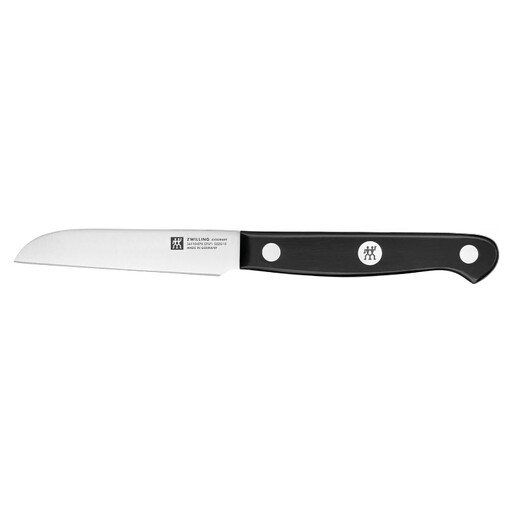
Why this product fits the profile: This compact vegetable knife covers typical tasks like peeling, trimming and cutting small ingredients, without requiring a full knife set.
Blade length, V-edge and material are all clearly stated. Dishwasher suitability is mentioned, while hand washing is recommended to preserve the knife.
8 cm blade made from specially smelted stainless steel, ergonomic plastic handle and manufactured in Germany according to product details.
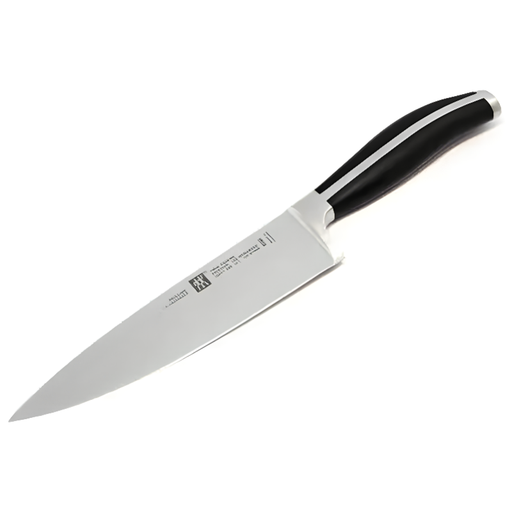
Why this product fits the profile: The longer blade is designed for regular prep work such as chopping herbs, dicing vegetables and cutting meat.
The product details state 20 cm blade length, FRIODUR ice-hardening and a one-piece SIGMAFORGE construction. Hand washing is also explicitly recommended.
Full-tang construction without rivets, V-edge with 15 degrees per side and ergonomic plastic handle with finger guard.
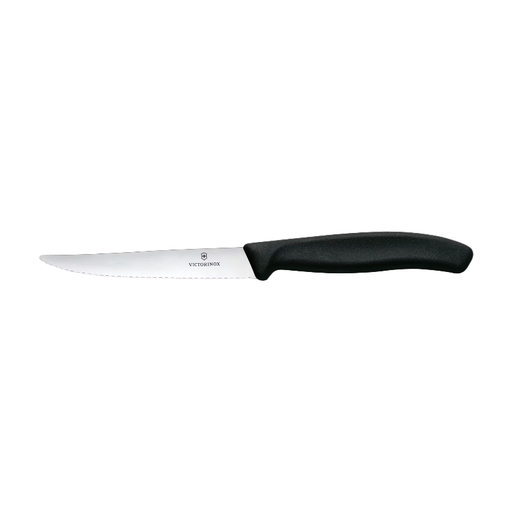
Why this product fits the profile: Six knives with an 11 cm serrated edge are designed for family meals, barbecues, pizza and serving multiple guests.
The serrated edge is clearly specified and suits cutting firm crusts. This avoids trying to use a plain all-purpose knife for every table task.
Six pieces, stainless steel according to the product description, ergonomic PP handles and dishwasher suitability.
Only use kitchen knives on suitable chopping boards made of wood or plastic. Glass, stone and ceramic surfaces can damage the edge. After cutting, knives should not be left sitting in washing-up water. Clean them, dry them and store them separately from other cutlery – for example in a knife block, a drawer insert, a magnetic strip or with a blade guard.
If you notice visible chips, a loose handle or a damaged blade, the knife should not be used further. Especially with a chef’s knife or carving knife, a secure grip is essential. For ongoing maintenance, depending on the edge geometry, a honing steel, whetstone or a suitable knife sharpener can be used.
We’ve put together a full, regularly updated list of products that fully meet these strict selection criteria and the safety regulations in force in the EU.
For many households, a chef’s knife of around 18 to 20 cm is versatile. A small paring or vegetable knife can also be a useful addition. If you often serve pizza or steaks, you’ll also need a knife with a serrated edge.
The lifespan depends on the blade steel, grind, usage, chopping board and care. Cutting on hard surfaces, incorrect storage and contact with other cutlery can dull the edge more quickly. Regular honing or professional sharpening helps maintain usability, but doesn’t replace careful handling.
Some models are labelled as dishwasher-safe according to product details. However, hand washing is still often recommended to preserve the edge and handle. For knives with a wooden handle or those explicitly marked for hand washing, the dishwasher should be avoided.