
Lieferung heute & morgen

Qualitätsgarantie

Willkommens-Angebote freischalten: KOSTENLOSE Lieferung | Bis zu 80 % RABATT | Kostenlose 30-Tage-JoyPlus-Testphase
App herunterladen
LED lights differ not only in shape and colour temperature. The type of connection, installation dimensions, dimming technology and the intended location are all crucial. If you focus solely on wattage or product images, you could easily end up buying a light that doesn't fit your existing cut-out, flickers with your dimmer, or isn't sufficiently protected for the outdoor area you have in mind.
The IP44 rating describes protection against solid foreign objects and splashing water. It is suitable, for example, for many bathroom areas, covered entrances or sheltered patios. However, it does not automatically cover direct water jets or permanently unprotected outdoor installation.
IP65 LED recessed spotlights offer, according to the product specification, a higher level of protection against dust and water jets. Nevertheless, the installation location, connection point and manufacturer's instructions must all be compatible. An IP rating does not replace a professional installation.
With conventional dimmable LED spots, a compatible leading-edge or trailing-edge dimmer is often required. If the light and dimmer are not matched, flickering, humming or a limited dimming range can occur. With smart lights, brightness control is sometimes handled exclusively via an app or voice control.
Before purchasing, you should therefore check:
With LED recessed spotlights, the ceiling cut-out, installation depth and connection type are not standardised. A model requiring a 67–75 mm cut-out will not fit an opening of 90–100 mm. A shallow installation depth can also be relevant if there is limited space above the ceiling for the driver or connection terminals.
Before ordering, you should therefore measure the existing cut-out, installation depth and mains voltage. Work on 230-volt connections should be carried out by a qualified electrician.
Luminous flux in lumens describes the amount of light emitted. The wattage, on the other hand, primarily indicates power consumption. For room planning, the lumen value is therefore more meaningful. A 600-lumen spot is suited to different tasks than a light with 1,200 lumens.
Colour temperature is given in Kelvin:
Many 3CCT lights offer these three settings via a switch on the light body. The adjustment is usually made before installation. With an RGB+CCT LED, coloured light and often app control are added.
For living spaces, 220–240 volts is standard. For motorhomes, boats and caravans, however, 12–24 volts DC may be used. A 12-volt model must not be connected directly to 230 volts. Conversely, certain 12-volt AC applications may require a separate transformer.
Aluminium can help with heat dissipation, while polycarbonate or ABS are often used for covers and housings. However, the material alone does not indicate suitability for damp rooms. The stated IP rating, installation instructions and electrical design remain the decisive factors.
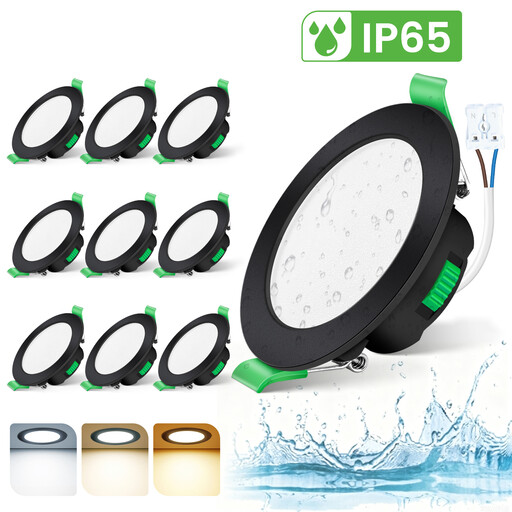
Why this product fits the profile: The 6-pack is designed for renovations and multiple identical ceiling cut-outs. The 3CCT selection allows you to adapt it to different rooms.
Cut-out of 67–75 mm, 29 mm installation depth and IP65 are clearly stated. Dimming is designed for compatible trailing-edge dimmers.
7 W, up to 600 lm according to the product specification, 3,000/4,000/6,500 K and a 6-pack.
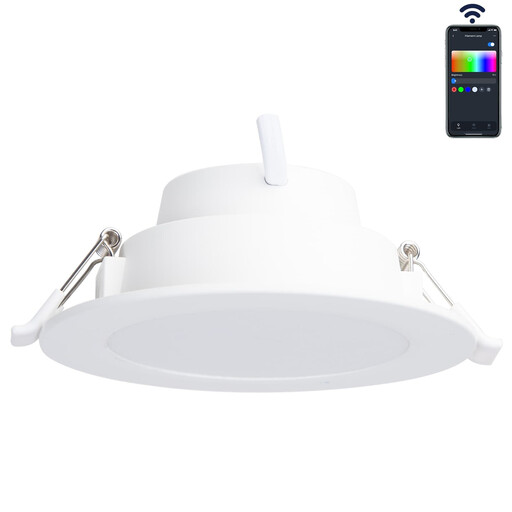
Why this product fits the profile: This smart LED recessed spotlight is aimed at users who want to control colour temperature, RGB colours and brightness via Bluetooth Mesh or compatible voice assistants.
The product specification explicitly states IP20 and indoor use only. Dimming is done via the app, not an external wall dimmer.
9 W, 780 lm, RGB+CCT from 2,700 to 6,500 K, 120° beam angle and Bluetooth Mesh support.

Why this product fits the profile: This model is designed for campers, vans, caravans, motorhomes and boats. The low voltage suits many mobile power systems.
The permissible voltage of 12–24 V DC is clearly distinguished from 230-volt lights. For 12 V AC, a separate transformer is required according to the specification.
4 W, 400 lm, 3CCT selection, IP44 and a required ceiling cut-out of 55–68 mm.
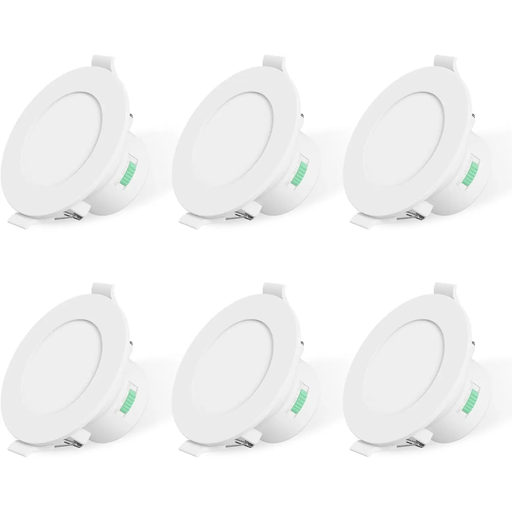
Why this product fits the profile: This LED stair lighting is designed for stairwells, hallways and standardised mounting boxes, and offers multiple light and power levels.
IP44, 230-volt connection, 30 mm installation depth and use with compatible phase dimmers are listed in the product data.
3CCT with 3,000, 4,000 and 6,500 K, dimmable from 10–100 %, up to 220 lm and 6 lights per set.
We have compiled a complete, regularly updated list of products that fully meet these strict selection criteria and the safety regulations in force in the EU.
For rooms without a recessed ceiling, LED ceiling lights can be a practical alternative. Pay attention to the mounting type, luminous flux and the stated room size. A 22 W light with around 2,400 lm is, according to the product specification, intended for compact areas such as hallways, balconies or stairwells.
As a replaceable bulb, an LED bulb E14 variant is suitable for compatible fittings. The Aigostar Smart LED Filament Candle E14 C35 offers, according to the product description, 4.5 W, 470 lm, Bluetooth Mesh control and a colour temperature of 2,700–6,500 K. Before buying, check the shape, maximum light height and app compatibility.
For the garden, LED garden lighting and RGB-CCT spots with a ground spike are worth considering. With an IP44 model, the power supply should be protected, the light correctly installed and use in extreme weather conditions considered according to the instructions.
No. The light must be explicitly suitable for the dimming technology used. Some products require a trailing-edge dimmer, while smart models control brightness only via an app. The combination should be checked against both manufacturers' specifications before installation.
The stated lifespan depends on the model and, for the products mentioned, is, for example, 15,000, 25,000 or 30,000 hours. The actual service life depends on factors including operating hours, heat dissipation, ambient temperature and the quality of the power supply.
Power consumption is given in watts and should be considered alongside the required luminous flux in lumens. A direct comparison is only meaningful if both lights offer a similar amount of light, usage duration and light distribution. With smart lamps, a small standby consumption may also occur.