People with a limited fat allowance
If you’re including nuts in a low-fat diet, measuring your portion matters more than the pack size. Product examples listed by EDEKA and REWE show that even plain nuts can contain a lot of fat per 100 g.


A large pack of nuts may suit a low-fat diet if nuts fit your eating plan, you measure out portions and can use them all up. Compare the fat per 100 g and the ingredients of the specific products. Plain nuts contain no added oil, but that doesn’t automatically make them low in fat.
If you’re including nuts in a low-fat diet, measuring your portion matters more than the pack size. Product examples listed by EDEKA and REWE show that even plain nuts can contain a lot of fat per 100 g.
If several people eat nuts or you cook with them regularly, a larger pack may suit your needs. The key is whether you can store opened nuts properly and use them up.
If you have allergies, check the ingredients and any warnings about possible traces on the specific product. For young children, also bear in mind that whole nuts can pose a choking risk.
First, check whether nuts fit your eating plan and what portion size works for you. Then choose a pack size that suits how much you use and your household’s needs.
| Criteria | What to check | Who it matters most to |
|---|---|---|
| Fat and portions | Compare the fat per 100 g on the specific pack and decide how much you plan to use each time. | If I’m including nuts despite having a limited fat allowance, I want to decide on my portion before eating. Around 42% of consumers put this concern first. |
| Usage and freshness | Match the pack size to how much you use and check the storage instructions once opened. | I don’t want a large pack to sit open for too long, as I only use nuts occasionally. That’s why choosing a pack size that suits your usage is a priority for around 33% of consumers. |
| Allergens and safe storage | Check the ingredients, allergen and trace warnings, and any other warnings on the specific pack. | If I’m shopping for other members of my household, I need to consider allergens and keep whole nuts out of reach of young children. This is a priority for around 25% of consumers. |
No added oil doesn’t mean a product is low in fat: the plain cashews listed by EDEKA contain 47.1 g of fat per 100 g.
Use the ingredients list to check for added ingredients, and the nutrition information to assess the fat per 100 g and your planned portion.
A large pack won’t suit every household. If you use nuts slowly, the quality of an opened pack may deteriorate.
Before buying, think about how quickly you’ll use them. For shelled walnuts, Verbraucherzentrale recommends storing them in an airtight container in the fridge or freezer.
The roasted, salted peanuts listed by EDEKA contain sunflower oil and salt. Their ingredients are therefore different from those of the plain cashews listed there.
For each variety, compare the ingredients list and the fat and salt per 100 g rather than assuming the ingredients based on the type of nut.
Nut mixes can contain several types of tree nuts. The Seeberger nut mix listed by REWE also carries a warning about the risk of choking for children under four.
Check the information on the specific pack every time you buy, and keep whole nuts out of reach of young children.
The Seeberger nut mix listed by REWE contains hazelnuts, almonds, cashews and walnuts in a 400 g pack.
EDEKA sells, among other products under this own-label brand, plain cashews and roasted, salted peanuts.
ALDI SÜD lists various 500 g XXL formats under FARMER NATURALS, including plain walnut kernels and almonds.
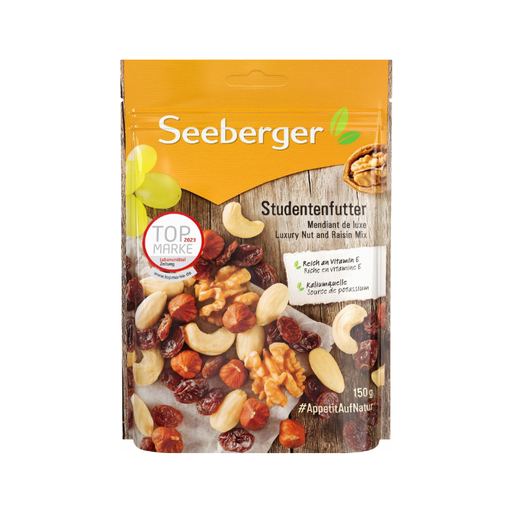
The student trail mix shown here comes in a 150 g pack. If you’re specifically looking for a large pack, consider whether this size suits how much you actually use rather than relying on the product category alone.
 No image available
The 150 g pack is an option if you prefer to plan your nut portions and don’t need a large pack to stock up on.
Pack size: 150 g. To help you choose, compare the nutrition information and ingredients in this particular mix with those of other nut products.
No, the pack size doesn’t make nuts low in fat. The plain cashews listed by EDEKA contain 47.1 g of fat per 100 g, while the roasted, salted peanuts contain 51 g. The Seeberger nut mix listed by REWE contains 56 g. What matters is whether the specific product fits your diet and the portion you measure out.
Start with the fat per 100 g and the ingredients, then check the other nutritional information and salt content. ‘Plain’ doesn’t make this comparison unnecessary: for example, the salted peanuts listed by EDEKA also contain sunflower oil and salt.
Check the specific tree nuts and peanuts listed in the ingredients, along with any warnings about possible traces. Lebensmittelklarheit explains that common allergens must be labelled on food products; when choosing, always refer to the information on the specific product.
Follow the storage instructions on the pack and keep opened nuts away from heat and moisture. For shelled walnuts, Verbraucherzentrale recommends storing them in an airtight container in the fridge or freezer.
Whole nuts can pose a choking risk for young children. The Seeberger nut mix listed by REWE carries an explicit warning about this risk for children under four, so keep products like these out of their reach.