
Lieferung heute & morgen

Qualitätsgarantie

Willkommens-Angebote freischalten: KOSTENLOSE Lieferung | Bis zu 80 % RABATT | Kostenlose 30-Tage-JoyPlus-Testphase
App herunterladen
Choosing the right olive oil can be a challenge given the vast array of varieties, origins, and quality seals. Terms like "extra virgin," "cold-pressed," or the question of which oil is best for frying often lead to uncertainty. This guide serves as a reference, presenting objective criteria to help you make an informed choice that meets your culinary needs.
To make the right choice, a basic understanding of the different properties of olive oil is helpful. The following points summarise the most important aspects.
The most important distinction in olive oil is its quality grade. This indicates the quality and the production method.
For pure enjoyment in salads or for finishing dishes, an extra virgin olive oil is the standard choice due to its distinct flavour.
Not every olive oil is suitable for every purpose. The deciding factor is the smoke point—the temperature at which an oil begins to smoke and break down.
The origin shapes the character of an olive oil. Italian olive oil, especially from regions like Sicily or Tuscany, is often known for its grassy and peppery notes. Greek olive oil, for example from Crete, is frequently characterised by a milder, fruitier aroma.
You can identify an organic olive oil by the EU organic seal. This guarantees that the olives come from certified organic farming and that no synthetic chemical pesticides or fertilisers were used in production.
Here is a selection of products that cover different requirements and uses.

What makes it special This extra virgin olive oil comes from Buccheri in Sicily and is made from olives grown in certified organic cultivation. It is described as an oil with fruity notes and represents the quality for which Italian olive oil from this region is known. The production follows the strict criteria for organic olive oil.
Objective Features
Who it's for This oil is a suitable choice for consumers who value organic farming and a robust, high-quality oil for cold dishes, such as salads, bruschetta, or for finishing cooked meals.
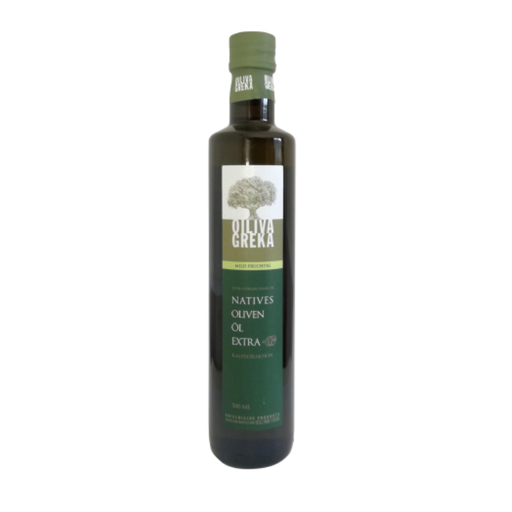
What makes it special This extra virgin olive oil is produced directly on Crete. It is made by cold extraction using exclusively mechanical methods, which meets the criteria for the highest quality grade. Greek olive oil from the island of Crete is prized for its balanced flavour profile.
Objective Features
Who it's for Ideal for home cooks and gourmets looking for an authentic Greek olive oil for Mediterranean dishes, salads, and appetisers. It offers a classic taste experience for daily use in cold preparations.

What makes it special This product was specially developed for cooking at high temperatures. It is a blend of refined and virgin olive oils. According to the manufacturer, it is heat-resistant up to 195°C and is therefore explicitly suitable as an olive oil for frying, grilling, and baking.
Objective Features
Who it's for This oil is aimed at anyone who wants to enjoy the health benefits of olive oil in hot dishes and needs a reliable, high-heat oil for the daily preparation of warm meals.
The world of oils is diverse and offers the right product for every taste and purpose. If the options presented here don't quite match what you're looking for, you can find a wider selection in our category.
Discover our entire range of Cooking Oil.
1. Can you fry with extra virgin olive oil? Frying with extra virgin olive oil is possible at low to medium temperatures (up to approx. 180°C), for example, for gently sautéing vegetables. It is less suitable for high-heat searing, as its smoke point is lower than that of special frying oils. If the smoke point is exceeded, undesirable substances can form and the delicate flavour is lost.
2. What does "cold-pressed" mean for olive oil? "Cold-pressed" is a traditional term that is often used interchangeably with "cold-extracted" today. Both terms describe a mechanical production process without the addition of external heat. The temperature throughout the entire process must not exceed 27°C. This gentle method is a prerequisite for the "extra virgin" quality grade and serves to preserve the aromas and nutrients.
3. How do you store olive oil correctly to maintain its quality? Olive oil is sensitive to light, heat, and oxygen. To preserve its quality and flavour for as long as possible, it should be stored in a cool, dark place—for example, in a closed kitchen cabinet, but not in the refrigerator. After opening, the bottle should always be tightly sealed to minimise oxidation from contact with air.