
Lieferung heute & morgen

Qualitätsgarantie

Willkommens-Angebote freischalten: KOSTENLOSE Lieferung | Bis zu 80 % RABATT | Kostenlose 30-Tage-JoyPlus-Testphase
App herunterladen
Watercolour pencils combine precise drawing with water-soluble colour effects. When dry, you can use them just like classic coloured pencils; with a damp brush, they create washes, gradients and softer transitions. For artists, illustrators, art students and creative beginners, this sounds straightforward at first. However, there are several points when buying that determine how practical they actually are.
Many products boast a high number of colour shades. For getting started, though, what matters more is whether the colours included suit your subject matter and whether individual shades can be bought separately. A small watercolour pencil set with well-chosen basic colours can be more practical than an extensive selection where many hues rarely get used.
If you mainly draw plants and landscapes, you will need different colours to someone creating portraits, architecture or manga illustrations. So check whether the shade you want – such as Olive Green, Sepia, English Red or Light Blue – is also available individually or in a suitable pack.
Water-soluble coloured pencils need a surface that can absorb moisture. Thin printer paper often buckles, while the surface can become rough with repeated reworking. For watercolour painting, watercolour paper with a sufficient weight is recommended. The more water you use, the more important paper thickness and surface quality become.
Mixed-media techniques on mixed-media paper are also possible. However, the results depend on the paper, the amount of water, the brush and the pigment application. Marketing claims such as 'intense colours' should therefore always be considered in the context of your specific use.
Soft watercolour pencils release colour easily and blend quickly. This is handy for broad areas and soft transitions. For very fine details, however, a lead that is too soft can become blunt more quickly or wear down more when sharpening. For technical drawings, fine outlines and small details, a stable wooden casing, a well-bonded lead and a suitable sharpener are crucial.
Watercolour pencils can be used in several ways:
Look for clear information about water solubility. The terms watercolour pencils or water-soluble coloured pencils basically describe the same concept, but they do not replace checking product details such as lead diameter, pack contents and colour shade.
A larger lead diameter can offer advantages for areas and strong colour application. The Faber-Castell Albrecht Dürer watercolour pencil, for example, is offered with a 3.8 mm lead. For STAEDTLER Karat watercolour pencils, the product information mentions a soft, water-soluble lead.
Also important for your buying decision are:
A metal sharpener with the right opening can be useful for soft leads. Sharpening too roughly, on the other hand, leads to unnecessary material loss.
If you pay attention to traceable material information, you will find references to FSC-certified wood or PEFC-certified wood on several products. Such certification refers to the origin of the wood and should not be confused with a statement about the painting effect.
Watercolour pencils should be stored dry and protected from prolonged direct moisture. A metal tin or a roll-up case protects the tips during transport. After blending, the brush should be cleaned so that colour residues do not spread onto subsequent subjects.
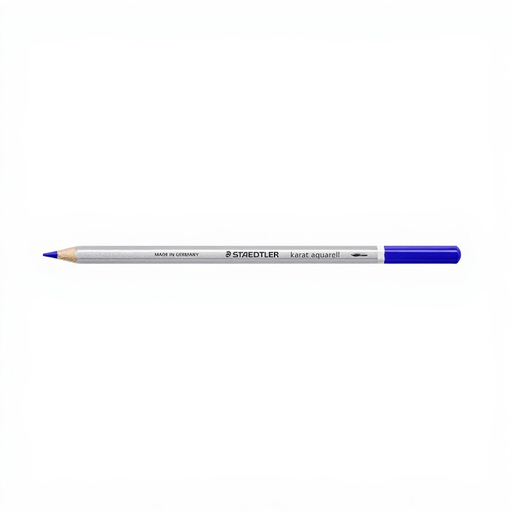
Why this product suits the profile: A compact pack of six blue coloured pencils is ideal for trying out dry drawings and your first watercolour effects without a large colour selection.
The product information explicitly mentions a water-soluble lead and several application techniques, rather than just boasting a high number of colours.
Hexagonal wooden casing, soft water-soluble lead and, according to the product information, FSC-certified wood.
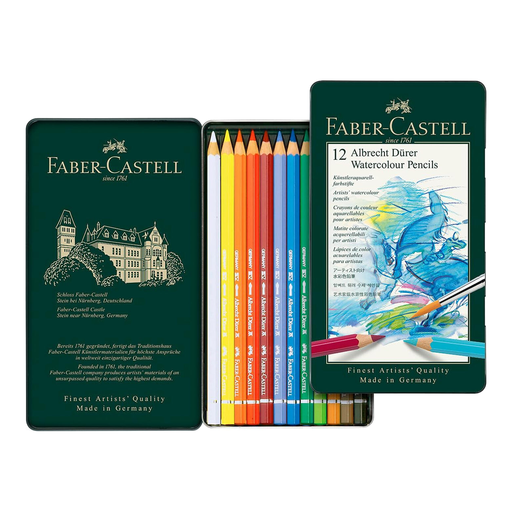
Why this product suits the profile: The set offers twelve colour shades, a specified 3.8 mm lead and a metal tin for artists, illustrators and students who regularly work with different colours.
The information lists the lead, set contents, storage and application separately. This makes it easier to assess what is included before buying.
12 water-soluble coloured pencils, metal tin and specified 3.8 mm lead diameter for controlled colour application.
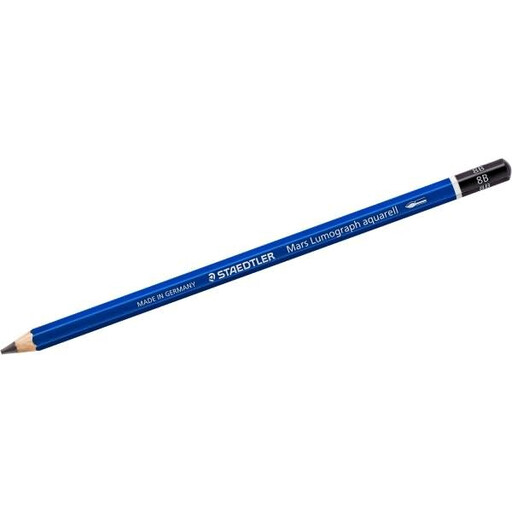
Why this product suits the profile: The black 8B graphite pencil is designed for dark sketches, hatching and washable graphite effects – a specialised addition to coloured artist pencils.
The lead is explicitly identified as water-soluble graphite with a hardness grade of 8B, not as an ordinary black coloured pencil.
8B graphite, approximately 3.6 mm lead diameter and PEFC-certified wood according to the product information.
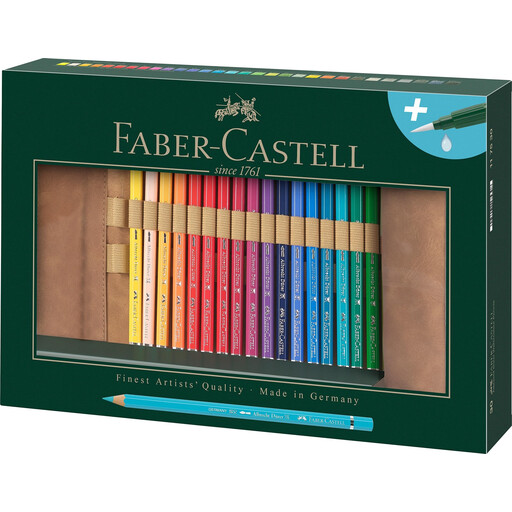
Why this product suits the profile: The 30-piece set is aimed at users who regularly work with many colour shades and want to transport their pencils.
The contents list includes 30 pencils, a roll-up case and a water brush. Storage is therefore part of the product and not an additional purchase later on.
30 water-soluble coloured pencils, 3.8 mm leads according to the product information, roll-up case and water brush.
We have put together a complete, regularly updated list of products that fully meet these strict selection criteria and the safety regulations in force in the EU.
For even gradients, first apply a thin, dry layer of colour and then dissolve it with a clean, slightly damp brush. Work from light to dark and wait between several water layers until the paper has dried sufficiently. Too much water can spread pigments uncontrollably and warp the paper.
Do not store watercolour pencils permanently in a damp environment. Tips should be protected before transport. With children under three years of age, special care is required due to small parts that could be swallowed and sharp pencil ends.
For beginners, a manageable watercolour pencil set with several basic colours makes sense. This allows you to try out dry drawings, simple gradients and working with a brush without having to buy an extensive colour palette straight away. Look for clear information about water solubility and what is included.
For initial attempts, sturdy mixed-media paper works well. For larger amounts of water or several washes, watercolour paper with a higher weight is more suitable. Thin paper can buckle or become rough when blending.
The lifespan depends on lead hardness, sharpening technique, pressure and frequency of use. Soft leads wear down more quickly with large colour areas. A suitable sharpener, dry storage and controlled pressure help to reduce material loss.