
Lieferung heute & morgen

Qualitätsgarantie

Willkommens-Angebote freischalten: KOSTENLOSE Lieferung | Bis zu 80 % RABATT | Kostenlose 30-Tage-JoyPlus-Testphase
App herunterladen
Condensation on windows, musty smells in the cellar or laundry that takes a long time to dry are typical signs of high indoor humidity. An electric dehumidifier can reduce moisture effectively – provided its performance, placement and drainage suit your actual needs.
However, buying the wrong model can often lead to unnecessary costs. Manufacturer specifications such as “20 litres per day” usually refer to set test conditions, for example 30 °C and 80% relative humidity. In a cool German cellar, the actual dehumidification performance is often lower. The stated room size is also only a guideline and depends on ceiling height, insulation, ventilation and the source of the moisture.
A 20L, 25L or 30L dehumidifier is not automatically suitable for every large area. The litre figure describes the maximum amount of water extracted under specific conditions. A more compact model may be sufficient for bedrooms, bathrooms or smaller living spaces. In a damp cellar or utility room, however, a higher air circulation rate and continuous drainage are practical features.
The term “quiet dehumidifier” often refers to sleep mode. Operating noise may be higher in standard or laundry-drying mode. For a bedroom, specific dB(A) figures, a sleep mode and a timer are therefore more important than a general marketing claim.
A small water tank needs to be emptied several times a day when humidity is high. For a cellar dehumidifier or longer periods of unattended operation, a dehumidifier with drain hose is usually more practical. The hose must run downhill to a suitable drain; a pump is not automatically included.
Start by considering the floor area and the level of moisture:
Always read these figures in light of the test conditions specified by the supplier. A mould-prevention dehumidifier does not replace an investigation into the cause of the problem: leaks, thermal bridges, inadequate ventilation or penetrating moisture must be addressed separately.
Ice can form on the heat exchanger in cool cellar rooms. A dehumidifier with auto-defrost interrupts compressor operation when necessary and defrosts automatically. This is particularly relevant at temperatures close to 5 to 15 °C. Check the specified operating range; many units are designed for temperatures of approximately 5 to 32 or 35 °C.
Look for:
On units using R290, the refrigerant circuit must not be opened, heated or damaged. The unit should stand on a level, stable surface. Depending on the instructions, it may need to remain upright for a specified period after transport or being tilted before it is switched on.

Why this product suits the profile: Suitable for rooms of up to around 25 m², this unit offers a manageable capacity, a 3.8-litre tank and a drain hose for bathrooms or smaller living spaces.
The combination of a tank, continuous drainage, timer and automatic shut-off reduces the need for frequent checks.
12 L/day under the specified conditions, auto-defrost and a 24-hour timer.

Why this product suits the profile: Designed for living spaces of up to around 40 m², this model combines app control, scheduling and a sleep mode with a stated capacity of up to 20 L/day.
The stated operating noise of 40 dB(A) and separate sleep mode make it easier to assess noise claims more accurately.
App control with 24-hour scheduling, a 2.5-litre tank and two drainage options.
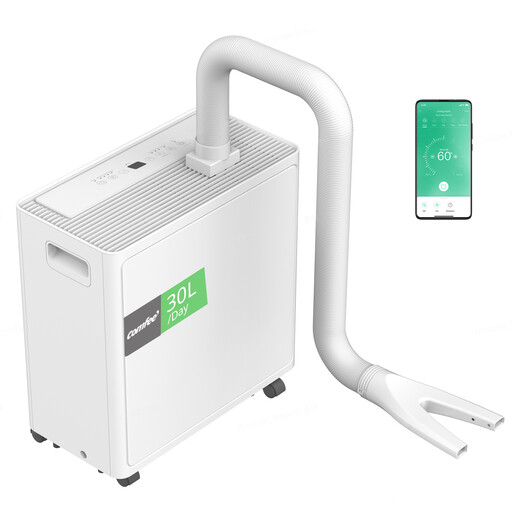
Why this product suits the profile: Designed for larger areas of up to around 72 m², this model is suitable for cellars, utility rooms and frequent use, thanks to its laundry-drying mode, app control and continuous drainage.
The 3.2-litre tank can be used with a drain hose, so longer operating periods do not rely solely on manual emptying.
30 L/24 h under test conditions, four operating modes, auto-defrost and a sound pressure level of 45.3–47 dB(A).
We have put together a complete, regularly updated list of products that fully meet these strict selection criteria and the safety regulations applicable in the EU.
This depends on the humidity level, room size and target setting. To begin with, running the unit for several hours at a time may be sensible. A hygrometer can help you monitor changes. Many units switch off the compressor automatically once the target humidity has been reached and restart when humidity rises again.
Running costs depend on the power consumption, operating time and electricity tariff. A 200-watt unit theoretically uses 0.2 kWh per hour of operation; actual consumption may be lower because of pauses and automatic regulation. Check the stated power consumption and use the timer or humidity control.
It is not possible to give a reliable fixed lifespan for every model. Regular filter cleaning, unobstructed airways, correct positioning and avoiding moving the unit while it is running can help prolong its service life. If you notice an unusual smell, smoke, a damaged cable or unusual noises, switch the unit off and disconnect it from the mains.