
Lieferung heute & morgen

Qualitätsgarantie

Willkommens-Angebote freischalten: KOSTENLOSE Lieferung | Bis zu 80 % RABATT | Kostenlose 30-Tage-JoyPlus-Testphase
App herunterladen
Purchasing a new home for a small pet is an important decision. However, the market for small animal cages can be overwhelming. Many products promise more than they deliver, leading to disappointment for both owner and pet. This guide will help you recognise the most common traps and make an informed choice based on functionality and species-appropriate housing.
The three most common pitfalls when buying a rodent cage are:
To avoid a bad purchase, you should focus on objective criteria. These three points are essential for selecting a durable and species-appropriate home.
The most important metric for your pet's well-being is the uninterrupted floor space. When reading the product description, pay attention not just to the external dimensions, but to the clear floor area. For ground-dwelling animals like guinea pigs, an XXL guinea pig cage with a large footprint is more important than multiple small levels. For animals that love to climb, like mice or hamsters, a tall Nagarium with deep bedding and climbing opportunities can be a good choice. Designing a species-appropriate mouse cage means providing space for both digging and climbing.
The material determines the cage's longevity, safety, and hygiene.
A good small animal cage must be practical for daily use. Large doors on the front and top are essential for removing the animal without stress and for setting up the cage. Removable bottom trays or fully opening tops make the weekly deep clean significantly easier. An indoor playpen should be easy to assemble and disassemble for flexible use.
Instead of making blanket recommendations, we present models that are well-suited for specific profiles and animal species.
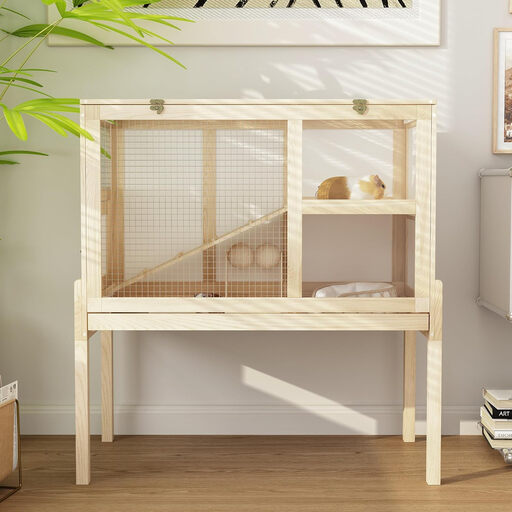
Why This Fits Their Persona: With its cabinet-like appearance, this model seamlessly integrates into any living space. It is ideal for owners of climbing rodents like mice who are looking for an aesthetically pleasing yet functional enclosure. The glass fronts allow for excellent observation of the animals.
The combination of coated particleboard and tempered glass bypasses the trap of unsuitable materials. The hinged lid facilitates access for cleaning and feeding, solving the problem of impracticality.
Sturdy, furniture-like construction. Good ventilation through the mesh top and a clear view of the animals through the glass fronts.
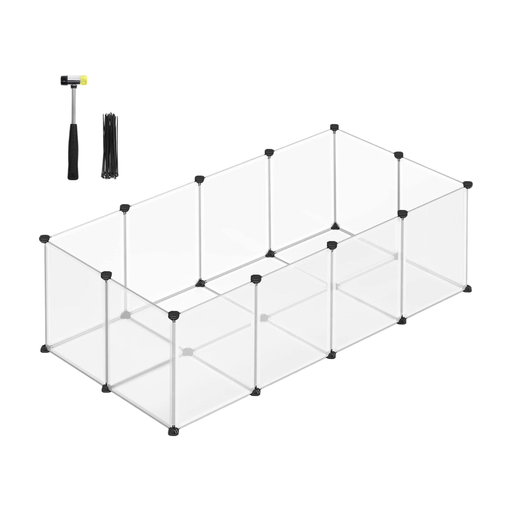
Why This Fits Their Persona: Perfect for owners who need a customisable and secure indoor play area. The modular system allows the shape and size to be adapted to the available space, ideal for guinea pigs, rabbits, or hedgehogs.
The integrated floor panels solve the problem of protecting carpets or wooden floors and prevent animals from digging under the enclosure. The seamless plastic edges offer no surface for gnawing.
Modular, expandable interlocking system. The integrated floor protects the surface underneath and stabilises the structure.
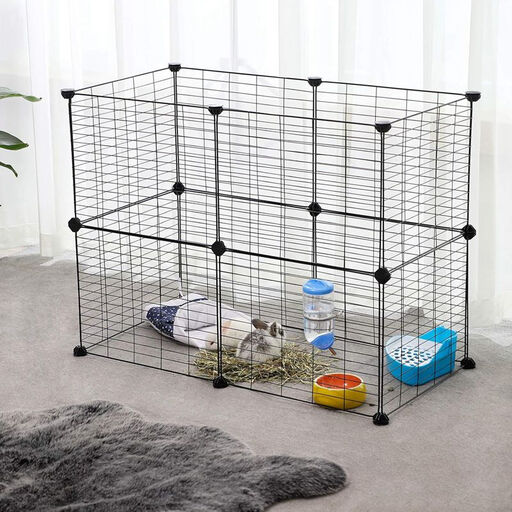
Why This Fits Their Persona: This enclosure is tailored to the needs of guinea pigs. It offers a very large, single-level area that accommodates the natural urge to move that these animals have. The deep base tray reliably keeps bedding and mess inside the cage.
It addresses the pitfall of misleading size specifications by offering an objectively large and fully usable floor space of over one square metre. The simple design with a large front door avoids the cleaning problems of complex structures.
Very large, uninterrupted floor space. Deep, leak-proof plastic tray and good ventilation through the wire top.
We have curated a comprehensive selection of enclosures that have been vetted for functionality and compliance with species-appropriate housing standards.
The cleaning frequency depends on the animal species, the number of animals, and the cage size. A daily spot-clean to remove leftover food, wet bedding, and droppings is recommended. A weekly deep clean, where all bedding is replaced and all surfaces are wiped down with a pet-safe cleaner, is essential for hygiene.
A combination has often proven to be the most practical. A Nagarium with a deep base made of glass or plastic allows the hamster to dig extensively without kicking out bedding. A wire top ensures good air circulation and provides climbing opportunities. If you prefer a wooden hamster cage, make sure the wood is treated with a saliva-proof, non-toxic varnish to protect it from moisture and gnawing.
Since guinea pigs do not climb, the largest possible floor space is crucial. As a guideline for two animals, animal welfare organisations recommend a minimum area of 120 x 60 cm, although bigger is always better. An XXL guinea pig cage offers more room for movement and social behaviour. Additionally, daily, supervised time in a playpen should be provided.