
Lieferung heute & morgen

Qualitätsgarantie

Willkommens-Angebote freischalten: KOSTENLOSE Lieferung | Bis zu 80 % RABATT | Kostenlose 30-Tage-JoyPlus-Testphase
App herunterladen
Whether for a birthday, wedding, afternoon tea, catering event or shop floor, cake stands and dessert stands create extra levels and make cakes, cupcakes, chocolates and canapés easy to see and serve. The choice ranges from simple cake stands and tiered stands to multi-tiered cake stands and modular display risers.
However, attractive looks alone are not enough. Unclear dimensions, delicate surfaces or an insufficiently wide base can make a buffet stand impractical for everyday use. The following guide from the Joybuy Product Recommendation Officer explains which criteria matter before you buy and which models suit different uses.
Product images often give a generous impression of size. In practice, the actual dimensions of each tier and the height of the complete arrangement are what matter. A cupcake stand with small platforms may be suitable for individual cupcakes, but it may not provide enough room for a large cake or wide dessert plates.
Before buying, check the following:
Metal, wood, plastic and glass differ in weight, cleaning requirements and appearance. A coated metal surface may look decorative, but it should not automatically be assumed to be heat-resistant or dishwasher-safe. With wood, moisture and liquid foods can put strain on the surface.
A food display stand should therefore be used in accordance with the manufacturer’s care instructions wherever possible. For direct contact with food, it is also advisable to check the relevant product information and, where necessary, use plates, baking paper or suitable inserts.
Several tiers do not automatically mean that every tier is suitable for heavy cakes. A large cake concentrates its weight over a small area. A narrow base or uneven tabletop can also affect stability.
For a buffet, the food presentation stand should be placed on a flat, dry and stable surface. Heavy cakes belong on the bottom tier or on a tier specifically designed for them. With metal stands, maximum load specifications are particularly important.
For tiered stands and multi-tiered cake stands, diameter, width, depth and the distance between tiers are crucial. Small gaps can make it difficult to remove desserts. Larger gaps require more space, but improve visibility.
Nesting sets, meaning sets that fit inside one another, save storage space. This is particularly useful for homes, cafés with limited storage or event planners transporting several buffet arrangements.
For a candy bar display or wedding reception, decorative design may be the main priority. In bakeries, patisseries and cafés, cleaning, repeated use and a robust construction are more important. In retail, a display riser can also showcase jewellery, cosmetics or small products.
Important: a stand for presenting food is not automatically a container for preparing it. Hot baking tins, naked flames or trays straight from the oven should only be placed on products explicitly designed for such use.

Why this product suits this profile: The set provides four rectangular tiers at different heights for cupcakes, pastries, appetisers or small products, and can be nested for storage.
The stated individual heights of 2, 3, 4 and 6 inches make it easier to plan the arrangement. The nesting function reduces the storage space required.
Four sizes, metal construction, rectangular surfaces and no assembly required according to the product information.

Why this product suits this profile: The transparent glass design with metal handle is ideal for canapés, small desserts and other portion-sized foods at formal occasions.
The three stated plate diameters of 18, 25.5 and 29.5 cm make the available surface easy to understand and help you choose suitable portions.
Three tiers, glass design, metal handle and a stated product weight of 1.885 g.
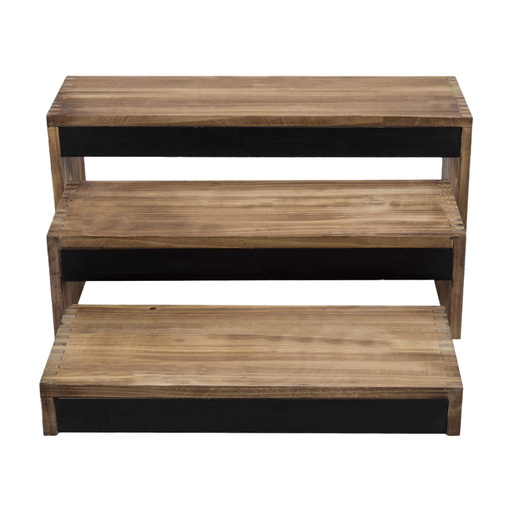
Why this product suits this profile: The three-piece wooden set with chalkboard surfaces is designed for large dessert tables, events, shop floors and changing labels.
The widths of 16.75, 18.5 and 21 inches and the depth of 7 inches are clearly specified. This makes it possible to plan the table space in advance.
Three heights, a nestable construction and writable chalkboard surfaces according to the product description.

Why this product suits this profile: Four square combinations of wooden tops and metal bases are suitable for dessert tables, catering, bakeries, parties and small retail displays.
The four stated heights of 2.6, 3.6, 4.7 and 6.7 inches prevent the tiers from merely looking different without creating a stepped presentation.
Four pieces, square surfaces measuring approximately 15 × 15 cm and a combination of wood and metal.
We have compiled a complete, regularly updated list of products that fully meet these strict selection criteria and the safety regulations applicable in the EU.
Before decorating, the table should be level and free from moisture. Heavy cakes can be placed on a separate cake board, while cupcakes, petit fours or fruit can be arranged on the raised tiers. A suitable plate or hygienic protective layer can be placed between the food and the surface, unless the manufacturer states that direct food contact is suitable.
After use, remove any residue promptly. For many wooden and coated metal stands, a soft cloth and mild cleaning solution are sufficient. Products with chalkboard surfaces should be labelled and cleaned in accordance with the relevant instructions. Storing them in a dry place helps prevent rust on metal and protects wooden surfaces.
For a small afternoon tea, two or three tiers are often sufficient. For a candy bar or a larger buffet, several individual display risers can be more flexible than a permanently connected tiered stand. This allows the height, spacing and viewing angle to be adjusted to suit the size of the table.
Its service life depends on the material, load, cleaning and storage conditions. Metal stands should not be overloaded or stored in a permanently damp environment. Wooden surfaces benefit from dry cleaning and should not remain in contact with liquid for extended periods. With glass, careful handling and safe storage are important.
A traditional serving stand has no ongoing energy costs. The only expenses to consider are cleaning products, replacement parts where applicable and storage space. In commercial settings, hygienic working procedures and regular visual inspections of the construction may also be relevant.