
Lieferung heute & morgen

Qualitätsgarantie

Willkommens-Angebote freischalten: KOSTENLOSE Lieferung | Bis zu 80 % RABATT | Kostenlose 30-Tage-JoyPlus-Testphase
App herunterladen
The right cake stand should support cakes securely, present them attractively and be easy to clean. In practice, however, unclear dimensions, delicate materials and decorative constructions are among the most common causes of disappointing purchases. This guide explains what private buyers, home bakers, hosts, cafés and catering businesses should consider before buying.
The term “cake stand” says little about the actually usable surface area. A cake plate with a diameter of 28 cm may be too small for a cake with decorations, piped edging or an additional cake dome. Before buying, measure the diameter of the cake including its decorations and compare it with the available serving surface.
With tiered models, the plates may also vary in size. For example, a three-tier stand may accommodate only small desserts or cupcakes on the top level, while the lower tier is suitable for a larger cake.
Glass, metal and wood can all be sturdy, but stability also depends on weight, base, connecting elements and the supporting surface. A tall tiered stand with a narrow base requires a level surface that is protected from vibrations. For a buffet with regular guest traffic, broad serving surfaces and a reassuring overall weight matter more than purely decorative details.
Not every cake stand is dishwasher-safe. In particular, wooden cake stands often must not be soaked. On painted or coated surfaces, harsh cleaning products can alter the finish. A glass cake plate with a metal handle may also consist of several individual parts that need to be cleaned separately and dried thoroughly.
The material should suit the intended use. For everyday use at home, a compact wooden cake stand may be all you need. For a versatile buffet, stackable metal risers or a tiered glass stand offer greater flexibility.
A round cake plate measuring 28 to 32 cm in diameter accommodates many standard cake sizes. For large novelty cakes, you should also allow for a suitable margin around the edge. The height determines whether a cake dome will fit and how easily guests can reach the desserts.
A specific maximum load is not provided for every model. Heavy, tall cakes should therefore only be placed on a stand whose construction appears suitable and whose base rests securely on the surface. Small dessert stands or cupcake stands are not automatically designed to support a full-sized cake.
Look for clear instructions such as “clean with a damp cloth”, “not dishwasher-safe” or “not suitable for use in the oven”. A cake stand should not be used as a cutting board unless the manufacturer expressly permits it. With tiered stands, it is also worth checking whether the levels nest together or can be disassembled for space-saving storage.

Why does this model fit the brief? With a diameter of 28 cm and a height of 9 cm, this round acacia wood cake stand is designed for compact afternoon tea spreads, kitchen worktops and smaller buffets.
The stated dimensions make it easier to compare the stand with your own cake. Care is straightforward but limited: wipe with a damp cloth, dry immediately and do not place it in the dishwasher, microwave or oven.
Acacia wood with natural grain; weight of 0.673 kg; suitable for cakes, pastries, fruit and desserts.

Why does this model fit the brief? This transparent glass stand with a metal handle distributes cake slices, canapés and small desserts across three levels, making it ideal for afternoon tea spreads and special occasions.
The three plates have clearly stated diameters of 29.5 cm, 25.5 cm and 18 cm. This allows you to plan in advance which foods belong on each level.
Three levels; glass surfaces for a neutral presentation; total weight of 1.885 kg according to the product information.

Why does this model fit the brief? Four metal stands in different heights create flexible display levels for cupcakes, desserts, snacks or products in a retail setting.
The rectangular serving surfaces and heights from 2 to 6 inches are clearly specified. Before buying, check that the dimensions suit the plates or pastries you intend to display.
Four pieces; nest together for space-saving storage; brass-tone finish and metal frames for a structured buffet display.
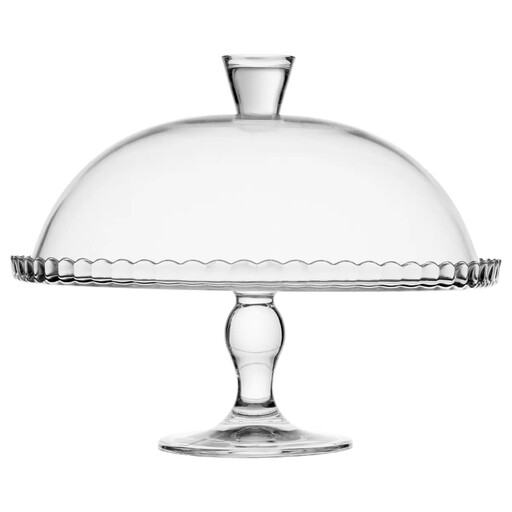
Why does this model fit the brief? With a glass dome and a diameter of 32 cm, this model is designed to present cakes and gateaux in private or publicly accessible venues.
The combination of a 32 cm diameter, 26 cm height and 2.65 kg weight provides concrete planning data. This makes it possible to check the required serving area and clearance for the dome in advance.
Glass stand with glass dome; 32 cm diameter; according to the product description, intended for professional use and venues with regular public access.
Our category features a regularly updated selection of products in different sizes, materials and configurations.
The serving surface should be at least as wide as the cake’s diameter. Additional room is advisable for decorations, a piped border or a dome. For standard cakes, 28 to 32 cm are useful benchmarks, although the actual dimensions of the cake remain the deciding factor.
Wooden stands can generally be cleaned with a soft, slightly damp cloth. They should not be left in water for extended periods and are usually not dishwasher-safe. Any spilled liquids should be removed immediately. For some acacia or bamboo models, a suitable food-safe treatment can help preserve the surface, provided this is recommended in the care instructions.
A tiered stand is primarily designed for several smaller dishes. Whether it can support a heavy cake depends on the manufacturer’s specifications for its construction and load capacity. For a single large cake, a broad, low cake plate is often easier to arrange and more stable.