If your calligraphy sheet is lying still, your camera’s built-in self-timer may be all you need. Try it with your camera set up securely before buying any accessories. If you always shoot from the same tripod position, a cable release that’s compatible with your camera could be a good option. A supported wireless remote gives you more freedom to move around, while a compatible camera app can also let you adjust settings and take photos from your mobile device. Whichever option you choose, you’ll still need to check the framing, sheet and lighting.
The right shutter release for your needs
Photographers using a fixed tripod position
If the sheet is lying still and you’re not moving the camera, the self-timer may be all you need to start with. If you’d rather take the shot yourself, check that a cable release is compatible with your camera’s socket. Nikon Germany lists the self-timer and compatible remote controls as ways to avoid touching the camera’s shutter button.
Photographers who change their setup between shots
If you reposition the sheet or background between shots, a supported wireless remote can let you take a photo from a different spot. Compatibility with your specific camera is key: Sony Germany lists the models that can be operated with the RMT-P1BT.
Photographers who want remote control
If you’d also like to adjust camera settings from your mobile device, check the app’s features for your specific model. Canon describes Camera Connect as a way to adjust settings and release the shutter; the features available depend on which camera is supported.
What to consider when buying
Camera’s built-in self-timer
A good choice if: the sheet is lying still and you don’t need to make any adjustments as soon as you start the timer.
The trade-off: You won’t need a separate shutter release, but you’ll have to wait for the delay you’ve set.
Cable release
A good choice if: your camera stays in one place and its shutter-release socket is easy to reach.
The trade-off: You can take the shot without touching the camera, but you’re limited by the cable and socket.
Wireless remote or radio trigger set
A good choice if: you move around your shooting area and your specific camera supports the remote.
The trade-off: Depending on the model, you may need to pair the remote or connect an additional cable to your camera. The Rollei Wireless remote shutter release 28146 requires a compatible cable.
Supported camera app
A good choice if: you want to adjust settings and take photos from your mobile device.
The trade-off: The features available depend on your camera model and the app’s compatibility.
| What matters |
What to check before buying |
Who should pay particular attention |
| Camera compatibility |
Check your camera’s full model name against the accessory compatibility list. Check the socket and, if necessary, whether you need an adapter. For example, Canon distinguishes between E3 and N3 sockets, while Fujifilm lists an additional adapter for certain RR-100 cameras. |
When I’m looking for a shutter release for my camera, I want to be sure the model and socket are compatible. Around 36% of consumers put compatibility first. |
| Taking photos with a fixed setup |
Try the self-timer first. If the delay doesn’t suit your workflow, check for a compatible cable release and make sure the cable is long enough. |
When my camera is fixed above the sheet, I want to take a photo without touching the tripod. Around 29% of consumers prioritise touch-free shooting from a fixed position. |
| Freedom to move around |
Check that your camera is explicitly listed as compatible and see what’s included in the box. A radio trigger set may need a separate cable to connect to the camera. |
When I need to reposition the sheet or background several times, I want to be able to take a photo from a different spot. Around 21% of consumers say freedom to move around matters most. |
| Remote control |
Check your camera’s manual to see whether its app supports the settings you need and remote shutter release. |
If I want to adjust settings from my mobile device, a simple shutter button may not be enough. Around 14% of consumers put remote control first. |
Common assumptions to avoid
-
A brand name or Bluetooth doesn’t guarantee compatibility
Manufacturers list accessories for specific camera models and sockets. A remote release that isn’t compatible with your camera won’t solve the problem.
Check your camera’s full model name against the remote’s compatibility list. For cable models, also check the socket and whether you’ll need an adapter.
Fujifilm says that some cameras listed for the RR-100 also require a 2.5 mm to 3.5 mm adapter.
-
“Wireless” doesn’t always mean no cable connected to the camera
Rollei says that the Wireless remote shutter release 28146 requires a compatible cable to connect it to the camera.
Before buying, check the receiver socket and what’s included in the box, and make sure you have the right camera cable.
You need to select the required cable separately for this Rollei radio trigger set.
-
A remote release won’t fix your whole composition
Taking a photo without touching the camera won’t align the sheet or adjust the framing and lighting for you.
Take a test shot and check that the whole sheet is in frame and that the background and lighting look right.
Key brands to consider
Canon
Canon offers wired shutter releases for certain EOS sockets and lists Camera Connect as another option for supported cameras.
- The RS-80E3 and RS-80N3 are each designed for the corresponding socket.
- The socket types aren’t interchangeable, and compatibility depends on the camera model.
Nikon
Nikon describes the MC-DC3 as compatible with certain mirrorless Z cameras and the MC-DC2 as compatible with certain DSLR cameras.
- Depending on your camera, you may also be able to use the self-timer or a supported app to take photos.
- The Nikon name alone doesn’t confirm that a particular remote release will fit.
Sony
The RMT-P1BT Bluetooth remote is designed for cameras that are specifically listed as compatible.
- Sony says that with a supported camera, it doesn’t need a connection cable or separate receiver.
- Your camera must be listed as compatible, the remote control function must be enabled and the devices must be paired.
Fujifilm
Fujifilm lists the RR-100 for certain X and GFX cameras.
- The compatibility list names specific camera models.
- A 2.5 mm to 3.5 mm adapter is also listed for some models.
Rollei
The Wireless remote shutter release 28146 is a radio trigger set for use from different positions.
- The set offers wireless operation via radio.
- Rollei says you’ll need a compatible cable to connect it to the camera, which must be selected separately.
Joybuy products for smartphone photography
This selection is for smartphone photography using a detachable Bluetooth remote shutter release. It doesn’t include shutter releases for standalone cameras.
 No image available
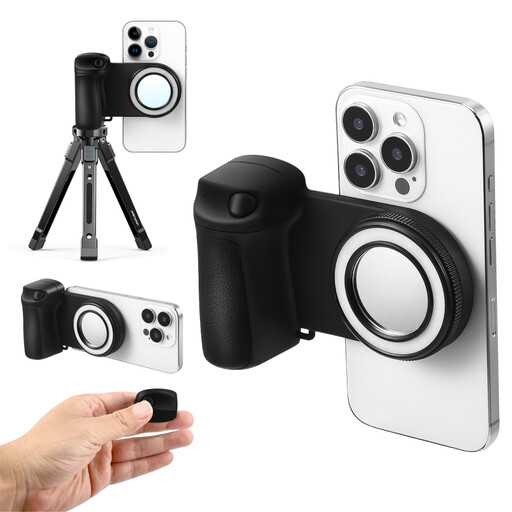
Magnetic smartphone grip with Bluetooth remote shutter release, fill light and 1/4-inch tripod socket (black)
For taking smartphone photos remotely, this product is described as having a detachable Bluetooth remote shutter release. The grip is designed for smartphones and isn’t described as a shutter release for a standalone camera.
The product is listed with a 1/4-inch tripod socket. The description also mentions a magnetic quick-release system.
View at Joybuy
Frequently asked questions
Do I need to buy a remote release to photograph a calligraphy sheet that’s lying still?
Not necessarily. First, try your camera’s self-timer with your camera set up securely. Nikon Germany lists the self-timer and compatible remote controls as alternatives to avoid touching the camera’s shutter button.
What should I check if my Sony RMT-P1BT won’t take a photo?
First, check whether Sony lists your camera as compatible with the Bluetooth remote. For supported models, Sony says Bluetooth and remote control must be enabled and the devices paired. The menu names may vary.
Does a radio trigger set need an additional cable?
It depends on the model. Rollei says the Wireless remote shutter release 28146 requires a compatible camera cable, which must be selected separately. Check what’s included with the specific set.
What rights do I have in Germany if an item bought online doesn’t fit or is faulty?
For a distance-selling contract with a business that is generally eligible for cancellation, the German Civil Code provides a right to cancel without giving a reason, usually within 14 days. For a standard purchase of goods, the period starts when you receive them, although statutory exceptions and information requirements apply. If an item is faulty, you also have statutory claims against the seller. European Union consumer information states that goods generally have a minimum two-year legal guarantee; this is separate from any voluntary manufacturer’s guarantee.


