If you can clearly see the pen tip and edges of the paper on your camera’s screen from where you sit, you don’t necessarily need an extra monitor for calligraphy videos. If your camera is positioned awkwardly above the desk, a separate HDMI monitor with magnification or focus peaking can make it easier to check your shot. Before buying, check your camera’s HDMI live view, as well as the space, mounting and power requirements.
Who might benefit from a camera monitor?
Calligraphy video makers who need to see fine details
When your camera is positioned above the desk, you’ll want to see whether the pen tip and fine lines are in focus as you write. Fotonomaden explains that an additional monitor can make it easier to check focus.
Calligraphy video makers with limited desk space
You’ll want to keep the paper and your hand movements unobstructed, while positioning the screen, mount and cables so they don’t get in the way of your writing area.
Calligraphy video makers with a fixed camera setup
For longer recordings from the same position, the camera signal, mounting and power supply all need to work with your setup. For example, Atomos lists NP-F or USB-C-PD power for the Shinobi GO and Shinobi II.
What should you look for when buying a camera monitor?
| Buying criterion |
What to check |
Who will find this most important? |
| Sharpness of fine strokes |
Check magnification and focus peaking on the specific model. These tools don’t replace checking the recording itself. |
If I want to check the pen tip and fine lines in the live view as I write, focus control is essential. Around 25% of consumers prioritise sharpness. |
| Clear writing space |
Consider the monitor’s dimensions and weight together with the mount, cables and any battery. |
If there needs to be room for paper and my writing hand on a small desk, the monitor shouldn’t take over the work area. Around 25% of consumers prioritise having clear space. |
| Compatible HDMI live view |
Check the HDMI connection, signal format and frame rate against your specific camera and recording mode. |
If I want to view the live feed from my existing camera reliably, I’ll check the signal connection before looking at additional features. Around 19% of consumers prioritise HDMI compatibility. |
| Easy viewing in changing light |
Check the monitor’s position and reflections where you’ll use it. A maximum brightness figure alone doesn’t show how easy it will be to see the screen there. |
If the ambient light changes, I want to assess the paper and ink on the monitor and check the exposure. Around 12% of consumers prioritise light control. |
| Power supply |
Check the power sources supported by the exact model and what’s included with the version you’ve chosen. |
If I’m planning longer recordings with a fixed setup, the power supply should suit it without cluttering my workspace with unnecessary accessories. Around 19% of consumers prioritise continuous power. |
Common buying mistakes
-
Confusing ‘4K HDMI’ with a 4K display resolution
A monitor can accept a 4K signal and still have a Full HD display. Atomos lists a 4K UHD input of up to 30 frames per second for the Shinobi II, alongside a display resolution of 1920 × 1080 pixels.
Compare the supported input formats and frame rates separately from the native display resolution.
-
Forgetting about the battery, cables and mount in a small setup
A monitor without a built-in battery needs an external power supply; cables and mounting hardware also take up space. Atomos states that the Shinobi GO and Shinobi II have no built-in battery.
Check which parts are included with the specific version and how much space the complete setup will need.
Depending on the version, you may need to buy a suitable power source, HDMI cable or mount separately.
-
Confusing an HDMI input with an HDMI output
An HDMI input receives the camera signal, but doesn’t automatically pass it on to a second screen. The manufacturer information available for the Shinobi II models doesn’t list an HDMI output.
If you want to connect another display, check the HDMI output and supported signal formats on the exact model.
Key brands at a glance
Portkeys
Portkeys describes the PT5 III as a 5.4-inch monitor for checking your image in a cramped workspace.
- Portkeys lists HDMI input and output, along with focus and exposure tools.
- The stated maximum brightness of 800 nit alone doesn’t tell you how easy the display will be to read at your desk by the window.
- The manufacturer’s dimensions and weight make it easier to plan how to mount the monitor.
Atomos
Atomos describes the Shinobi GO and Shinobi II as 5.2-inch monitors with HDMI input and tools for checking focus and exposure.
- Atomos lists 1500 cd/m² brightness and NP-F or USB-C-PD power for both models.
- Atomos says neither model has a built-in battery, and no HDMI output is listed for either device.
- The Shinobi II also offers a camera control option for compatible cameras.
FEELWORLD
According to the manufacturer, the F5 PROX combines a 5.5-inch display with HDMI input and output, plus tools for focus and composition.
- FEELWORLD lists 1600 cd/m² brightness and 1920 × 1080 pixels for this model. These are manufacturer specifications, not independent measurements, and don’t indicate the recording resolution.
- Check the power supply and what’s included with the specific version before buying.
Viltrox
Viltrox describes the DC-V1 as a 5.5-inch touchscreen monitor with HDMI input and output, focus peaking and waveform.
- Viltrox lists NP-F, DC and USB-C as power options.
- The manufacturer’s website gives different weights for the DC-V1, so check the exact weight before mounting it where the load capacity is limited.
Related products from Joybuy
The following Joybuy products are larger HDMI monitors. To check a camera’s image on one, the camera’s live view needs to be compatible with the monitor. On a small desk, you’ll also need to consider how much room it takes up.
 No image available
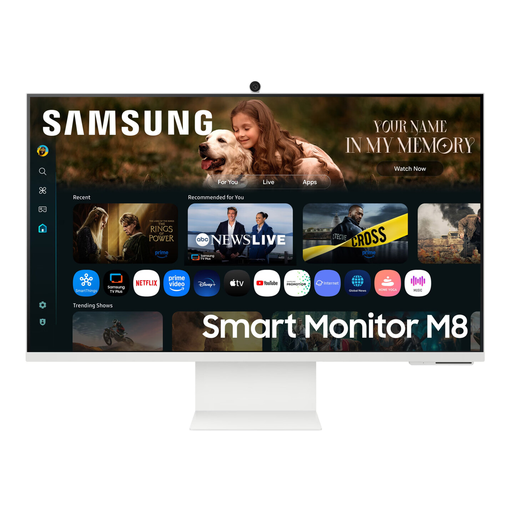
Samsung M8 M80F (2025), 32-inch, VA, 4K UHD, 60 Hz, webcam
The HDMI input can display a live view if your camera’s signal is compatible. Check that this combination will work before buying.
32-inch VA display with 4K UHD and 60 Hz, plus a webcam. With the stand, the monitor measures 713,4 × 616,2 × 200,1 mm, so you’ll need to allow enough desk space.
Joybuy
 No image available
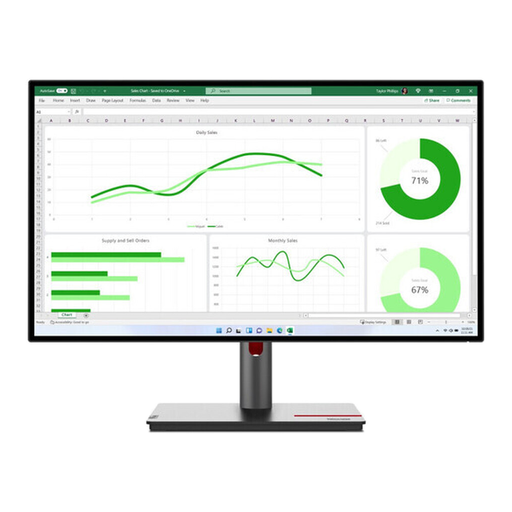
Lenovo ThinkVision P27q-30, 27-inch, QHD, 60 Hz, IPS
The HDMI input will only work with a camera feed if it supports your specific camera’s signal. Check the format and frame rate.
27-inch IPS display with 2560 × 1440 pixels, 60 Hz, 350 cd/m², 1000:1 contrast ratio, 4 ms response time, plus HDMI and DisplayPort. With the stand, the monitor is 611,9 mm wide and 204,5 mm deep.
Joybuy
Frequently asked questions
Does the monitor need a 4K display resolution if my camera outputs a 4K HDMI signal?
No. The HDMI input format and display resolution are different specifications. Atomos lists a 4K UHD input of up to 30 frames per second for the Shinobi II, and a display with 1920 × 1080 pixels. Also check that the monitor supports your camera’s frame rate and signal.
How can I stop camera menus from covering the writing in the live view?
Check the HDMI display settings in your camera’s manual and test them in the video mode you’re using. Sony says you can choose whether recording information is shown at the HDMI output on the Sony ILCE-7M5; this won’t necessarily apply to other cameras.
Can I use an Atomos Shinobi II without an additional battery?
According to Atomos, the Shinobi II has no built-in battery, but it can be powered by NP-F or USB-C-PD. Make sure you have a suitable power source and check what’s included with the specific version you’re buying.
Can an old camera monitor go in household rubbish?
No. The German Environment Agency points out that old electrical appliances in Germany must be disposed of separately from household rubbish. Remove any detachable batteries and dispose of them separately before handing the monitor in.


