Instructors filming on their own
If you’re painting and filming at the same time, an external monitor lets you check the frame without going over to the camera each time. Remember to plan where the screen will sit and how the cables will run, too.


Choose a camera monitor whose HDMI input accepts your camera’s signal in the recording mode you actually use, and which you can see clearly from your painting position. For a small table, a compact monitor with focus and exposure tools is a sensible starting point. A larger display needs more room, while a monitor-recorder is only worth considering if you also want to record externally. Make space for the mount, cables and power supply as part of your setup.
If you’re painting and filming at the same time, an external monitor lets you check the frame without going over to the camera each time. Remember to plan where the screen will sit and how the cables will run, too.
Peaking can help you judge focus on fine brushstrokes, and some models also offer image magnification. Even so, check the actual recording as well.
If you’re adding a monitor to your existing setup, the camera output and monitor input need to be compatible with the recording mode you want to use. Also consider how both devices will be powered.
When filming a ceramic painting tutorial at a small table, the priorities are a usable camera signal, details you can see clearly, and a setup that leaves your work surface and hands free.
| Priority | What to check before buying | Who it matters most to |
|---|---|---|
| HDMI picture while recording | Check your camera model, output resolution and frame rate against the input formats supported by the specific monitor. | If I need to see a picture while recording, my camera’s HDMI output must be compatible with the monitor. Around 25% of consumers put HDMI compatibility first. |
| Focus on fine brushstrokes | Check whether the model offers peaking and, if needed, image magnification; assess how well you can see your subject in your own setup. | If I want to show fine brushstrokes, I need to check the focus on the tip of the brush. Around 25% of consumers rank fine-detail focus as their top buying priority. |
| A clear preview without losing worktop space | Plan the display size, viewing distance, mounting, support and cable routing together. | If I want to see the preview from my painting position without making room by moving my ceramics or hands, visibility and space are especially important. Around 20% of consumers put this priority first. |
| Exposure for light-coloured ceramics | Check whether the specific model offers waveform, a histogram, zebras or false colour; review a test recording under your intended lighting. | If I want light-coloured pieces and work lights to look balanced in the picture, I need to assess exposure accurately. Around 15% of consumers prioritise exposure control. |
| Power for the whole lesson | Check the supported power source and whether batteries, power adapters and cables are included with the exact variant on offer. | If the monitor needs to run throughout a longer lesson, the power supply and accessories must suit the setup. Around 15% of consumers first look for uninterrupted power. |
A monitor may accept certain 4K input signals but still have a panel with a different native resolution. Portkeys lists a 1920 × 1080-pixel panel for the PT5 II; also check whether it supports your specific camera signal.
Compare input formats, frame rates and native panel resolution separately.
A larger display may be easier to see from a little further away, but on a small table it takes up space you need for painting materials and your hands.
Plan the screen position and cable route using the dimensions of the specific model, and check the view from where you sit.
Depending on your setup, you may need a suitable mount or a different cable route.
What’s included can vary by variant. FEELWORLD describes the standard F5 PROX package as coming without a battery or power adapter; the NEEWER F700 is available with different battery configurations.
Check the power connections and what’s included with the specific variant before deciding.
You may need to buy a compatible power source or suitable cable separately.
A monitor-recorder adds external recording to picture monitoring. You don’t need this extra feature just to preview your footage.
First decide whether you want to record in-camera or genuinely need external recording. If you do choose a recorder, check the signal formats and recording media it supports.
External recording may mean extra effort to find suitable media and power supplies.
According to Portkeys, the PT5 II is a compact 5-inch HDMI monitor designed for setups where space is at a premium.
The Shinobi GO is a 5.2-inch preview monitor with focus, exposure and framing tools in a compact unit.
According to FEELWORLD, the F5 PROX is a 5.5-inch HDMI monitor with focus and exposure tools.
The F700 is a 7-inch option if a larger preview screen will fit into your setup.
Video Assist is an option if external recording is part of your workflow as well as picture monitoring.
These portable displays are worth considering if you have room for a larger screen on your table. Before using one, check that your camera’s HDMI output is compatible with the monitor input, and plan the mounting and cable routing.
 No image available
A larger preview is worth considering if the display will fit on your small table; VESA compatibility may also be useful when positioning it.
Listed specifications include 2560 × 1600 pixels, a 16:10 aspect ratio, a 1200:1 contrast ratio, 450 Nits, QLED, Mini-HDMI, Type C and VESA compatibility. Check that your camera output is compatible with the monitor input.
The 16-inch display may take up a large part of your work surface.
 No image available
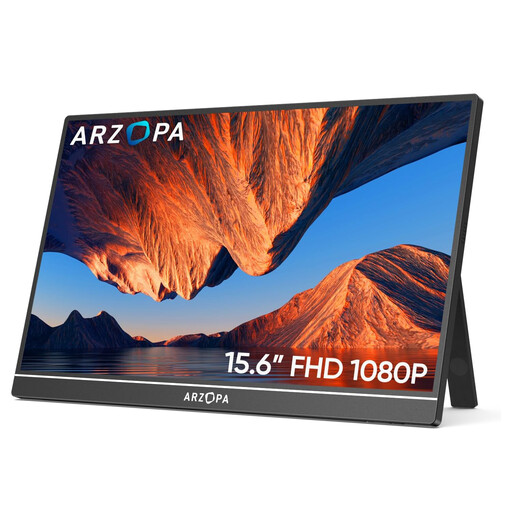
This larger display may be suitable if there’s room for it at your painting station; check the view from where you sit and where the stand will go.
The product name specifies 1920 × 1080 pixels and an IPS panel. USB-C and HDMI are also listed. Check that your camera output is compatible with the monitor input.
The 15.6-inch display may take up a lot of space on a small table.
 No image available
If there’s room on your table for a larger display, the stand and VESA compatibility may be useful when positioning it.
Listed specifications include 1920 × 1080 pixels, an IPS panel, 100% sRGB, Mini-HDMI and two USB-C ports. The description also mentions an adjustable stand and VESA compatibility. Check that the signal is compatible with your camera.
The 15.6-inch display may take up a lot of space on a small table.
Not with the preview function alone. To make an additional external recording, you’ll need a monitor-recorder model; check which signals and media the specific device supports. Blackmagic Design describes recording features for the Video Assist range.
First check your camera’s HDMI output in the selected recording mode, including the resolution, frame rate and display settings, and compare them with the monitor input. Sony notes that, for certain Sony cameras, recording and proxy settings can affect which screen displays a picture; this doesn’t necessarily apply to all cameras.
Check which power sources your specific model supports and whether one is included with the variant you’ve chosen. Route the HDMI and power cables away from your painting area; follow the device instructions for cleaning and handling moisture.
No. The statutory warranty is a legal right against the seller if goods are faulty; a manufacturer’s guarantee is a voluntary offer subject to its own terms and conditions. So, even if you buy a package with a battery, check the specific guarantee terms and who the seller is.
There’s no blanket yes-or-no answer without knowing how you plan to film and publish the video. If you process personal data, you need a legal basis; valid consent is one possible basis, but it isn’t the only one. The Federal Commissioner for Data Protection and Freedom of Information sets out the requirements in Article 6(1) of the GDPR. Consider your plans for filming and publication separately before recording if people can be identified or their contributions attributed to them.